Insurance Claim Supplements: How Hidden Damage Gets Added to a Claim

A supplement adds to an insurance claim that is already open — line items for damage or costs missing from the first estimate, usually because nobody could see them until work started. It is not an appeal and not a second claim. It succeeds on evidence: dated photographs, a line-item estimate, and the code or manufacturer instruction behind each added item.
An insurance claim supplement is what keeps a settlement accurate once the work begins. The first estimate is written by somebody looking at a closed building: sheathing sits under shingles, framing sits behind drywall, and a price quoted in April is not always the price a supplier gives in September. When any of that turns out differently on the day, the claim does not start over — it gets supplemented. Policy wording varies by carrier and by policy year, so read your own alongside this.
What is a supplement on an insurance claim?
A supplement is a formal request to revise the estimate on a claim that is already open, adding scope or cost the original did not include. The carrier reviews it against the same policy, the same date of loss and the same claim number. It changes the amount of the loss, not the decision to cover it.
That distinction matters, because three different things get called "reopening a claim" in conversation and they behave differently. A supplement adds to a file that is still open. Reopening means asking a carrier to look again at a claim it has already closed, which is the same evidence but a colder start. An appeal disputes a decision — a denial, or a coverage position — and turns on policy language rather than quantities. Which one you are making changes what you send.
A supplement is ordinary. It is not an accusation that the first estimate was written badly, and framing it that way tends to slow it down. A roof cannot be inspected through its own shingles, and a carrier's adjuster is working from a scope written at one moment in time, under their employer's guidelines. New facts are the reason the process has a supplement step at all.
One Illinois point is worth stating early, because it changes who does what. Illinois separates the roles: contractors build, and licensed public adjusters negotiate claims. Your contractor should document what they found — photos, measurements, a line-item estimate — but negotiating the supplement with your insurer is not their role. Our construction partner page sets out how that division works when a repair and a claim run at the same time.
What actually justifies a supplement?
Something that was not knowable, not visible, or not correctly quantified when the first estimate was written — or a requirement that only attaches once the work is permitted and inspected. A supplement is not a second opinion on prices already agreed. It needs a reason and a document behind the reason.
| What triggers it | What it means | What tends to prove it |
|---|---|---|
| Concealed damage exposed by tear-off | Decking, subfloor or framing turns out damaged once the covering comes off | Dated photos from the day it was exposed, plus the crew's field notes |
| Building code requirement | The repair as estimated does not meet the code the permitted work must satisfy | The code section, the permit condition, or an inspector's correction notice |
| Manufacturer installation instruction | The material cannot be installed as the estimate assumes without voiding its warranty | The printed installation page for that product |
| Missed or under-measured line items | The item was always there and simply not written, or the quantity is short | Measurements, a diagram, photos of the item in place |
| Cost movement between estimate and repair | Material or labour prices moved while the claim was being settled | Dated supplier quotes for the same specification |
| Scope that grew during mitigation | Drying found more affected material than the first reading indicated | The daily moisture log and the drying company's readings |
Two rows deserve a caution. Code is only claimable to the extent your policy funds it: many forms carry a separate ordinance or law provision with its own limit, often a percentage of the dwelling limit, and some exclude code upgrades altogether. Check yours before counting on it. Price movement is the hardest of the six to evidence: a supplier's written quote dated from the week the work was booked carries the argument, and "everything went up" does not.
What does a supplement look like in numbers?
One roof, worked through. The figures are an illustration rather than anybody's file, and every market is different — the shape of it is the useful part. The original estimate assumed one layer of shingles over sound decking, because that is what could be seen from outside.
At tear-off the crew found a second layer of shingles underneath the first, twelve sheets of soft decking, forty feet of rotted fascia behind the gutter line, and an eaves detail the permit required to be brought up to current code. None of the four could have been written from the ground, and all four had to be paid for before the roof could go back on.
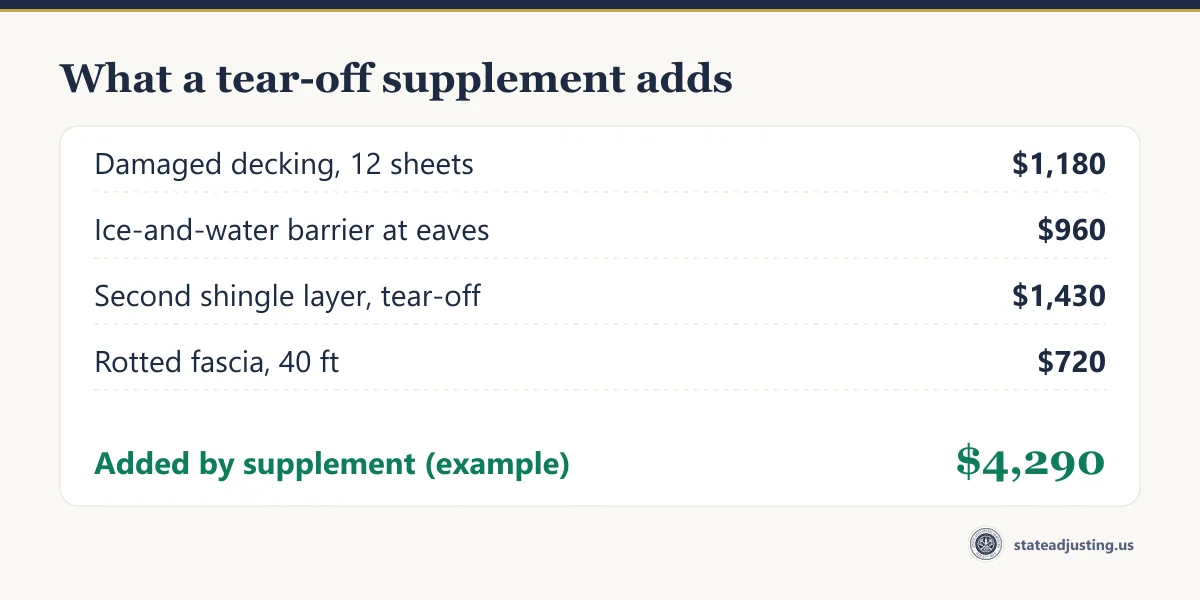
Three things follow. The deductible was already applied to the original claim, and in most forms it applies once per covered loss, so a supplement on the same loss does not carry a second one — your own policy governs. On replacement cost coverage the supplement settles like the rest of the claim: an actual cash value payment first, the withheld depreciation recoverable once the work is invoiced, which is the subject of our guides to recoverable depreciation and ACV versus replacement cost. And a supplement is far easier to establish than a re-inspection months later, because the evidence is standing open in front of the camera.
What goes into a supplement request?
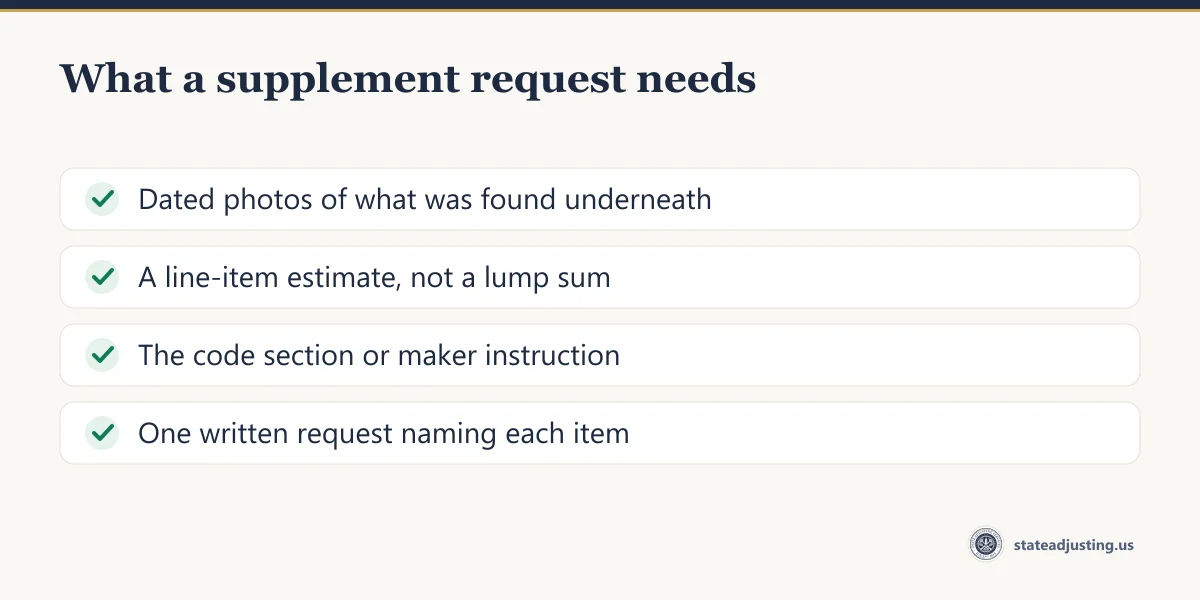
Four things, in one written package: photographs of the condition, a line-item estimate in the carrier's format, the document that makes the item necessary, and a written request that names each added item and the reason for it. Lump sums and phone calls both tend to produce more questions than a properly built request does.
- Photographs taken the day it was exposed. A wide shot that places the area on the building, then close-ups of the actual condition, with a tape measure or a shingle in frame for scale. Photographs taken after the repair is finished prove nothing about what was there.
- A line-item estimate, not a lump sum. Units, quantities and unit prices, in the same estimating format the carrier used. A reviewer comparing two documents line by line can approve line by line; a reviewer handed one number can only say yes or no to all of it.
- The measurement behind each quantity. Twelve sheets of decking is a checkable claim. "Some bad decking" is not.
- The code section, permit condition or correction notice, where code is the reason for the item — and the manufacturer's printed installation instruction where that is the reason.
- One written request, sent against the claim number, listing each added item with one line of reason each. Email is fine and has the advantage of being dated automatically.
- The date the work stopped, if it did. Carriers ask, and a stalled job with an open roof is worth putting in writing at the time rather than reconstructing later.
How long does a supplement take, and what if it is refused?
Usually a re-inspection or a desk review, then a revised estimate. Timing depends on the carrier's workload and on whether the evidence answers the reviewer's questions on the first pass. A partial approval is a normal outcome, not a rejection: some items go through, some come back with a reason, and the reason is what you work from next.
The practical difficulty is that a crew cannot stand still while a file is reviewed, and exposed framing cannot be left open through a week of Illinois weather. So the documentation has to be complete before the work continues, not after: once the roof is closed, the photographs and measurements taken on the day are all the review has. If work does pause, put the pause and its date in writing at the time.
When items come back refused, ask for the response in the same form you sent it: item by item, with the reason for each. A general statement that the supplement was not approved cannot be answered; "the decking is considered pre-existing" can be, with a photograph. Most supplement disagreements resolve at that level of detail — the same pattern behind our guide to what carriers routinely leave out of a hail estimate.
If the two estimates simply will not converge, most policies contain an appraisal provision — a mechanism for settling a disagreement about the amount of the loss, in most forms not about whether the loss is covered. It is a formal step with its own costs. We are licensed Illinois public adjusters, not attorneys, and nothing here is legal advice: where the argument is about coverage rather than quantities, or where a policy deadline is close, that is the point to speak to an attorney. The Illinois Department of Insurance also takes consumer complaints.
Supplement, reopened claim, or appraisal?
They answer different problems, and using the wrong one costs weeks. The table below is the short version; which applies to you depends on whether your file is still open and on whether the disagreement is about quantities or about coverage.
| Compared on | Supplement | Reopening a closed claim | Appraisal |
|---|---|---|---|
| What it addresses | Added scope or cost on a claim still open | New information found after the file was closed | A disagreement about the amount of the loss |
| Typical trigger | Hidden damage exposed at tear-off | Damage noticed months later, or a payment never completed | Two estimates that will not converge |
| Who decides | The carrier's adjuster | The carrier's adjuster | Two appraisers and, if needed, an umpire |
| Main constraint | Evidence has to be captured before the work closes up | Policy deadlines, and dating the damage to the original event | Cost and time; a formal process |
The middle column is the one that surprises people. Once a claim is closed and the repair finished, the question stops being what it costs and becomes how you know it came from that storm — much harder to answer from a repaired building. Deadlines apply too: most policies carry a suit-limitation clause counted from the date of loss, not from the date the argument started, plus proof-of-loss requirements with their own timing. If either date is close, that is a reason to get advice quickly rather than keep negotiating.
What to do next
If work has not started yet, agree one thing with your contractor before the first shingle comes off: nothing gets removed, replaced or thrown away without being photographed first, wide then close, on the same day. That single habit is what most successful supplements are built from, and it costs nothing.
If work has started and something has been found, build the package before the area is closed up, send it in writing against the claim number, and keep a dated copy of everything you send. If items come back refused, ask for the reasons item by item.
We handle residential and commercial property claims across Illinois, and supplements are a routine part of them — our hail damage and water damage pages set out how we scope each, the process page describes how a claim runs with us in it, and past clients describe how it went on our reviews page. If you would like somebody to read a supplement refusal and tell you what the file is missing, our free claim review costs nothing. When we are engaged, our fee is a percentage of what we recover, agreed in writing and regulated by Illinois law, with $0 owed upfront. We answer the phone Monday to Friday, 8:00 AM to 5:00 PM, on (630) 297-8136.
Questions we get about this
Is a supplement the same as filing a new claim?
No. A supplement stays on the existing claim: same claim number, same date of loss, same deductible already applied. It adds scope or cost to an estimate that is already open. A new claim is for a separate event on a different date, and it brings its own deductible with it. Getting this wrong at the start sends the paperwork to the wrong place and costs weeks.
Will I pay a second deductible on a supplement?
In most forms, no. The deductible applies once per covered loss, and a supplement is part of the same loss rather than a new one. Your own policy governs, so read the deductible provision on your declarations page, and be aware that some policies carry separate deductibles for particular perils such as wind or hail, which can differ from the all-other-perils figure.
Can my roofer negotiate the supplement with my insurance company?
In Illinois the roles are separate: contractors build, and licensed public adjusters negotiate claims. Your contractor should document what was found — dated photos, measurements, a line-item estimate — and that documentation is often the heart of the supplement. Negotiating the claim itself with the insurer on your behalf is not part of a contractor licence in this state.
How late can I ask for a supplement?
It depends on your policy and on whether the claim is still open, so there is no single answer. Policies contain proof-of-loss and suit-limitation provisions counted from the date of loss, not from the date a disagreement started. Practically, evidence gets weaker every week: once the repair is finished, the question shifts from what it cost to proving the damage came from the original event.