Frozen outdoor faucet leaked in spring: what home insurance pays
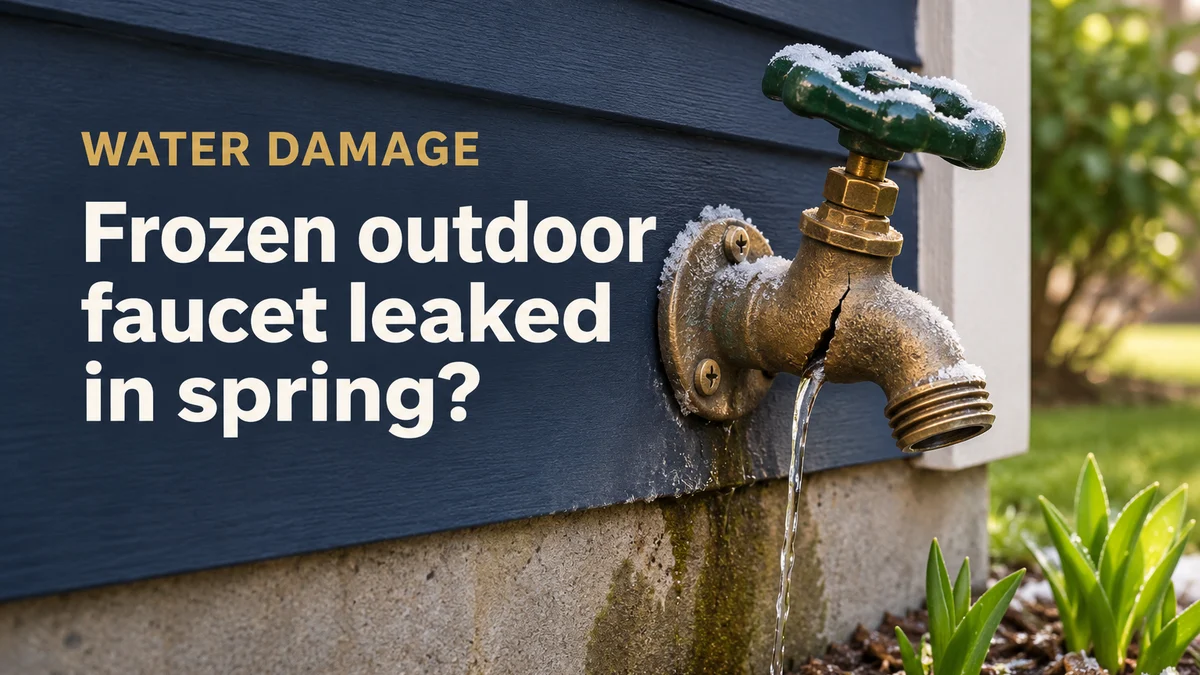
A frozen outdoor faucet usually does its damage in two seasons. The faucet splits in January, inside the wall, and nothing leaks. The water comes out in April, the first time someone turns the handle, and it runs into the basement ceiling or wall for as long as the faucet stays open. Home insurance often pays for that water damage and for opening the ceiling to reach the leak, but not for the faucet itself. The carrier will ask two things: was the house heated all winter, and why did nobody notice sooner.
We are licensed Illinois public adjusters, not attorneys. Nothing here is legal advice, and the wording of your own policy decides your claim.
Where a frost-free faucet splits, from the handle to the basement
Most Illinois houses built in the last few decades have a frost-free faucet, also called a sillcock. It looks like an ordinary spigot, but the valve that stops the water sits at the far end of a long tube, inside the heated part of the house. That design is the reason the leak hides. Follow it from the outside in.
- 1
The handle on the outside wall
Turning it moves a long stem that reaches back to the valve. Nothing at the handle holds water back.
For the claim: the handle and spout are part of the faucet, which the policy treats as the failed part.
- 2
The tube through the wall
When the faucet closes, the water left in the tube should drain out of the spout. A hose screwed onto the spout stops it draining, the trapped water freezes, and the tube splits.
For the claim: this split is usually where the water comes from, and nobody can see it from either side.
- 3
The valve inside the house
The house water pressure stops here while the faucet is closed. With the valve shut, a split tube in front of it stays dry.
For the claim: this is why a January freeze turns into an April leak.
- 4
The supply pipe in the basement
The line that feeds the faucet runs along the rim joist, the wooden band on top of the foundation wall.
For the claim: if this pipe froze, it leaks as soon as it thaws, so it is found in winter and the question becomes the heat in the house.
Why the leak waits until the first warm day
Because the valve holding the water back sits behind the split. All winter the pressure stops at that valve and the cracked part of the tube stays empty. The day someone opens the faucet to wash a car or fill a kiddie pool, water reaches the split and pours into the wall cavity. Often the spout still runs, a little weaker, so the person outside sees nothing wrong.
| Moment | What happens in the wall | What it means for the claim |
|---|---|---|
| A January cold snap, hose still on | Water trapped in the tube freezes and splits it. No water escapes yet. | The cause happens now, but there is no water damage to see or report. |
| The first use in spring | Water runs through the split, into the wall and onto the basement ceiling, sill plate and insulation, for as long as the faucet is open. | This is usually when the damage happens and when you find it. Write down the date and the time. |
| Every use after that | More water goes into the same cavity, often above a finished ceiling where nobody looks. | The longer it goes on, the easier it is for a carrier to argue the damage built up slowly instead of happening at once. |
Some carriers fix on the January freeze to argue the loss is old, or that it falls in an earlier policy period. The wet drywall and the stained ceiling you are claiming were damaged when the water escaped, so your record of that day carries the weight. We explain how these date arguments run in our guide on what to do when the insurer says the damage is old.
Does the freezing exclusion apply if the house was heated all winter?
On the standard homeowners form, usually not. The form excludes freezing of a plumbing system, then lifts that exclusion when you used reasonable care either to keep heat in the building or to shut off the water and drain the system. A house that was lived in and heated through the winter meets the first route on its face.
The form first takes out loss from freezing of a plumbing system, including water that leaks from it because of the freeze. The very next sentence gives that loss back when you took reasonable care to do one of two things. The first is to maintain heat in the building. The second is to shut off the water supply and drain the systems and appliances.
Two points follow for an outdoor faucet. First, the sentence names two ways to meet it, heat or draining, and a hose left on the spout is not part of either. That does not stop a carrier from raising the hose under another heading, such as wear and tear, neglect or a maintenance condition in its own form, so ask for a letter that names the exact provision it relies on.
Second, a carrier may say the faucet sits in the outside wall rather than in the heated building. On a frost-free faucet the split is in the tube, inside the wall. A photograph of where the tube cracked, taken before the plumber leaves with it, settles more than a page of argument.
What the claim can pay, and the one part it will not
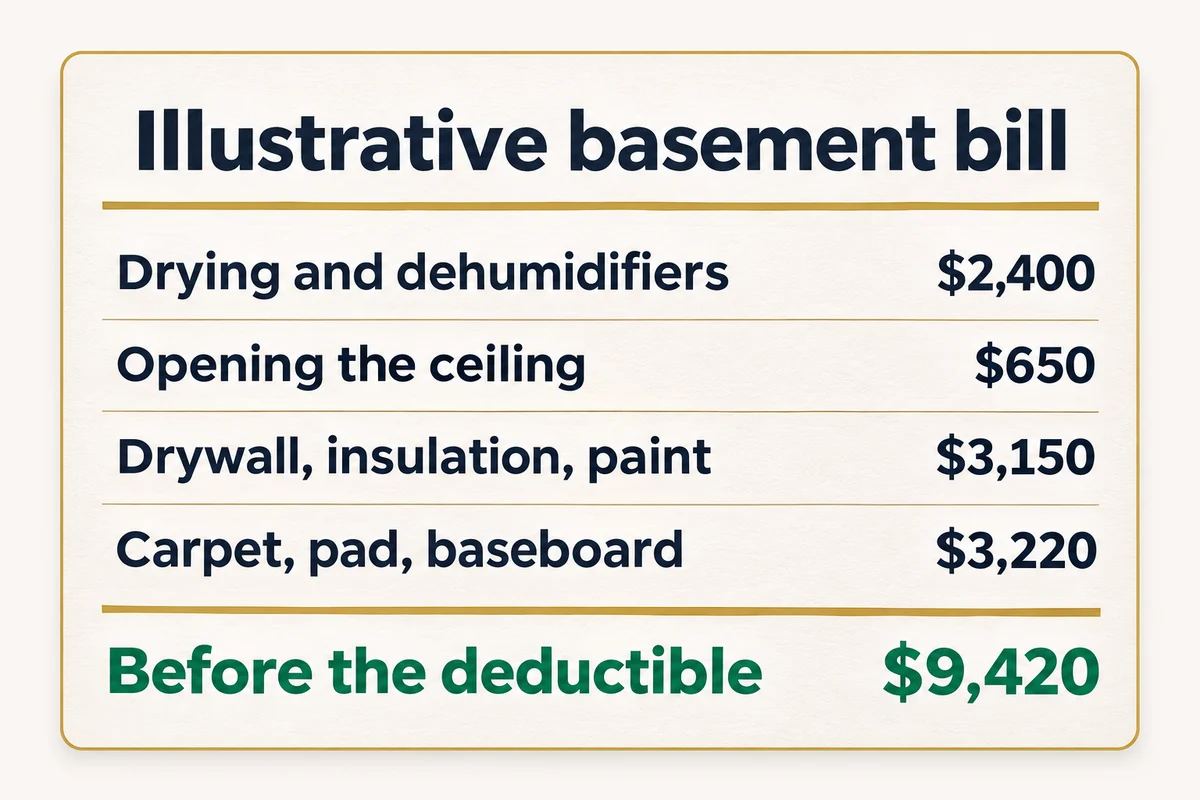
The water damage part of most homeowners policies pays for what the water did and for opening the building to reach the leak. It does not pay for the faucet the water came from. Here is an illustrative bill for a split faucet above a finished basement. It is a worked example, not a client file.
| Line | Paid by the claim? | Amount |
|---|---|---|
| Drying, dehumidifiers and moisture readings | Yes, damage the water caused | $2,400 |
| Opening the ceiling below the faucet | Yes, the tear-out to reach the leak | $650 |
| Ceiling and wall drywall, insulation and paint | Yes | $3,150 |
| Carpet, pad and baseboard | Yes, with depreciation held back on some policies | $3,220 |
| Paid lines together | $9,420 | |
| Deductible | Taken off once for the occurrence | -$1,000 |
| Payable before any depreciation held back | $8,420 | |
| New frost-free faucet and the plumber's labor | No, the failed part stays with you | $380 |
The faucet is usually the smallest line on the bill. When it is replaced, ask the plumber to keep the old one and show you where it split. That piece of tube shows where the water came from, which is the carrier's first question. If the drip went on long enough for mould to grow, check your policy for a separate, smaller mould limit; our guide to mould after a water loss explains how that limit works.
Each run of the hose puts more water in the wall
A split frost-free faucet only leaks while it is open. A burst pipe in a ceiling runs until someone closes the main. The faucet goes quiet each time the handle is turned off. If nobody notices, every car wash and every evening of watering the garden adds water to the same cavity, and the damage grows over weeks. Many carriers' own forms exclude water that leaked again and again over a period of time. Whether yours has such an exclusion, and how it counts the time, is written in your policy.
Where the water usually hides:
- On the sill plate and rim joist, the wood on top of the foundation, where it soaks in before anything drips.
- Above a finished basement ceiling, where it spreads along the drywall and shows up as a stain a few feet from the faucet.
- Inside the outside wall, behind the insulation, where the first sign may be a swollen baseboard or a musty smell.
- In the crawl space under an addition, which nobody walks into in May.
If you find a stain in July under a faucet you have used all summer, report it the day you find it and say plainly when the faucet was first used that year. When the pipe froze inside the house instead, the heat records a carrier asks for are set out in our guide to frozen and burst pipe claims.
Questions the adjuster is likely to ask
When was the faucet last used before the freeze?
Answer with what you have: a fall date you remember, a photo of the yard with the hose on the wall, a receipt for having the sprinklers blown out. If you are not sure, say so rather than guess.
Was a hose attached over the winter?
Say what happened. A hose on the spout is a common reason the tube splits, and the carrier will see it in the photographs. What matters next is that the house was heated, and which provision the carrier relies on if it disagrees.
Was the house heated the whole winter?
Gas or electric bills for December through February show it. A smart thermostat history helps too, if it still reaches back that far.
When did you first see water, and when did you call?
Give the date you found the water and the date you reported it. Policies ask for prompt notice, and a short gap between those two dates is the easiest part of this claim to get right.
Where exactly did the tube split?
The plumber's photograph of the cracked tube, or the tube itself, answers this better than any description.
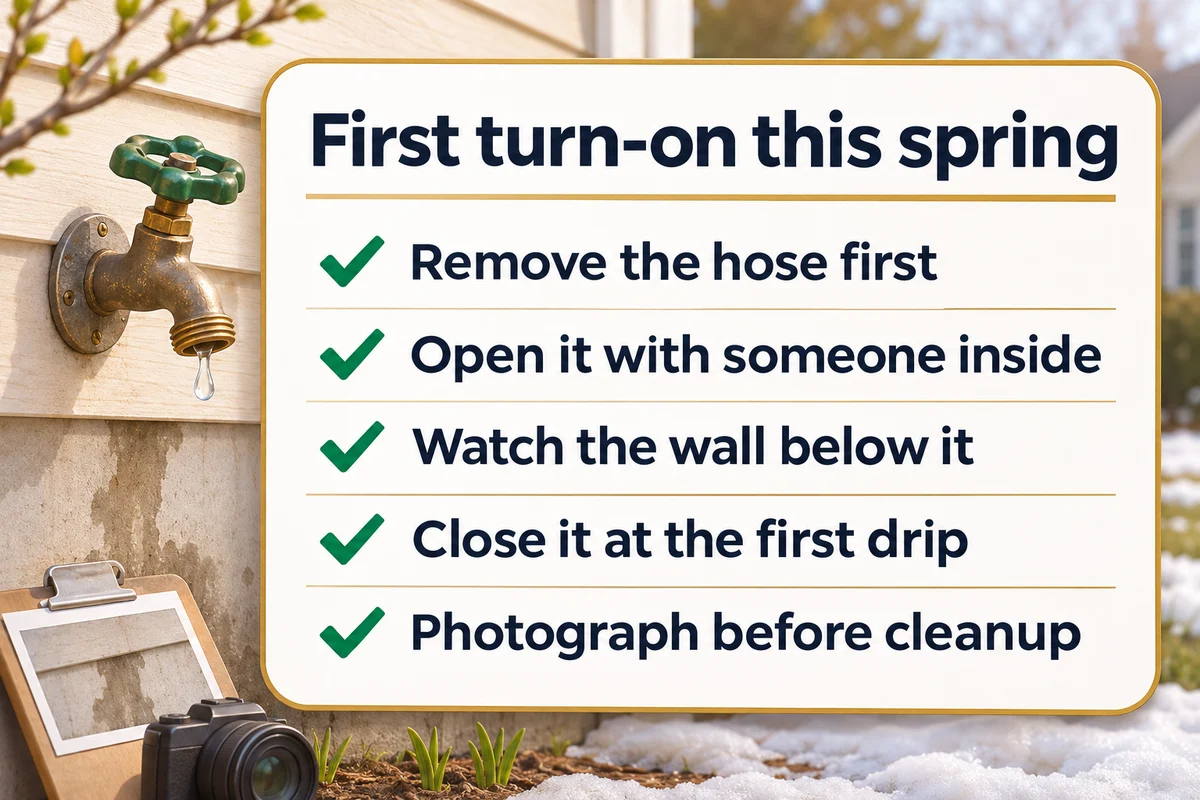
The first time you turn it on this spring
A short check at the first use catches a split tube before it soaks a ceiling.
- Take the hose off before you open the faucet, if it is still attached.
- Have one person open the faucet outside while another stands in the basement below it, with the ceiling and wall in view.
- Let it run for a minute and watch for a drip, a wet sill plate or water running along a joist.
- At the first sign of water inside, close the faucet, then shut the faucet's own inside valve if it has one, or the main.
- Photograph the wet area, the faucet and the hose before anyone cleans up or opens the ceiling.
- Report the loss, write down the claim number, and get the water dried out the same week.
If the carrier has paid the drying but not the finished ceiling, or sent a letter that cites freezing without naming the provision, we can look at it. We handle frozen pipe damage claims and other water damage claims across Illinois. A review of your file is free: send the declarations page, the carrier's estimate or letter, and your photographs. If we take the claim on, our fee is a percentage of the recovery, agreed in writing, capped by Illinois law and paid out of the settlement, with nothing upfront and no fee if there is no recovery. We are open Monday through Friday, 7:00 AM to 7:00 PM, and Saturday and Sunday, 9:00 AM to 5:00 PM, at (630) 297-8136 or through our contact page.
Questions we get about this
Does home insurance cover a frozen outdoor faucet?
Usually it covers the water damage the split faucet causes inside the house and the cost of opening the wall or ceiling to reach it, but not the faucet itself. The freezing exclusion on the standard homeowners form does not apply if you used reasonable care to keep the house heated, or to shut off and drain the water. Your own policy governs.
Is it a problem that I left the hose on the faucet over the winter?
It is a common cause of the split, and a carrier may raise it. The standard freezing exclusion is lifted by maintaining heat in the building or by shutting off and draining the water, and a hose is not named in that sentence. If a denial relies on the hose, ask the carrier to name the exact provision in writing.
The faucet froze in January but leaked in April. Is it too late to claim?
Report it when you find the water. A frost-free faucet holds the water back at a valve behind the split, so it often leaks only at the first use in spring. Keep a record of the date the faucet was first opened and the date you found the water, and report it promptly.
Will insurance pay to replace the outdoor faucet?
Usually not. The policy treats the faucet as the part the water escaped from, so the new faucet and the plumber's labor to fit it are normally your cost. Opening the ceiling or wall to reach it, drying the area and repairing the water damage are the parts the claim can pay.