Furnace broke down: what home insurance pays and what it leaves out
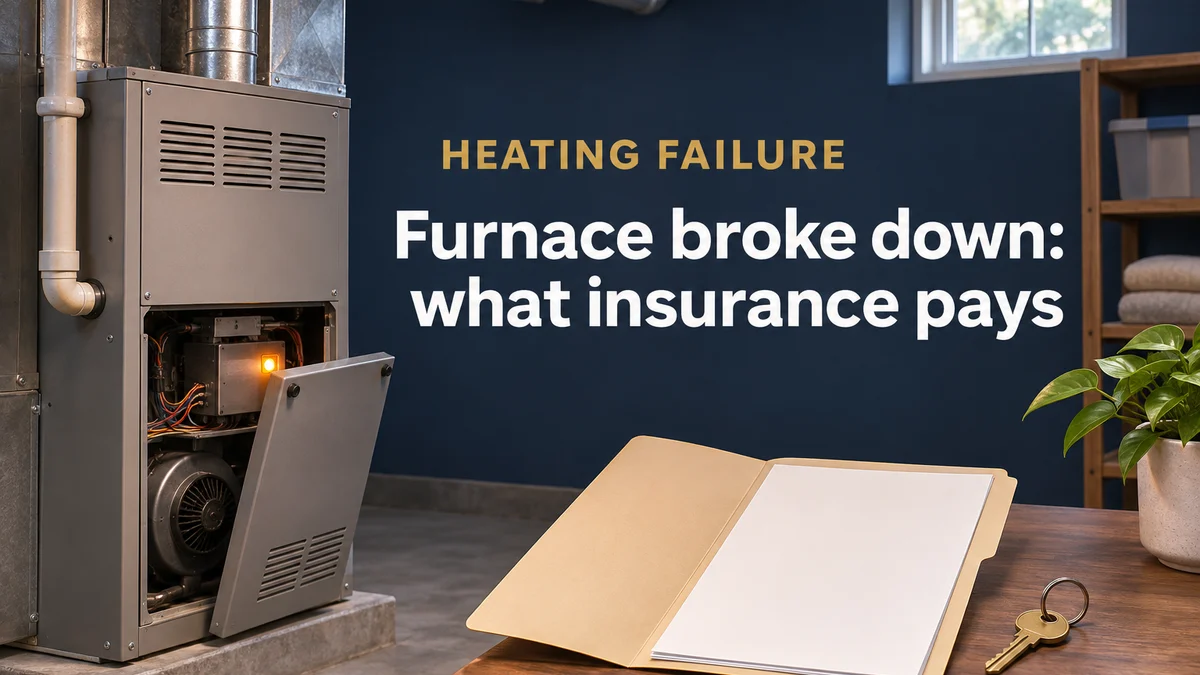
A furnace insurance claim is really two claims. One is for the furnace or boiler itself, and the other is for whatever the failure did to the house: water in a finished basement, soot on the walls, pipes that froze while the heat was off. A standard homeowners policy often refuses the first and pays the second, because it asks what broke the equipment, and wear and mechanical failure are excluded while the water and smoke that follow usually are not. Knowing where that line runs tells you what to photograph, what to ask the technician to write down and what to put in the claim.
Every policy reads a little differently, and your own form and endorsements decide every point below. We are licensed Illinois public adjusters, not attorneys, so this is how these files are usually handled and not legal advice.
Two questions in one furnace claim
The policy treats the heating unit and the damage it causes as separate questions. The unit is judged by what broke it. The damage to the rest of the house is judged by what reached it, usually water or smoke, and that is often covered even when the unit is not. Three sentences in the common open-perils homeowners wording set this up. These are taken from a published form, HO 17 31 04 91, and many Illinois policies use the same or very close language.
Wear and tear, marring, deteriorationand
mechanical breakdownsit on the list of things the policy does not insure. A furnace that quits because a motor burned out or the heat exchanger wore through falls here.
we cover loss caused by the water including the cost of tearing out and replacing any part of a building necessary to repair the system or appliance.If an excluded cause makes the system leak, the water damage is still paid, and so is opening a wall or ceiling to get at the broken part.
We do not cover loss to the system or appliance from which this water escapedThe boiler that leaked is not replaced under this part of the policy, even though the drywall it soaked is.
So when a carrier says your furnace is not covered, that sentence may be correct and still say nothing about the basement. Ask for the decision on the unit and the decision on the resulting damage separately, in writing.
What broke it decides the answer
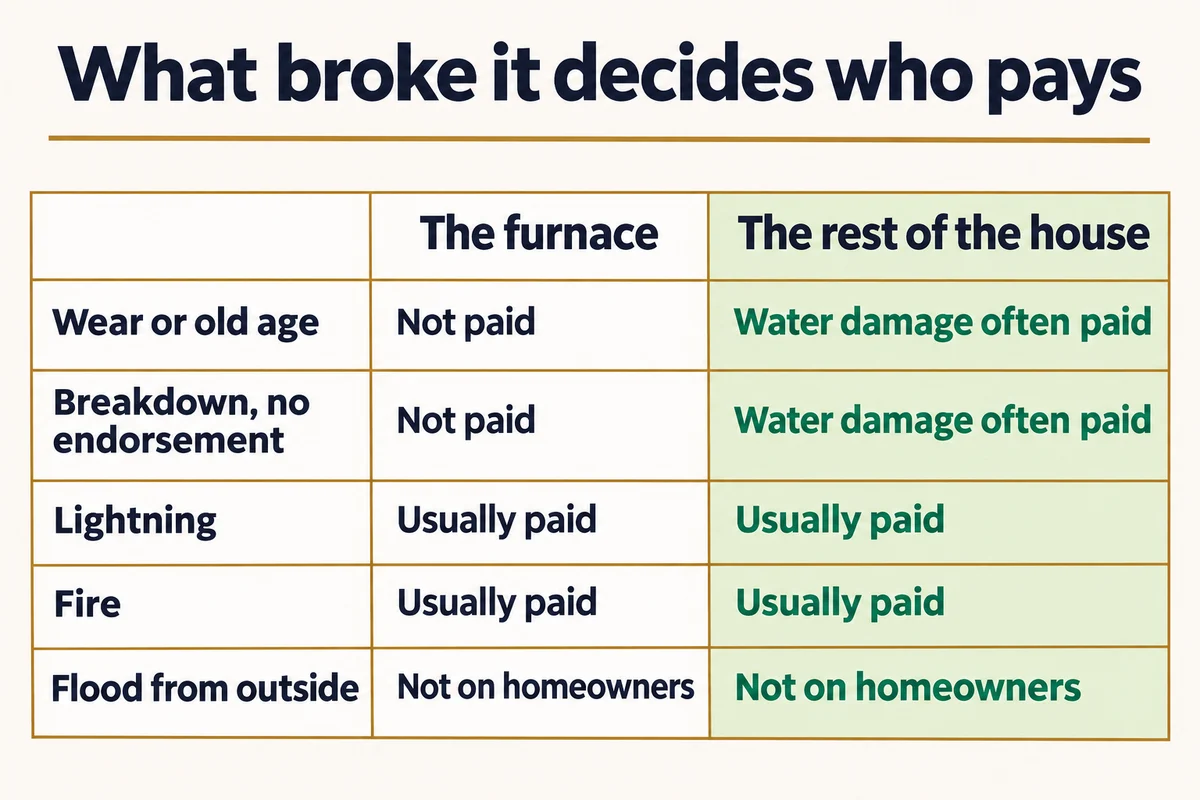
The cause of the failure decides both verdicts. Fire and lightning are covered perils on almost every homeowners form, so a furnace they destroy is usually paid along with the house. Old age and internal breakdown are excluded for the unit, but the water or smoke they release often is not. The common causes tend to read like this.
| What happened | The furnace or boiler | Water, smoke and the rest of the house | What shows the cause |
|---|---|---|---|
| Old age, a cracked heat exchanger, rust through | Excluded as wear, deterioration or corrosion | Water or soot it releases is often covered as sudden damage; the slow seep of a long leak usually is not | The technician's written finding and the age on the data plate |
| Blower motor, control board or circulator pump fails | Excluded as mechanical or electrical breakdown on a standard form | Resulting water damage and tear-out often covered | The failed part, kept, and a report naming it |
| Lightning strike nearby | Usually covered; lightning is a named peril | Usually covered | A strike record for the address and the date, plus other electronics damaged at the same time |
| Power surge with no lightning | Depends on the form; some exclude electrical damage to the equipment itself | Depends on what the surge damaged | A utility outage record and an electrician's note |
| Fire, in the unit or anywhere in the house | Usually covered | Usually covered, including smoke and soot from a puffback | Fire department report, or the technician's account of the misfire |
| Flood water from outside | Not covered by a homeowners policy; a flood policy is a separate contract | Not covered by a homeowners policy | The water line on the walls and where it came in |
| Freezing | Often covered if you kept heat on or drained the system; the wording varies | Often covered on the same condition | Gas and electric bills, thermostat history, the date heat was lost |
The puffback row is common in Illinois basements: an oil or gas burner misfires and blows soot through the ducts into every room. That is a fire or smoke loss, not a breakdown, and our article on smoke damage without a fire explains how the cleaning gets scoped. For the surge rows, the question of whether the utility or your policy pays is set out in who pays for power surge damage in Illinois.
What an equipment breakdown endorsement adds
An equipment breakdown endorsement is an optional addition to a homeowners policy that pays to repair or replace home systems, including furnaces and boilers, after a sudden mechanical or electrical breakdown. It fills the gap in the first row of the strip above. It is not a home warranty, and it usually still excludes ordinary wear.
If you are not sure you have it, look at the declarations page for an endorsement with breakdown in its name and an added premium beside it. Then read the endorsement itself for these points:
- The limit, and whether it is per breakdown or per year.
- Its own deductible, which is often separate from the policy deductible.
- Whether wear, tear, rust and gradual deterioration are excluded, and how the endorsement tells a breakdown from old age.
- Which equipment it lists, and whether the furnace, boiler, water heater and heat pump are named.
- Whether it pays to repair first and replace only if repair costs more, and whether it pays for more efficient equipment when the old model is gone.
The weak point is cause again. A carrier can accept a breakdown claim and still deny the furnace as wear if the technician's note says the unit was simply old. A breakdown endorsement pays for a part that failed, so the report needs to name the part and the failure.
One failure, two policies
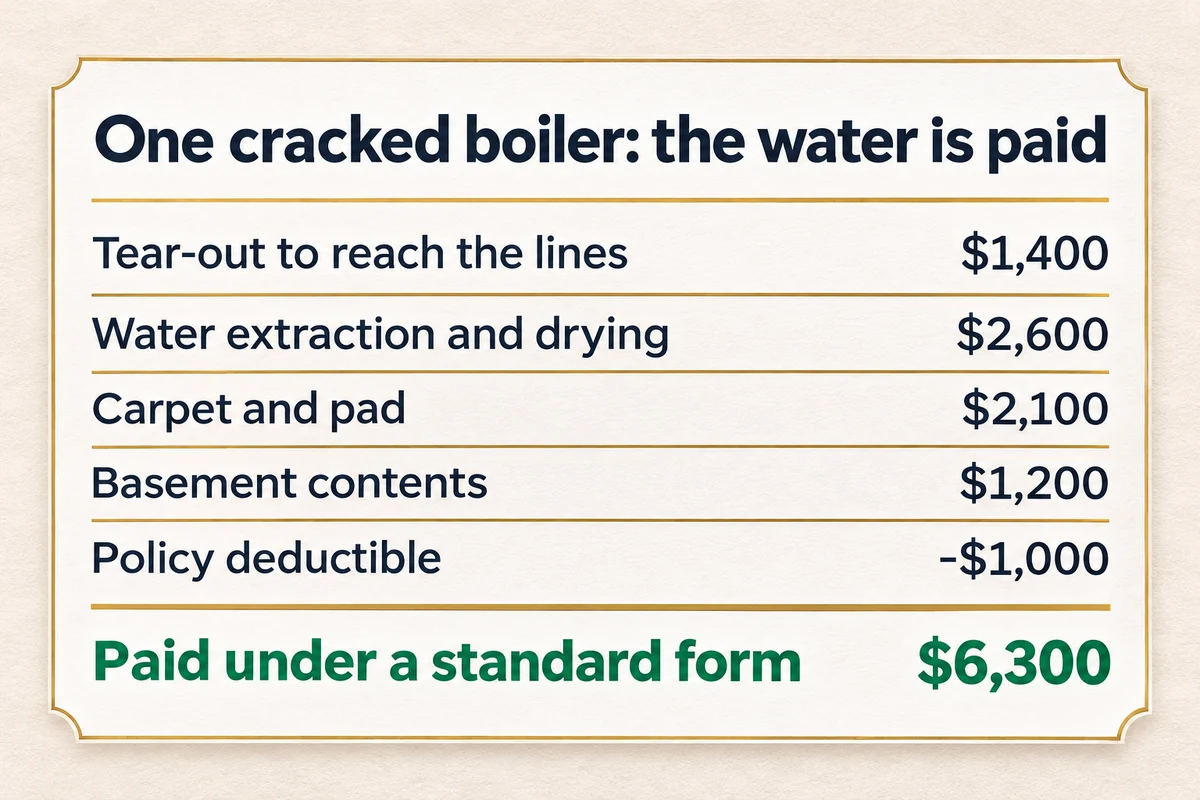
A made-up example shows how much rides on the endorsement. The figures are invented for illustration and are not a result of ours. In January a circulator pump control fails, the boiler runs dry and a cast-iron section cracks. Water runs across a finished basement before anyone notices. The policy deductible is $1,000; the endorsement in the second column has its own $500 deductible. Depreciation is left out to keep the sums plain.
| Line | Standard form | With breakdown endorsement |
|---|---|---|
| Boiler replacement | $0 (owner pays $9,800) | $9,800 less $500 = $9,300 |
| Opening a wall to reach the supply lines | $1,400 | $1,400 |
| Water extraction and drying | $2,600 | $2,600 |
| Carpet and pad | $2,100 | $2,100 |
| Basement contents | $1,200 | $1,200 |
| Policy deductible on the water damage | less $1,000 | less $1,000 |
| Paid by the carrier | $6,300 | $15,600 |
Under the standard form the owner is out $10,800: the boiler and the deductible. With the endorsement, $1,500. The water damage is paid either way, which is the part owners most often leave on the table when the first letter says the boiler is not covered.
The contents line depends on a different part of the policy. Personal property is usually covered for named perils only, and the usual list includes water that escapes from a heating system and the sudden cracking or bulging of a steam or hot water heating system. Check that your form says so.
The heat is out in January: the first hours
When the furnace stops in freezing weather, the furnace is no longer the expensive part. Pipes in outside walls and crawl spaces can freeze within hours, and a burst line can do more damage than the furnace is worth. Most policies also make you protect the property from further damage once you know about a loss. In order:
- First hourPhotograph the thermostat, the furnace with its panel on, any error light and any water on the floor. Write down the time the heat went out.
- Same hourCall for service. If a technician cannot come soon, open cabinet doors on outside walls, let taps on those walls drip, and add safe temporary heat. If you leave the house, shut off the main water and drain the lines.
- Before repairAsk the technician to keep the failed part and to photograph it in place. Do not let the old unit be hauled away until the carrier has seen it or said in writing that it does not need to.
- Same dayReport the loss to the carrier if there is any water, soot or frozen pipe damage, even if you think the unit is excluded.
- KeepEvery receipt: the emergency service call, space heaters, drying equipment, a hotel night if the house became unlivable.
Freezing is where the policy wording matters most. On many forms the condition to keep heat on or drain the system applies only while the home is vacant, unoccupied or being built; on others it applies at all times. Our guide to frozen and burst pipe claims goes through that condition and how carriers test it.
Getting the cause in writing
The technician's report often decides the claim, and most are written to sell a repair, not to settle a cause. A note that reads "unit failed, recommend replacement" lets the carrier fill in wear and tear. Before the technician leaves, ask for a report that says:
- which part failed and how it failed, in plain words;
- whether the failure was sudden, and whether the unit was running normally before it;
- whether there are signs of lightning, a surge, fire, freezing or outside water;
- the age, make and model of the unit from the data plate;
- what the leak or the misfire reached, with photos.
If the carrier's adjuster has denied the whole claim because the unit is excluded, ask which sentence of the policy applies to the water damage. Often there isn't one. We handle burst pipe and power surge damage claims across Illinois, including the ones that start at the furnace, and a first look at your file costs nothing: send it to us.
Questions we get about this
Does homeowners insurance cover a furnace that stops working?
Usually not when it stopped from old age, wear or an internal breakdown, because those are excluded on standard forms. It usually does when fire or lightning destroyed it. Water, soot or frozen pipe damage the failure caused to the rest of the house is a separate question and is often covered. Your own policy governs.
If my boiler leaks, will insurance pay for the water damage?
Often yes. Common homeowners wording pays for water damage from a heating system even when the cause of the leak is excluded, including the cost of opening walls or ceilings to repair the system. It does not pay for the boiler itself under that provision, and slow leaks over weeks are usually excluded.
What is equipment breakdown coverage for a furnace?
It is an optional endorsement that pays to repair or replace home systems such as a furnace or boiler after a sudden mechanical or electrical breakdown, which a standard form excludes. It usually has its own deductible and still excludes ordinary wear and tear, so the cause of the failure still matters.
Should I let the HVAC company remove my old furnace before the insurance adjuster sees it?
Not if you are making a claim. Keep the failed part and the old unit, or at least photograph them in place, until the carrier has inspected them or told you in writing that it does not need to. The failed part is the evidence of what caused the loss.