The insurer says the damage is old: how the date of loss gets proved

When the insurer says the damage is old, the claim turns on one question: did the loss happen during the policy period, from a cause the policy covers? A homeowners policy pays for loss that occurs while it is in force, not for damage that was already there, and not for wear. So the carrier's letter is really a statement about a date. You answer it with records that fix dates: when the roof was last seen whole, when a storm crossed your address, when the damage was found. In Illinois the letter itself also has to meet a rule, and many do not. Your own policy wording governs, so below are the lines to look for and the records that move the date.
Every record narrows the window
Think of the date of loss as a window with two edges. One edge is the last day anyone can show the property without this damage. The other is the day the damage was found. Every dated record you add moves one of those edges, and the storm has to sit inside what is left. The strip below is an illustrative file, not a client's, with the dates chosen to show how the window closes.
- May 15, 2025Policy starts. Purchase inspection says the roof has no missing or broken shingles.
- Sept 2025Gutter cleaner's dated photos show the north slope whole.
- Apr 28, 2026Hail reported two miles away on the storm report page.
- May 20, 2026Water stain found on the bedroom ceiling.
- May 21, 2026Claim reported to the carrier.
Shaded: the window left once the September photos exist. Without them, the window would reach back past the start of the policy.
Notice which record did the work. The stain proves nothing about when the roof broke; it only proves when water got through. The September photos are what pushed the early edge forward by four months. A file with only the stain and the storm report invites the reply that the damage could have come from any storm in the past few years, including one before you owned the house.
The three policy sentences behind the word old
A denial that calls damage old nearly always leans on one of three lines. The quotes below are from the standard homeowners form HO 00 03 04 91, in the copy filed with the Nevada Division of Insurance. Many Illinois policies use the same words or close to them; yours may number them differently.
The policy period condition
"This policy applies only to loss in Section I ... which occurs during the policy period."
The word is occurs, not discovered. Finding a leak in May does not by itself place the roof damage in May.
The wear exclusion
"Wear and tear, marring, deterioration"
It removes the wearing out itself. It does not remove storm damage to a roof that also happens to be worn.
The proof of loss line
"(1) The time and cause of loss"
If the carrier asks for a sworn proof of loss, you state the time and the cause to the best of your knowledge. A date you guessed becomes a date you swore to.
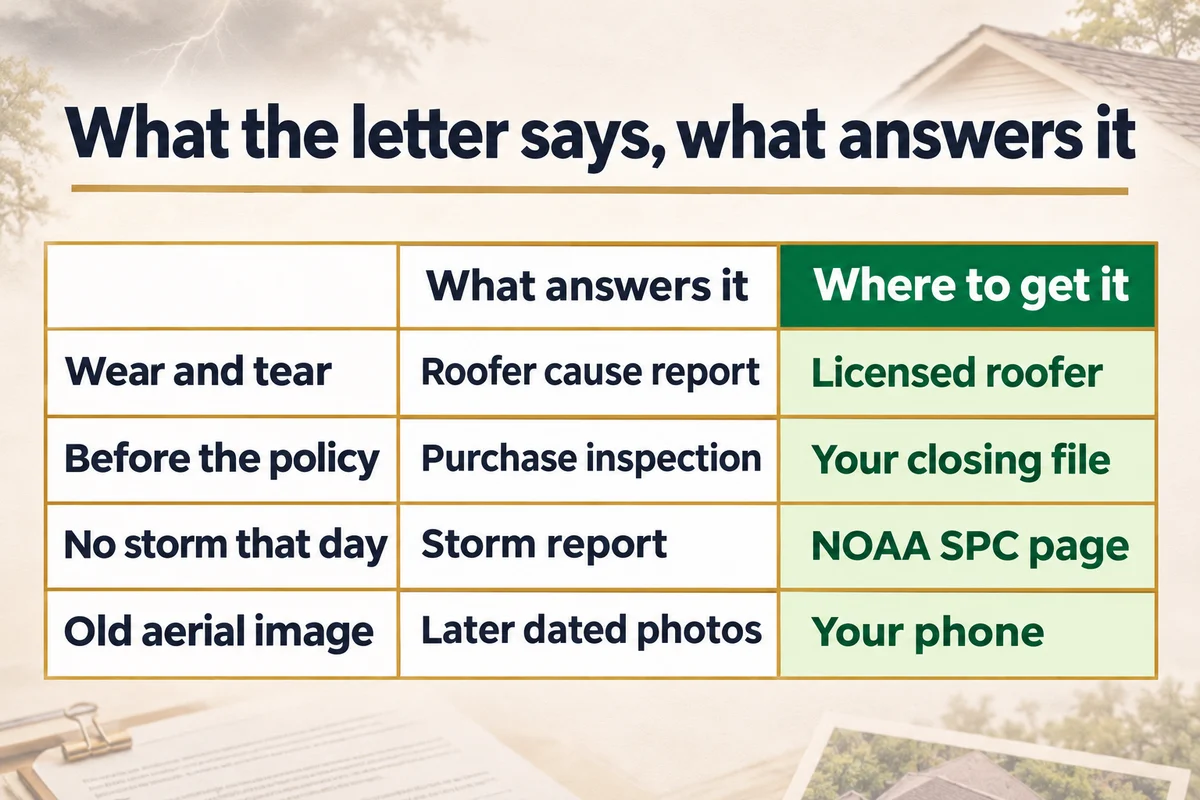
The second card is where most roof letters live. An older roof can be worn and still take real hail or wind damage on a known night. The honest question for the roofer is not how old the roof is but whether these particular breaks, creases or bruises came from this event. That is a cause opinion, and it should be written as one.
Which record fixes which edge
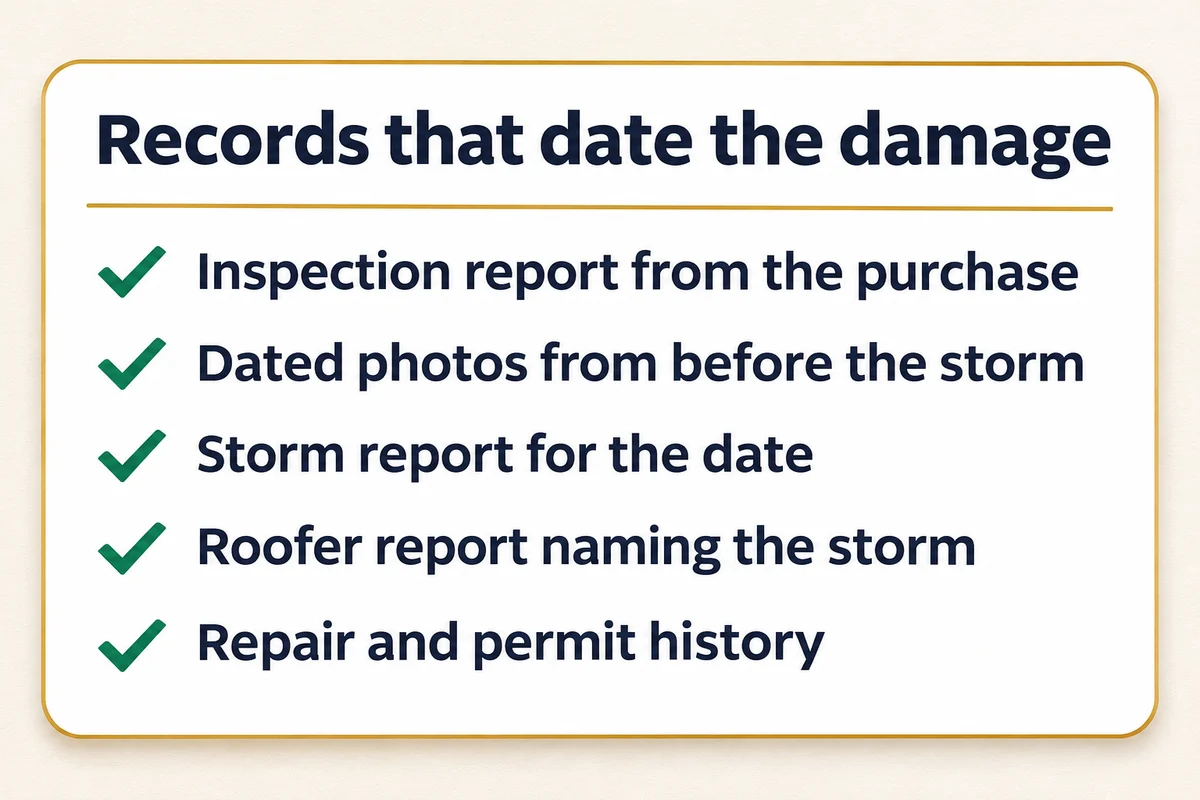
Each record below either proves the property was whole on a date (it moves the early edge later) or proves damage existed by a date (it moves the late edge earlier). Some do both. Gather the ones you can before you answer the letter.
| Record | What it can show | Where it usually is |
|---|---|---|
| Home inspection from the purchase | The roof, siding or ceiling as it was on the inspection date | Your closing file or the inspector's portal |
| Phone photos and videos taken before the storm | The property whole on the date in the file data; a party, a new car or a holiday in frame helps | Your phone, cloud backup, family members' phones |
| Work done on the house since you bought it | An invoice for gutters, siding or a skylight where the worker would have seen the damage | Contractor invoices, card statements |
| Storm report for your area | That hail or high wind was reported near you on a date | The Storm Prediction Center reports page and NOAA's Storm Events Database |
| Neighbours' claims or repairs after the same storm | That the event damaged roofs on your street | A conversation over the fence, a dated photo of their roofers |
| A roofer's or engineer's written cause report | Whether the damage matches that storm (size of marks, direction, fresh breaks) | An inspection you order, separate from the carrier's |
| The first photos after the damage was found | The condition on the day of discovery, before any repair | Your phone; keep the originals, not edited copies |
Send copies that keep the date. A photo that has been edited, screenshotted or passed through a messaging app can lose the date stored in the file, and then it is only a picture. Our checklist of what to photograph after property damage covers the shots taken on the day you find it.
What an Illinois denial letter has to contain
Illinois sets rules for how carriers handle claims in 50 Ill. Adm. Code 919. Section 919.50, read on the General Assembly's site today, says that when a first party claim is denied or settled for less than claimed, the company must give "a reasonable written explanation of the basis of the lower offer or denial within 30 days after the investigation and determination of liability is completed." Read the letter you received against four points.
- Does it name the clause?
- The rule says the explanation "shall clearly set forth the policy definition, limitation, exclusion or condition upon which denial was based." A letter that only says the damage is long-term or pre-existing, without pointing to a line of the policy, has not done that. Ask in writing which provision applies.
- Does it say what the date is based on?
- An aerial image, an inspection finding, a weather search for one date. Ask for the item itself: the image with its capture date, the inspector's photos, the weather data and the date range searched. Your claim file request can name each of them.
- Was it decided on a phone call?
- Section 919.50(b) says no company shall deny a claim on information from a telephone conversation or interview "unless such telephone conversation or personal interview is documented in the claim file." If you said on the phone that you had noticed a stain last winter, ask for the note of that call and correct it in writing if it is wrong.
- Is the Department's notice attached?
- The same subsection requires the Notice of Availability of the Department of Insurance to accompany the explanation. If it is missing, that is worth noting in your reply, and our guide to filing a complaint with the Illinois Department of Insurance explains what the Department does with one.
Old wear and new damage on the same roof
Most disputed roofs have both. The useful move is to separate them on paper instead of arguing that the whole roof is new damage.
Worn shingles on one slope, fresh breaks on another
Hail and wind usually leave a direction: one face of the house takes the hits. Ask the roofer to map the damage by slope and to say which marks are fresh and which are wear. A claim built on the slope that faced the storm is easier to date than a claim for every square of the roof.
An old leak and a new storm
If the attic shows old water staining under one spot and new staining somewhere else, photograph both and say so. Owning up to the old stain makes the new one more believable, and it keeps the adjuster from using one to explain the other.
Two storms, two dates
When the carrier says the damage came from an earlier storm rather than from no storm at all, the question becomes which event caused which item. We covered that split in the guide on a second storm before the roof was repaired.
How to answer the letter, in order
- Do not repair yet beyond a tarp or board-up. The carrier may want to inspect again, and permanent work can destroy the evidence of age.
- Write down, before you look anything up, when you last saw the roof or ceiling whole and when you found the damage. Use the words "about" or "no later than" where you are not sure; a guessed exact date is the easiest thing in the file to attack.
- Ask in writing for the clause relied on and for every item the date is based on, citing Section 919.50.
- Collect the records in the table above, with dates kept in the files.
- Order a cause report from a licensed roofer or an engineer who does not work for the carrier. Our guide to engineering reports on insurance claims shows how such an opinion is built and how to answer one.
- Reply in one letter: the date window your records support, the storm inside it, the cause report, and a request that the claim be reconsidered under the clause the carrier named. Keep a copy and a record of how you sent it.
- Watch the suit limitation in your policy while this goes on. A reconsideration request does not stop that clock unless the carrier says so in writing; whether and when to sue is a question for an Illinois attorney.
When to bring in a public adjuster
A dating dispute is mostly paperwork and inspection: building the window, getting the right cause opinion, and answering the letter clause by clause. That is the work we do on hail damage claims and wind damage claims across Illinois. We are licensed public adjusters, not lawyers, and nobody can promise how a carrier will decide; what we can do is put the dates and the cause in front of it in a form it has to answer.
Homeowners rate us 4.9 from 33 Google reviews. The first review of your denial letter and records costs nothing. If you hire us, the fee is a share of what is recovered, set by Illinois law and written into the contract, paid out of the settlement; no recovery means no fee. The office is open seven days a week: Monday through Friday 7:00 AM to 7:00 PM, Saturday and Sunday 9:00 AM to 5:00 PM, through our contact page or at (630) 297-8136.
Questions we get about this
What does it mean when the insurance company says the damage is old?
It means the carrier believes the damage happened before your policy period, before the storm you reported, or through wear rather than a covered event. A homeowners policy covers loss that occurs during the policy period, so the dispute is about the date of loss and the cause. Your policy wording governs.
How do I prove when storm damage happened?
Show the property whole on an earlier date (a purchase inspection, dated photos, invoices for nearby work), show a storm near you on a later date (a storm report), and get a written cause report from a licensed roofer or engineer tying the damage to that storm. Keep the dates stored in the photo files.
Does an Illinois insurer have to explain a denial in writing?
Yes. 50 Ill. Adm. Code 919.50(a)(1) requires a reasonable written explanation within 30 days after the investigation is completed, naming the policy definition, limitation, exclusion or condition relied on, with the Department of Insurance notice attached.
Can a worn roof still have a covered storm claim?
Often, yes. The standard wear exclusion removes the wearing out itself, not storm damage to a roof that is also worn. The claim is strongest when a roofer separates fresh storm damage from old wear, slope by slope, and links the fresh damage to a dated storm.