Broken sewer or water line in the yard: what insurance pays

A broken sewer line insurance claim usually turns on one fact: most homeowners policies treat the pipe under your yard as something you maintain, not as part of the house. Without a service line endorsement, the cost of digging up and replacing a cracked sewer lateral or a split water line is often refused. The water or sewage that reached the basement is a different question, answered by a different part of the policy, and it is often paid. Before anyone backfills the trench, it is worth knowing which piece of the bill belongs where.
Policies differ by carrier and by edition, and your own form and endorsements decide every point below. We are licensed Illinois public adjusters, not attorneys, so this is how these claims are usually handled and not legal advice.
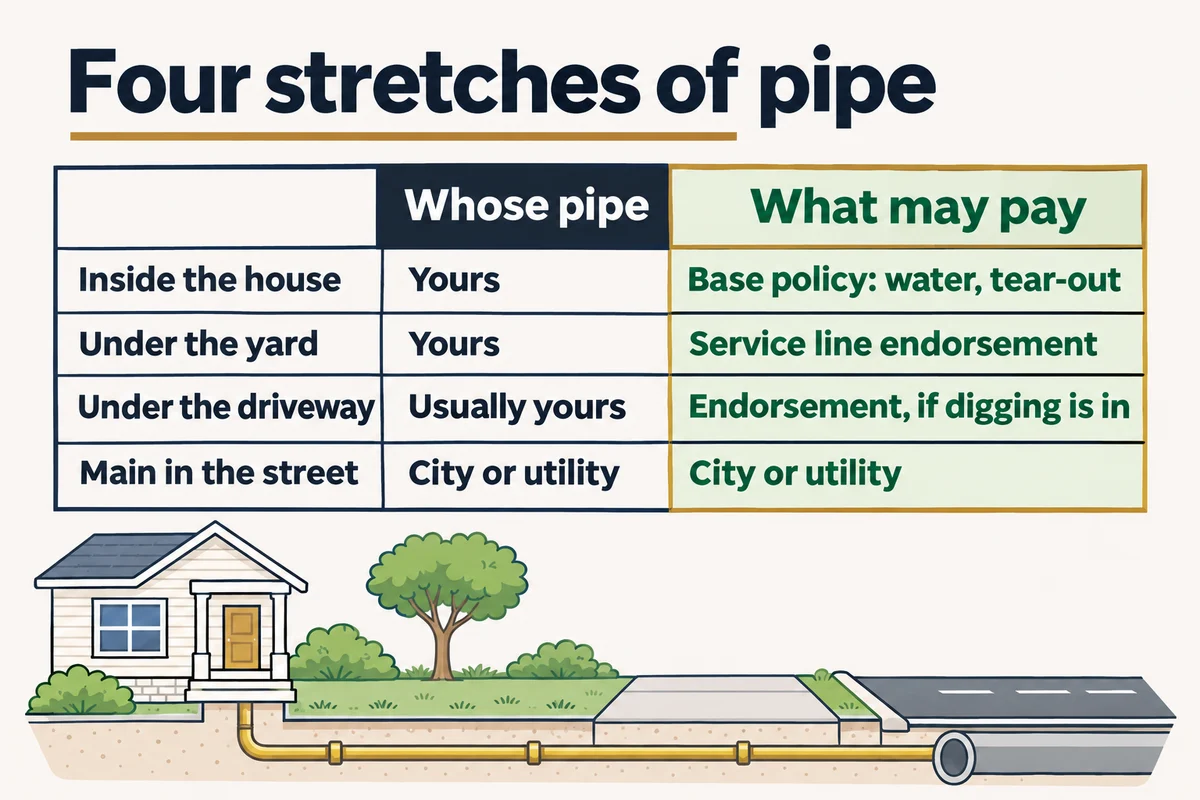
Four stretches of pipe, four different answers
A sewer or water line passes through four places on its way to the street, and the answer can change at each one. Find where your break is before you read the denial letter. A carrier that refuses the yard section may still owe for the house.
Where your part ends depends on the town and sometimes on the size of the building. Ask your village or city water department to tell you in writing, with a map if it has one, before you pay for work at the curb.
Why the base policy usually refuses the pipe in the yard
Because the things that break buried lines are mostly excluded: age, corrosion, roots, settling and soil that shifts. The base form insures sudden, accidental physical loss, and a clay lateral that cracked over years of root growth is neither. What the form often does give back is the water damage and the cost of reaching the leak inside the building.
Two passages in a published open-perils form, HO 17 31 04 91, show both halves. Many Illinois homeowners policies use the same or very close wording.
Settling, Shrinking, bulging or expansion, including resultant cracking, or pavement, patios, foundations, walls, floors, roofs or ceilingsThis sits among the causes the form does not insure. A line that sagged or cracked with the soil can be refused here, and so can the driveway that cracked with it.
we cover loss caused by the water including the cost of tearing out and replacing any part of a building necessary to repair the system or appliance.If water escapes from the plumbing for a cause not otherwise excluded, the water damage is paid, and so is opening part of the building to get at the break. The word is building. A lawn or a driveway is not part of it, which is why the yard and the slab are often answered differently.
The refusal letter usually names one of the reasons below. Each one says something narrower than it sounds:
- Wear and tear, deterioration, corrosion
- Names what broke the pipe, not what the break did to the house. If the letter stops there, ask for a separate decision on the water damage inside.
- Settling or cracking
- Reaches the pipe, foundation or pavement that cracked as the ground settled. On its own it does not decide the interior damage from a sudden break.
- Earth movement
- Aimed at ground that sinks, rises or shifts. How it differs from the settling exclusion, and what it gives back, is set out in our article on foundation cracks and the earth movement exclusion.
- Water below the surface of the ground
- Many forms exclude water in the soil that seeps through a foundation or slab. A carrier may argue the leaking line soaked the ground first and the water came in from outside. Where it came in, and how fast, decides this one.
- Continuous or repeated seepage
- Many forms exclude a leak that ran for weeks, often worded as 14 days or more. The date the problem was first noticeable matters, so write it down now.
- Not part of the dwelling
- Some carriers say a buried line is outside what the dwelling coverage insures. Read the declarations page and the endorsements before you accept it. This is the gap a service line endorsement fills.
If you have a service line endorsement, read it against the bill
A service line endorsement is an optional addition that pays to repair or replace buried lines you are responsible for, usually including the digging, after causes the base form refuses. Look on your declarations page for an entry called service line or buried utility lines coverage, with its own premium. Then read the endorsement for these points, in this order:
- The limit, and whether it applies per occurrence or per policy year.
- Its deductible. It is often separate from the policy deductible and has to be met on its own.
- Whether excavation, new concrete or asphalt, and lawn and landscaping repair are paid inside the same limit or on top of it. On a long lateral under a driveway, the digging and the concrete can use up most of a small limit before the pipe is counted.
- Which causes it lists. Endorsements commonly name a leak, break, collapse or freezing, and some also name wear, rust and roots. If roots or wear are missing from yours, the contractor's description of the cause carries the claim.
- Which lines it includes: sewer, water, gas, electric, and whether a well or septic line counts.
- Whether it pays for a different pipe material, a cleanout or other work the town requires, or whether that falls to ordinance or law coverage.
- Whether it pays for a hotel and meals while the house has no water or sewer service.
If the limit runs short, the line items still matter. Ask the carrier in writing how it applied the limit across pipe, digging and surface repair. Damage inside the house is usually claimed under the base policy, not the endorsement, and should not be counted against the endorsement limit.
Water and sewage inside the house are a separate claim
When a broken line floods the basement, the damage inside is judged on its own terms, and it is often worth more than the pipe. Two different things may have happened, and policies read them very differently:
- Clean water escaped because a supply line split under the floor or at the foundation wall. That is usually treated as a sudden discharge from the plumbing, which many forms cover even when the cause of the split is excluded, unless the leak ran for weeks.
- Sewage came up through a floor drain or toilet because the lateral collapsed or was blocked. That is usually excluded as water backing up through sewers or drains, and is paid only under a water backup endorsement, up to its limit.
Backup limits are often small, and the costs they have to stretch over are listed in our article on the water backup endorsement limit. Why a backup is not a flood, which a homeowners policy does not cover at all, is explained in sewer backup vs flood.
Get the cause on record before the trench is filled
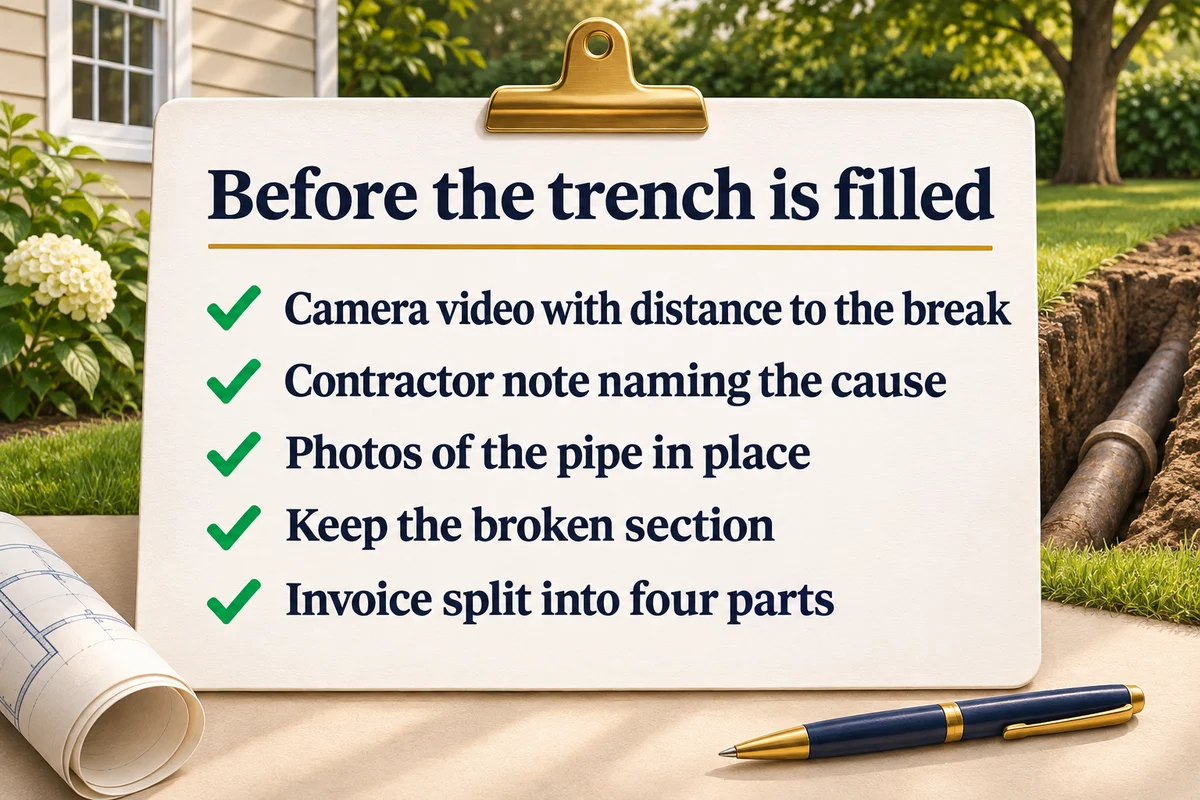
The cause decides every part of this claim, and it goes back under the soil within a day of the repair. Report the loss to the carrier before the work starts if you can, give it the excavation date so its adjuster can see the open trench, and ask the plumber or sewer contractor to record what they find.
Before the dig
- The camera inspection video, with the distance from the cleanout to the break written on the report.
- A written note from the contractor naming the cause: a collapsed or crushed section, an offset joint, root intrusion, a crack, freezing.
- Photos of the lawn, the driveway and the basement before anything is moved.
- The date you first noticed slow drains, a soft wet patch or a jump in the water bill, and the last few bills.
During and after
- Photos of the exposed pipe in place, with a tape measure in the frame.
- The broken section of pipe, kept, not thrown in the dumpster.
- The permit and inspection record if the town required one.
- An itemized invoice split four ways: pipe, excavation, concrete and landscaping, work inside the house.
- Photos of the backfilled trench and the new concrete.
A contractor note that only says replaced line
lets the carrier fill in old age. A note that says a section under the driveway collapsed, or split when the ground froze, gives the adjuster a cause to apply the policy to. The same logic appears in our article on frozen and burst pipe claims, which explains the heat condition many forms attach to freezing.
When a city crew or a contractor broke the line
If a street crew, a utility contractor or someone digging on the next lot cracked your line, the cost may be theirs. Write down who was working, where and on which day, photograph their equipment and the marks in the ground, and ask for the name of their insurer. You can still report the loss to your own carrier. Many policies pay a covered loss and then recover the money from whoever caused it. A claim against a town or a contractor is a question for an attorney, and claims against a local government can have short notice periods, so ask early.
What to do this week
Stop the water first: close the main shut-off for a supply line break, and stop using the drains for a sewer line. Call the carrier, then a licensed plumber or sewer contractor for a camera inspection. Ask the carrier for a written decision on each piece of the claim separately: the line, the digging, the yard and driveway, the damage inside. A refusal of the line is not a refusal of the basement.
We handle sewer backup claims and burst pipe claims across Illinois, and we give a second reading to denied claims. There is nothing to pay up front: our fee is a percentage of what we recover, so if nothing is recovered there is no fee. Send us the letter and the contractor's report, and we will tell you which parts of the bill the policy should answer.
Questions we get about this
Does homeowners insurance cover a broken sewer line in the yard?
Usually not on a standard form, because the causes that break buried lines, such as age, corrosion, roots and settling, are excluded and the line is treated as the owner's maintenance. A service line endorsement, if you bought one, is written to pay for the line and often the digging. Water damage inside the house is a separate question and is often covered. Your own policy governs.
Is the cost of digging up the yard covered?
Under a standard form, digging outside the building is usually tied to whether the pipe is covered, so it is often refused with it. Many forms do pay to tear out and replace part of the building to reach a leaking pipe. A service line endorsement often pays excavation and surface repair, sometimes inside the same limit as the pipe, so read how yours is written.
Who is responsible for the sewer line between my house and the street in Illinois?
It is set by each town or water utility, not by your insurance policy. The owner is often responsible for the private line from the house toward the main, and the city or utility for the main in the street, but the point where it changes hands varies. Ask your village or city water department to confirm it in writing before you pay for work at the curb.
What should I keep for a sewer line insurance claim?
The camera inspection video and report, a contractor note that names the cause of the break, photos of the pipe in place before it is removed, the broken section itself, the date you first noticed the problem, and an itemized invoice split into pipe, excavation, surface repair and interior work.