Smoke Damage Without a Fire: Puffbacks and Soot Claims
Smoke damage without a fire is usually covered. A furnace puffback, a fire next door or a fire in the unit below can coat an entire house in soot with no flames at your own address. The disagreement is rarely about coverage. It is about scope: how far the soot travelled, what can be cleaned, and what has to be replaced.
Smoke damage without a fire is one of the few losses where the homeowner and the carrier agree that something happened and still finish twenty thousand dollars apart. Nothing burned. There is no charred room to photograph and no fire report to attach. What there is instead is a grey film on every horizontal surface, a smell that returns whenever the heat runs, and an estimate written for one floor of a house that was sooted from the basement to the attic.
We are licensed Illinois public adjusters, not attorneys. Policy wording varies between carriers, and between editions of the same form, and your own policy governs. What follows is how these claims are usually handled — not a rule of law.
Is smoke damage covered when there was no fire?
Usually, yes. The dwelling is insured against risk of direct physical loss, and smoke is not an excluded cause. Personal property is covered under a named peril for smoke, which in the widely used homeowners form means sudden and accidental damage from smoke — and in more recent editions of that form, explicitly includes a puffback from a boiler or furnace.
Two things sit outside that peril in the form itself: smoke from agricultural smudging, and smoke from industrial operations. Neither describes a furnace in a basement or a house fire across the street. If your declarations page shows an older edition, the puffback sentence may not be printed there, and the argument is simply that a misfire is sudden and accidental smoke — which is what the peril already said before the wording was tightened.
Worth carrying into the first phone call: the paragraph governing your ceiling and the paragraph governing the sofa underneath it are not the same paragraph, and the contents one is the narrower of the two.
What is a puffback, and why does it soot the whole house?
A puffback is a misfire in an oil- or gas-fired furnace or boiler. Unburned fuel collects in the combustion chamber and ignites all at once, pushing soot back through the heat exchanger and the flue instead of up the chimney. If the system is forced air and the blower runs, the ductwork distributes that soot to every room it serves.
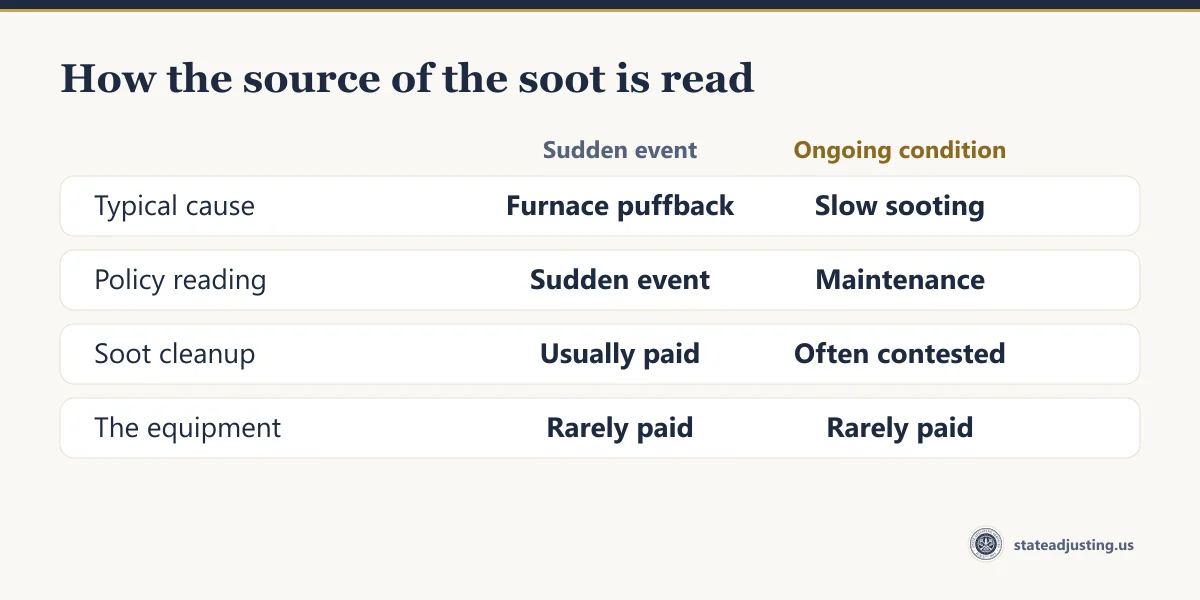
Puffback soot from fuel oil is oily rather than dry. It smears when wiped, which makes the first instinct the most expensive one: a homeowner with a cloth can turn a cleanable wall into one that has to be sealed and repainted. It also settles selectively, on cooler surfaces, so a faint grid appears on ceilings above the framing and dark edges collect around vents and door frames. Restorers call it thermal tracking, and it is the clearest sign that what is on the wall arrived through the air rather than from a candle on the shelf.
The furnace itself is normally not part of the claim. Mechanical breakdown and wear are excluded causes, so the failed burner assembly is one bill and the soot it pushed through the house is another. That is the same split as a failed supply line under a sink, where the part is yours and the water damage is the claim — we set it out in our guide to sudden versus gradual water damage.
The fire was next door. Whose claim is it?
Yours, on your own policy, with your own deductible. Smoke from a neighbor's fire is a covered cause under a standard homeowners form — nothing has to burn at your address. Your carrier may pursue the responsible party afterwards, and if it recovers, your deductible is normally returned to you out of that recovery.
The costly move here is waiting for the other household's liability insurer. That is a different process with a different timeline, no obligation to pay you promptly, and an adjuster who does not represent you. Report to your own carrier first and let subrogation happen behind the scenes. Late notice is a problem you create for yourself while waiting on someone else's file.
In a condominium or a two-flat the same event splits across two policies, because the association's document decides where the master policy stops and your unit owner's policy starts. Smoke travels through shared chases and corridors, so a fire in one unit routinely produces claims in three. Our post on condo and HOA losses covers which policy pays for what.
Ambient wildfire smoke is a harder question. Canadian wildfire smoke reached Illinois in the summer of 2023, and carriers frequently argue that outdoor smoke leaving no measurable residue is not direct physical loss at all. Courts have not answered that the same way everywhere, so it is a question for an attorney rather than one to assume either way.
How does a carrier decide how far the soot went?
By inspection — usually one walkthrough, on one day, by one person. Soot is an aerosol: it goes where the air goes and settles on the cooler surfaces first. So the affected area is almost always larger than the rooms where the film is obvious, and the first scope is very often written to exactly the rooms where the film is obvious.
These are the lines that go missing between the two.
| Usually in the first scope | Usually left out |
|---|---|
| Rooms with a visible film | Closet, drawer and cabinet interiors, where the smell stays |
| Walls and ceilings of the affected rooms | Attic and wall-cavity insulation, which cannot be cleaned |
| Wipe-down of hard surfaces | The HVAC ducts and air handler that distributed the soot in the first place |
| Paint over the affected walls | A sealing primer before repaint, and painting to a natural break rather than one wall |
| Structural cleaning | Contents cleaning as its own line, textile laundering, electronics evaluation |
| Cleaning | Odor treatment, and verification that the cleaning worked |
The second column is not a wish list. Repainting over unsealed oily soot bleeds through, and cleaning the rooms while leaving the ducts loaded means the smell returns on the first cold morning. What can be saved then depends on the material, and that decision belongs in the estimate rather than in a conversation.
| Material | Usual outcome |
|---|---|
| Glass, tile, finished metal, sealed wood | Cleaned |
| Painted drywall and trim | Cleaned, sealed and repainted; heavy oily soot may mean removal |
| Upholstery, mattresses, carpet and pad | Often replaced; some textiles clean successfully |
| Attic and wall insulation | Removed and replaced — it holds both soot and odor |
| Rigid and flexible ductwork | Rigid duct cleaned; flexible duct is commonly replaced |
| Electronics and appliances | Evaluated individually — soot residue is chemically reactive on contacts |
| Open food, cosmetics, medicines | Discarded |
What does the gap look like in money?
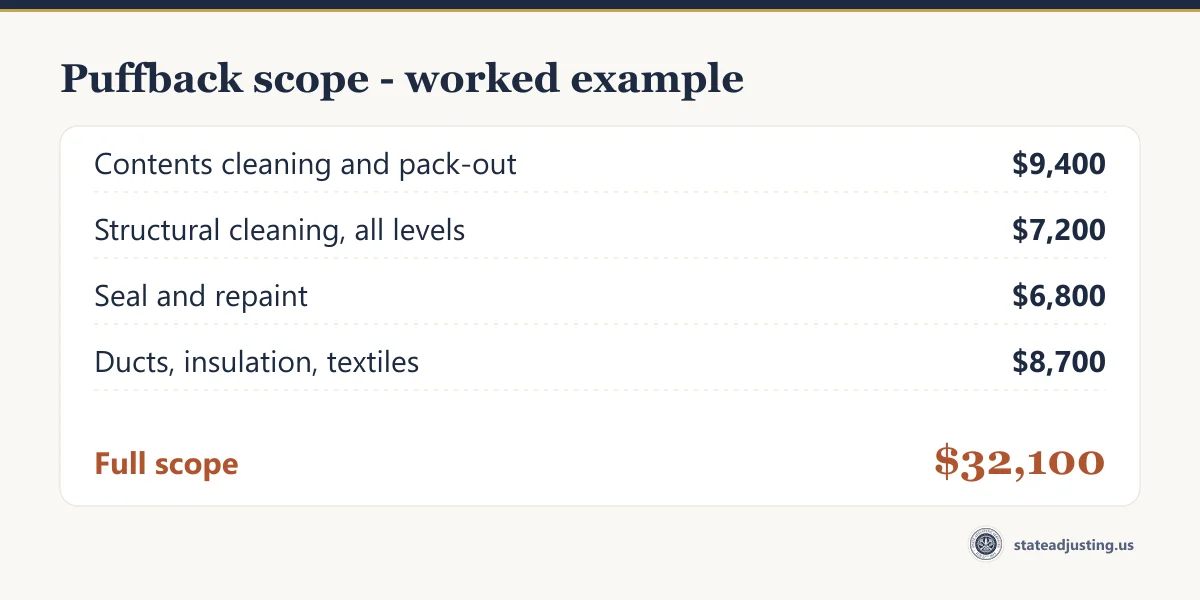
Large, and almost entirely a scope question rather than a coverage one. The figures below are an illustrative worked example to show where the money sits. They are not a past result of ours and not a quote.
A January puffback in a two-storey house with forced-air heat. No flames, no fire department, a fine grey film on all three levels and a smell that sharpens whenever the furnace cycles.
| Line | Replacement cost |
|---|---|
| Contents cleaning and pack-out | $9,400 |
| Structural cleaning, all three levels | $7,200 |
| Seal and repaint affected areas | $6,800 |
| HVAC duct cleaning and air handler | $2,150 |
| Attic insulation removal and replacement | $3,900 |
| Textiles and upholstery that did not clean | $2,650 |
| Full scope | $32,100 |
| First scope — basement and first-floor hall only | $6,450 |
| Difference in dispute | $25,650 |
Nothing in that difference is denied. It is simply not written down — a materially different problem, and one a second inspection can fix. Three notes on the arithmetic:
- One occurrence, one deductible. Structure, contents and cleaning all sit under the same event, so a $1,000 deductible is taken once — not once per category.
- The furnace is outside both columns. Replacing it might be $4,200, and it is commonly excluded as mechanical breakdown. Claiming it and losing does not weaken the soot claim, but expecting it does distort the numbers.
- Coverage D runs alongside. If the house is unfit to live in while contents are packed out and the ducts are cleaned, additional living expenses are a separate coverage with its own limit — see what you can claim while you are out of the house.
Three different findings hide in one letter
A soot letter usually blends three arguments into one paragraph, and each is answered with different evidence. Separating them first is what makes a response short instead of scattered.
- "This is normal household soiling." The cooking, candles and fireplace argument. Answered with a control sample from a sealed, unaffected space — inside a closed cabinet in an unaffected room, or a sealed storage box — set against a sample from the affected area, plus the date the household first saw the film.
- "The damage is limited to the area of origin." A scope argument, not a coverage one, and the most common of the three. Answered by sampling past the scoped rooms and by establishing whether the blower ran. A furnace that kept cycling for a day after the event is the whole case.
- "This developed over time." The maintenance argument. Answered with the HVAC service history, the technician's written findings on the day, and the failed component itself if it has not been thrown away.
One honest caveat on sampling: wipe and tape-lift testing produces a laboratory report, not a verdict, and no universally binding number obliges a carrier to pay. Its value is comparative — same lab, same method, affected area against a genuine control. A single reading from one wall proves very little.
What to do in the first week
- Shut the system down and report the loss. Every hour the blower runs moves soot further. Get the claim number the same day.
- Do not wipe anything. A smeared surface that would have cleaned now has to be sealed and repainted.
- Photograph before anyone cleans. Wide shots of each room, then close shots with something in frame for scale, then the inside of closets, drawers and cabinets — the places a scope forgets and a photograph proves.
- Keep the failed part and the technician's report. Ask for the findings in writing, and leave the burner assembly in place until the carrier has seen it.
- Build the contents list room by room before the pack-out. Once boxes leave the house, reconstructing what was in them is guesswork — our guide to contents inventories shows what each field on the list does.
- Read the scope against the house. Walk the estimate room by room and mark the ones that are not in it. That list, with the reason each room is affected, is a better response than a letter of disagreement.
What we can do
Soot claims are won on scope, and scope is written in the first week by whoever documents the house properly. We read the policy, the estimate and the photographs together and put a complete scope in front of the carrier, including the parts of the building nobody walked into. If you have an open fire and smoke damage claim where the estimate covers fewer rooms than the smoke reached, that is the gap we work on. Our claim process page sets out how a file is handled from the first call.
The review is free and there is no obligation. We are paid a percentage of the recovery, regulated by Illinois law and agreed in writing before we start: nothing upfront, and no recovery, no fee. Send us the estimate and the letter — contact us or call (630) 297-8136, Monday to Friday, 8:00 AM to 5:00 PM.
Questions we get about this
Does homeowners insurance cover smoke damage if there was no fire?
Usually yes. The dwelling is insured against risk of direct physical loss and smoke is not an excluded cause, while personal property is covered under a named peril for sudden and accidental damage from smoke — which in more recent editions of the widely used form expressly includes a puffback from a boiler or furnace. The peril excludes smoke from agricultural smudging and from industrial operations. Your own policy edition and wording govern.
What is a furnace puffback and is it covered?
A puffback is a misfire in an oil- or gas-fired furnace or boiler: unburned fuel builds up in the combustion chamber and ignites at once, pushing soot back through the flue and, on a forced-air system, through the ductwork into every room. The resulting soot damage is normally treated as sudden and accidental smoke and covered. The failed equipment itself is usually not, because mechanical breakdown and wear are excluded causes.
My neighbor had a fire and my house only smells of smoke. Who pays?
Your own policy pays, subject to your own deductible, and nothing has to burn at your address for smoke to be a covered cause. Report it to your carrier straight away rather than waiting on the other household liability insurer, which has no obligation to pay you promptly and does not represent you. If your carrier later recovers from the responsible party, your deductible is normally returned out of that recovery.
Can soot just be wiped off, or does it need professional cleaning?
Do not wipe it. Puffback and fuel-oil soot is oily and smears, so a cloth can turn a wall that would have cleaned into one that has to be sealed and repainted. Sealed hard surfaces such as glass, tile and finished metal usually clean. Insulation holds soot and odor and is replaced, flexible ductwork is commonly replaced, and upholstery, mattresses and carpet pad are often replaced. Photograph everything before any cleaning starts.