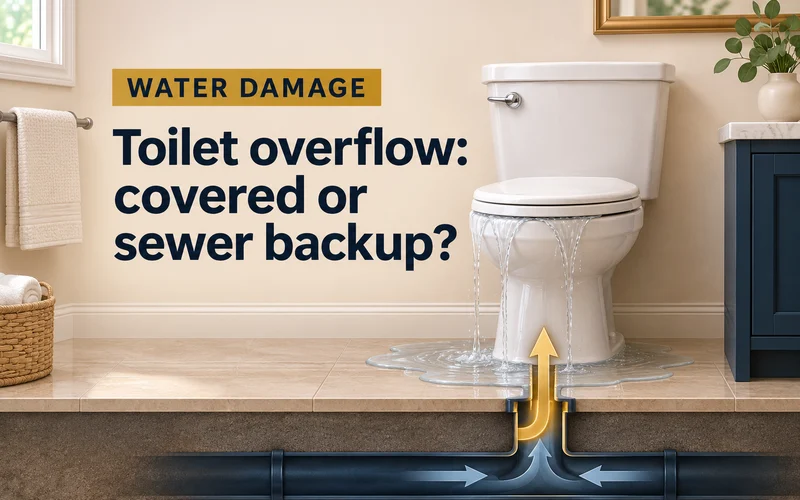
Water heater leak insurance claim: what is paid besides the tank

A water heater leak insurance claim usually pays for what the water ruined, and usually not for the water heater. If the tank split or a fitting let go and soaked the basement, a standard Illinois homeowners policy tends to cover the wet drywall, flooring, carpet, drying equipment and your belongings, minus the deductible. The tank itself, and the labour to swap it, stay with you unless something like a fire damaged it or you bought an equipment breakdown endorsement.
When a claim like this is disputed, the dispute is usually over whether the water came out all at once or seeped for weeks. This guide reads the policy sentences that decide that, shows one basement claim worked through in numbers, and lists what to keep before the old heater goes to the scrapyard. We are licensed Illinois public adjusters, not attorneys, and your own policy governs.
The three zones of one leak, and which of them the policy pays
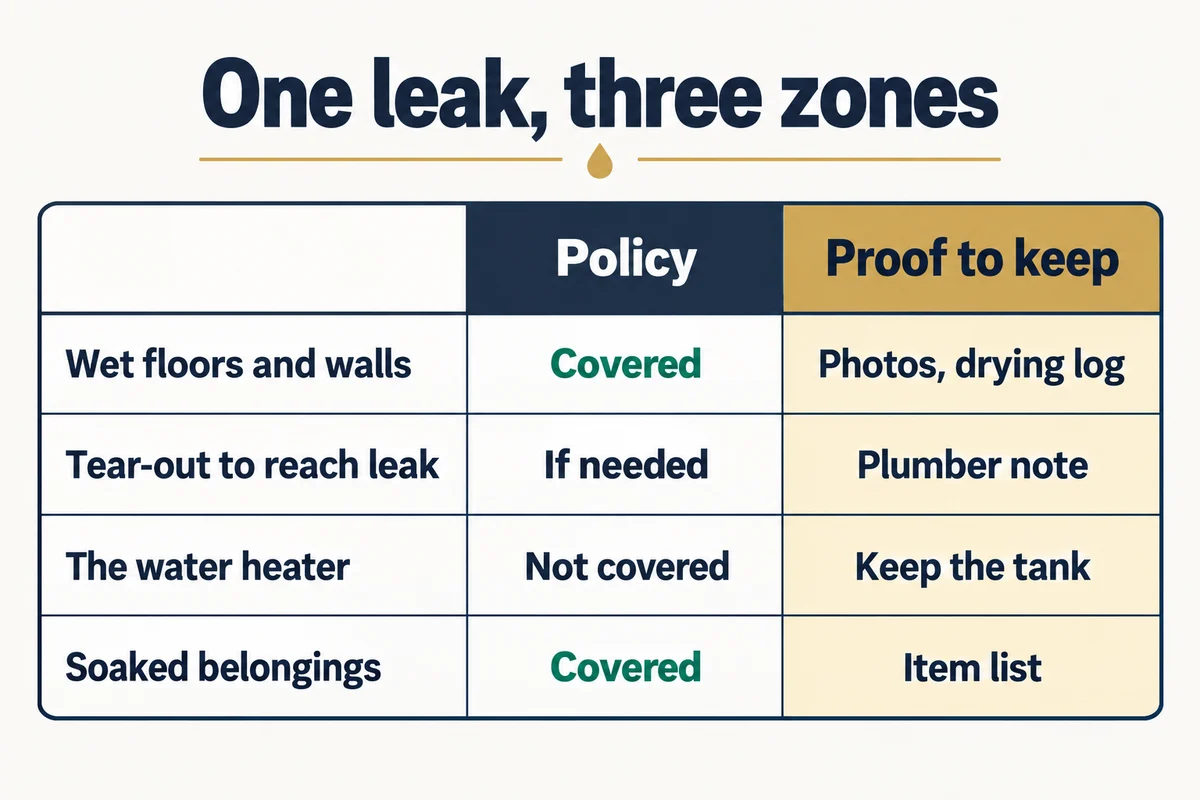
Every dollar in a water heater claim sits in one of three zones: the appliance that failed, the building you had to open to reach it, and everything the water touched. The policy treats each zone differently, so the first job is to sort the bills that way before anyone argues about totals.
The water heater
Your cost in most policiesThe widely used special form gives back cover for water escaping from a household appliance, then takes back the appliance itself: it does not cover loss to the system or appliance from which this water or steam escaped.
A worn tank is also wear and tear, which the dwelling cover excludes on its own.
Opening the house to fix it
Paid when it was neededThe same provision pays to tear out and replace part of the building, but only when that was necessary to repair the system or appliance.
A free-standing tank rarely needs it. A supply line inside a finished wall, or a heater boxed into a closet, often does.
Everything the water reached
Paid unless excluded elsewhereFloors, walls, trim, cabinets and the cost of drying them fall under the dwelling cover. Soaked furniture, boxes and electronics fall under personal property, which names accidental discharge from an appliance as a covered cause.
The wording quoted above is from the ISO Homeowners 3 special form, edition 03 22, as reproduced in a line-by-line analysis published by IRMI. Many carriers use that form or one close to it. Some write their own, so read the water provisions in yours before you rely on any of this.
Burst, drip or rust: how the leak gets read
The carrier decides coverage from what the leak looked like. A tank that split and dumped forty gallons overnight reads as a sudden discharge. A tank that wept under its base for a month reads as continuous seepage, which most policies exclude. The evidence you keep tells the adjuster which of those happened.
| What you found | How it tends to be read | What supports a sudden reading |
|---|---|---|
| Tank split at a seam, standing water across the floor | Sudden discharge from an appliance. The usual covered case. | Photos taken when you found it, the plumber's written note of where the tank opened, the time the drying crew started. |
| A fitting or nipple on top of the tank broke off | The broken part is wear and is not paid. The water it released can still be a covered discharge. | Keep the failed fitting. Ask the plumber to write that it parted, not that it had been dripping. |
| Water came from the relief valve or its pipe | Still water escaping from the appliance. The carrier will ask why the valve opened. | The plumber's finding on the valve and on the tank's temperature or pressure at the visit. |
| Rust ring under the tank, swollen baseboard, musty carpet | Often argued as seepage over weeks, and denied as gradual. | When the room was last seen dry and by whom, moisture readings that show how far the water spread, and anything that hid the leak, such as a finished floor or stored boxes. |
We cover the general rule, and why the exact seepage wording in your policy matters, in our guide to sudden versus gradual water damage.
One finished basement, worked through in numbers
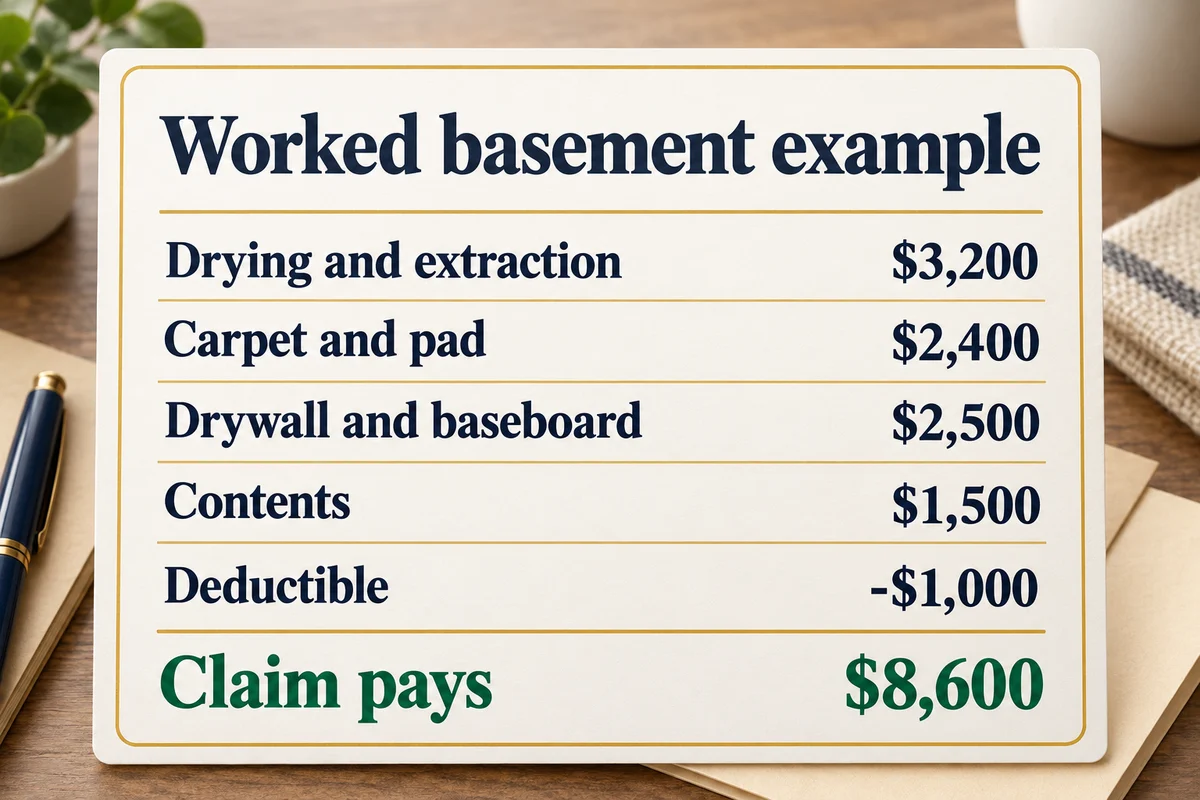
The zones become clearer on a single claim. The figures below are an example we made up to show the arithmetic, not a quote and not a result of ours: a 50-gallon tank in a finished basement splits overnight, and the water reaches the carpet, the bottom of the drywall and a storage corner. The policy has a $1,000 deductible.
| Line | Zone | Amount |
|---|---|---|
| Water extraction and three days of drying equipment | Everything the water reached | $3,200 |
| Carpet and pad, removed and replaced | Everything the water reached | $2,400 |
| Lower drywall cut out, replaced, baseboard and paint | Everything the water reached | $2,500 |
| Stored belongings ruined in the corner | Personal property | $1,500 |
| Deductible | -$1,000 | |
| New water heater and installation | The appliance: not part of the claim | $1,900 |
| Claim pays in this example | $8,600 |
The sum is $3,200 + $2,400 + $2,500 + $1,500 = $9,600, less the $1,000 deductible, which leaves $8,600. The $1,900 tank sits outside the claim entirely. Notice that it is the only line the owner pays from pocket besides the deductible, and it is the line most people assume the claim is about.
If the carrier pays the building lines at actual cash value first, meaning their worth after depreciation, the first cheque will be smaller than this and the rest comes after the work is done. Your mortgage company may also be named on the cheque for the building part.
When the tank itself is paid
The water heater is part of your house, so it is covered like any other part of the house when a covered cause damages it from outside. The exclusion bites when the tank fails on its own. These are the usual routes to having it paid:
- A fire, a lightning strike or a falling tree damaged the heater. Then the heater is a damaged part of the dwelling like the wall next to it.
- Your policy carries an equipment breakdown endorsement. Carriers sell it as an add-on for sudden mechanical or electrical failure of home systems; one Illinois HO-3 product summary from January 2025 lists it at up to $100,000 with a $500 deductible.
- A contractor or plumber caused the failure. Their liability insurer may owe the tank and the water damage, which is a separate claim beside your own.
A home warranty or service plan is a contract with that company, not insurance, and it follows its own terms.
Two lines on newer Illinois policies that can cap the claim
Before you count on the example above, look at the water section of your declarations and endorsements for two things that have spread through Illinois homeowners policies.
A fixed seepage period. Older forms excluded leakage over weeks, months or years without a number. Some current forms draw the line at a set count of days: the same 2025 Illinois product summary covers repeated seepage only if it lasted less than 14 days.
A water damage sublimit tied to the age of the house. That summary caps water damage at $10,000 for homes over 20 years old unless the policy is endorsed back up to full limits. On a basement like the one above, a $10,000 cap would still cover it. On a two-storey leak from an attic or upstairs closet heater, it might not.
Neither line is in every policy, and the numbers differ from carrier to carrier. If you find either one, it changes what you document first: dates for the seepage period, and a full scope early if a cap is in play.
What to get on paper in the first two days
You are expected to stop the water and protect the house before the adjuster comes, so cleanup does not hurt your claim. Throwing away the evidence can. In this order:
- Close the cold-water valve on the pipe above the heater. Turn the gas control to off, or switch off the heater's breaker if it is electric.
- Photograph the floor, the tank from all sides, the spot where the water came out and the rating plate, before anyone moves anything. Our guide on what to photograph after property damage lists the shots that matter.
- Report the claim to your carrier the same day, and write down the claim number and the time.
- Have the plumber write on the invoice what failed, where, and how it failed. A line such as tank shell split at lower seam carries more weight than replaced water heater.
- Keep the old tank, or at least the failed part, until the carrier's adjuster has seen it or told you in writing that you may dispose of it. Ask the plumber not to haul it away.
- Let a drying company set equipment and keep its daily moisture log. Those bills and logs are part of the claim, as our guide to emergency mitigation costs explains.
- Before carpet or drywall goes in the dumpster, photograph it and cut a small sample of the carpet and pad to keep.
Wet drywall and carpet that sit for days can grow mold, and mold is usually paid only within a small sublimit and only when the water that caused it was covered. Fast drying protects the claim as much as the house.
Where a public adjuster fits in a water heater claim
Most water heater claims are small enough to handle yourself with the steps above. The ones worth a second look are the claims the carrier has called gradual, the ones where the scope stops at the carpet when the drywall and cabinets were wet too, and the losses that spread upstairs. We read the policy against the evidence, write a full scope of the water damage claim and negotiate it with the carrier for a percentage of the recovery, with nothing upfront. If yours has stalled, send us the denial letter or the estimate and we will tell you whether there is more in it.
Questions we get about this
Does homeowners insurance replace a water heater that burst?
Usually not. The widely used homeowners form covers water that escapes from a household appliance but excludes loss to the appliance it escaped from, and a worn-out tank is also wear and tear. The damage the water caused to floors, walls and belongings is usually covered. The tank is paid when an outside covered cause such as fire or lightning damaged it, or when the policy has an equipment breakdown endorsement. Your own policy governs.
Will my claim be denied because the water heater was old?
Age on its own is not what most policies exclude for the water damage. The question is whether the water escaped suddenly or seeped over time. Age does matter for the tank, which is excluded anyway, and some newer Illinois policies lower the water damage limit on houses over a certain age. Photos, the plumber's note on how the tank failed and when the area was last seen dry carry more weight than the tank's age.
Is mold after a water heater leak covered?
Mold is usually covered only within a small sublimit and only when the water that caused it was covered, so a sudden tank failure gives a much better position than a slow drip. Starting drying within a day or two and keeping the drying company's moisture logs is the best protection for both the house and the claim.
Should I call a plumber before the insurance adjuster comes?
Yes. You are expected to stop the water and protect the house from further damage, and the reasonable cost of doing so is normally part of the claim. Photograph everything first, ask the plumber to write down what failed and how, and keep the old tank or the failed part until the carrier has seen it or agreed in writing that you may discard it.