Filing a complaint with the Illinois Department of Insurance over a property claim

An Illinois Department of Insurance complaint is a free, written request that the state's insurance regulator check how your insurer handled your claim. It works well on handling problems: letters nobody answers, a denial with no written reason, money the carrier agrees it owes but has not paid. It does not work on the size of the claim. The Department says plainly that it does not decide facts such as the value of damaged property, so a complaint that only says the estimate is too low usually comes back closed.
We are licensed Illinois public adjusters, not attorneys. What follows comes from the Department's own complaint process page, its property and casualty complaint form (June 2026 edition) and the claim handling rules in Part 919 of the Illinois Administrative Code. Your own policy governs your claim.
Which complaints the Department can act on
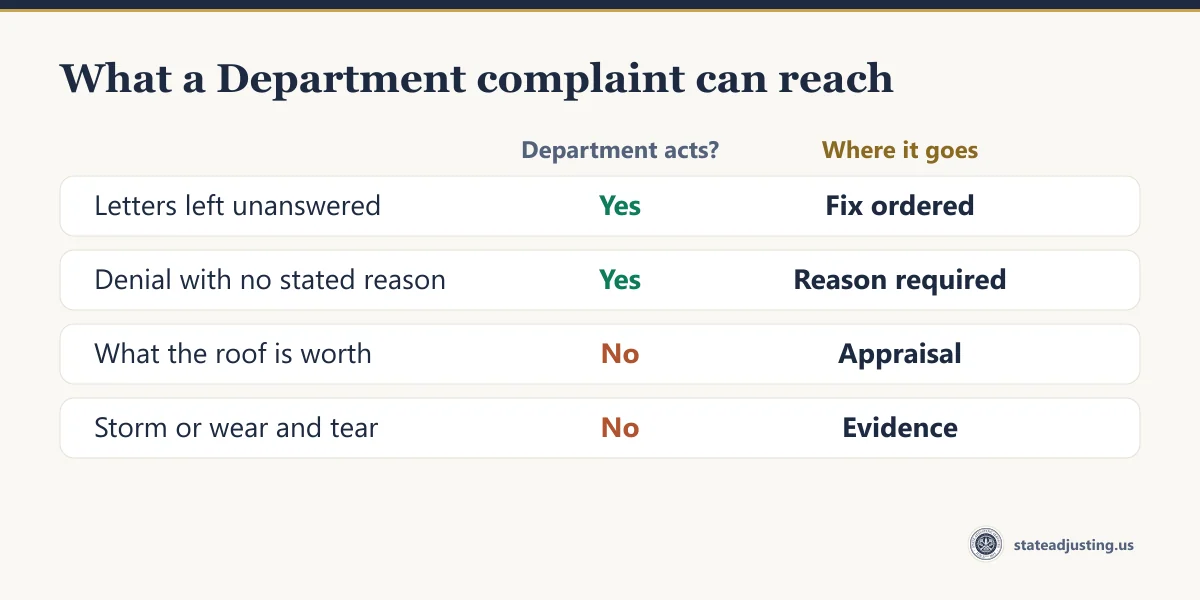
Sort your problem before you write a word. The Department reviews whether the company followed Illinois insurance law and the policy, then asks for corrective action when it did not. Problems that sit on the left side below are the ones that law speaks to. Problems on the right are disagreements about facts or money, and the Department's page lists them among the things it cannot do.
Handling problems the rules cover
- No decision on the claim within a reasonable time. Part 919.50(a) requires the company to affirm or deny liability within a reasonable time.
- A denial or a lower offer with no written explanation, or one that does not name the policy definition, limitation, exclusion or condition it relies on. Section 919.50(a)(1) gives the company 30 days after its investigation is complete.
- A denial letter sent without the Notice of Availability of the Department of Insurance, which the same subsection requires on a first-party denial or lower offer.
- An amount the company accepts but has not paid. The undisputed part of a claim is due within 30 days once liability is accepted and the payee is known.
- A denial that rests on a phone call or interview nobody wrote down in the claim file, which 919.50(b) does not allow.
- Letters, supplements and requests that go unanswered for weeks.
Disputes the Department says it does not decide
- What the damaged roof, siding or contents are worth. The Department's page names the value of damaged property as a fact it cannot determine.
- Whether the damage came from the storm or from age. That is also a question of fact, and it is answered with evidence on the building.
- Your account against the adjuster's account of a conversation, when neither side has it in writing.
- Whether you have a legal case. The Department does not act as your lawyer or give legal advice.
Most stuck property claims have something in both piles. The useful complaint is built only from the left one, and the money question goes down a different route, which we come back to below.
What happens after you file, step by step
The Department accepts complaints only in writing. After that the path is the same for a burst pipe in Peoria or a hail roof in Naperville, and the clock that matters most is the insurer's, not yours.
- Before filing: one written attempt with the companyThe Department asks you to contact the company first and keep notes of each call: the person's name, the date, a short summary. A dated email to the claim handler and the supervisor is the cleanest version of that record.
- FilingOnline through the Department's help center at idoihelpcenter.illinois.gov, or the completed form emailed to DOI.complaints@illinois.gov, or by fax to (217) 558-2083. Send copies, never originals. Questions before filing go to the consumer line, (866) 445-5364.
- A file number, in writingThe Department assigns a number and sends it to you. Every later email or call quotes it.
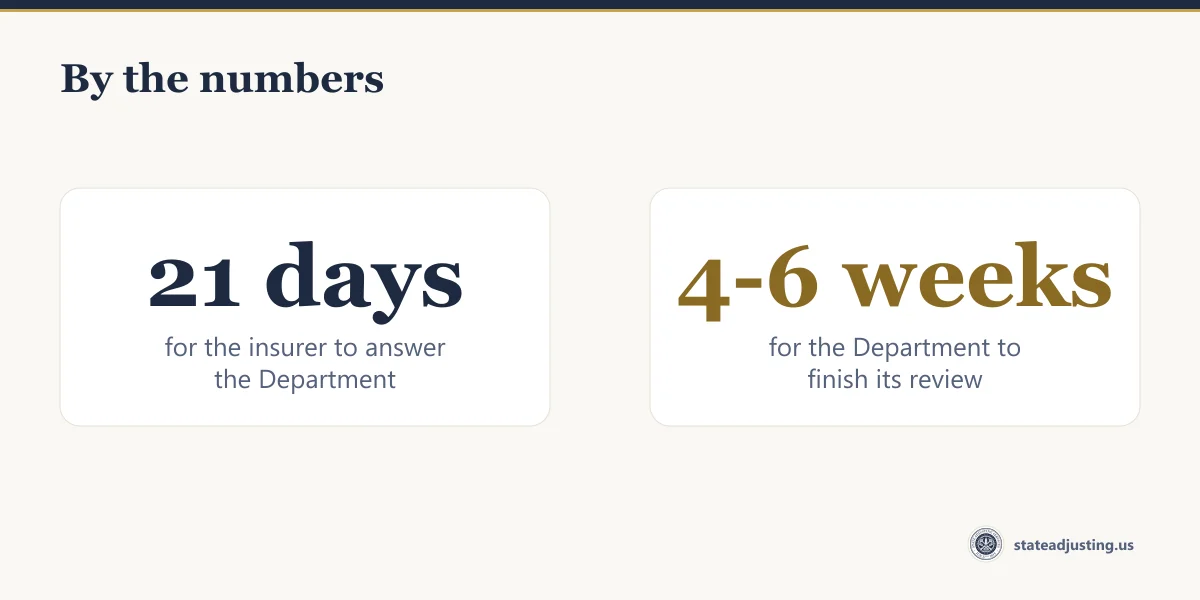
- A copy goes to the insurerThe company receives your complaint and, under Illinois law, has 21 days to respond to the Department.
- An analyst reads both sidesThe Department asks you to allow four to six weeks for its investigation to finish.
- A written resultOne of four outcomes: the complaint is resolved and closed; a violation is found and corrective action is requested; the company's response or investigation was incomplete and it must finish it; or no violation is found and the letter says why.
Nothing in that sequence stops your own claim deadlines. The suit limitation in the policy, the proof of loss request and the replacement cost notice keep running while the complaint is open. Our post on the deadlines that end claims in Illinois lists them, and none of them waits for the Department.
The complaint form, line by line
The property and casualty form is two pages. Most of it is plain identification, but four boxes decide whether the analyst can do anything with what you send.
| Line on the form | What to put there | Where people go wrong |
|---|---|---|
| Has this complaint been filed before? | Yes and the old file number, if you complained about this claim already | Leaving it blank opens a second file and splits the record |
| Date of loss, policy number, claim number | Copied from the company's own letters | A date of loss from memory that does not match the claim file |
| Individual completing this form, relationship to insured | Self, or Public Adjuster if your adjuster prepares it | Thinking a public adjuster can file alone. The form says a complaint filed by anyone else must carry the insured's signature |
| This complaint is against | My insurance company, for a claim on your own policy | Ticking the third-party box, which is for a claim against someone else's insurer |
| Signature and authorization | Your signature and date | An unsigned form. The signature is what lets the Department obtain the information it needs |
| Cancellation or non-renewal section | Skip it unless your complaint is about the policy ending | Missing that a hearing may be available if the documents arrive at least 20 days before the termination date |
| Please describe your complaint | Dates, what you sent, what has not been answered, the policy wording if a denial quotes it | A page about how unfair the estimate is, with no dates |
| What do you consider a fair resolution? | Something the rules require: a written decision naming the provision, payment of the amount already agreed | Asking the Department to order a specific settlement figure |
The form also carries a notice that complaints are confidential records, released only to the policy owner or an authorized representative and to the party complained against.
A worked example: nine weeks without an answer
A complaint from the left pile is built from dates and documents. The claim below is invented for this article; the dates and amounts show the method.
A homeowner in DuPage County has a hail claim with a June 9 date of loss. The company paid the first estimate. On July 14 the homeowner emailed a supplement for $7,240: the rear slope that was never measured, $5,180, and gutters and downspouts, $2,060, with photographs and a contractor's line items attached. Follow-up emails went on July 28 and August 11. No reply, no request for more information, no decision. On September 15 the homeowner files. The description box reads:
Claim number on file, date of loss June 9. On July 14 I sent the company a written supplement for $7,240 covering the rear roof slope and the gutters, with photographs and itemized pricing. I followed up in writing on July 28 and August 11. Copies of all three emails are attached. As of today the company has not acknowledged the supplement, asked for more information, or given a decision.
Fair resolution: a written decision on each line of the supplement that names the policy provision relied on for any part not paid, and payment of any part the company accepts.
Notice what it leaves out. It does not argue that the rear slope is worth $5,180, because that is the value question the Department will not decide. It asks for the thing the rules require: an answer, in writing, with a reason. If the company then pays $5,180 and refuses the gutters with a cited exclusion, the handling problem is solved, and what remains is a disagreement about the claim itself.
When the problem is the amount, not the handling
If the company has answered, in writing, with a reason, and you still think the number is wrong, a complaint is the wrong tool. The routes that can move a number are different ones.
- A documented supplement with evidence attached to each line, sent to the claim handler. Most scope differences close this way, because they are about what was measured, not about price.
- The appraisal clause in the policy, which settles the amount of loss through two appraisers and an umpire. Our guide to the appraisal clause covers when it fits and when it does not.
- A licensed public adjuster, who prepares and negotiates the claim for you under a written contract. We explain how we work a claim from inspection to payment.
- An attorney, when the dispute is about coverage, a legal question, or a suit deadline. Our post on public adjuster or attorney sorts which problem goes where.
These are not either-or with a complaint. A homeowner can file over nine weeks of silence and, once a decision arrives, take the remaining amount to appraisal.
What to send with the complaint
- The declarations page and the claim number.
- Every letter from the company, including any denial and the policy wording it quotes.
- Your own letters and emails, with dates, and a short call log.
- The estimate or supplement the company has not answered, with the photographs that support it.
- If anything is missing from what the company has sent you, a note saying so. Our article on requesting your claim file shows what a complete file holds.
If your claim is stuck and you are not sure which pile it belongs in, send us the letters. We review the file at no cost and tell you whether the problem is the handling, the amount, or both.
Questions we get about this
Does it cost anything to file a complaint with the Illinois Department of Insurance?
No. Filing is free. The Department accepts complaints in writing through its online help center, by email to DOI.complaints@illinois.gov, or by fax, and you can call its consumer line at (866) 445-5364 with questions first.
How long does an insurance complaint take in Illinois?
The insurer has 21 days under Illinois law to respond to the Department, and the Department asks you to allow four to six weeks for its investigation to finish. You receive a written explanation of the result.
Can the Department of Insurance make my insurer pay more on my claim?
Not on a disagreement about value. The Department says it does not determine facts such as the value of damaged property. It can require corrective action when the company broke an insurance law or did not follow the policy, for example by not giving a written reason for a denial.
Can a public adjuster file the complaint for me?
A public adjuster can prepare the form, and the form has a box for it, but the Department requires the insured's signature on a complaint filed by anyone else. Your own claim deadlines keep running while a complaint is open.