The Insurance Appraisal Clause: A Quiet Way Out of a Stuck Claim
Appraisal is a clause in most property insurance policies that settles a disagreement about the amount of a loss without a lawsuit. Each side appoints an appraiser, the two appoint an umpire, and a written agreement signed by any two of the three sets the figure. It decides money, not coverage — and each side pays its own appraiser.
When a claim stops moving, it is usually not because anybody has refused it. It is because two estimates for the same building sit thousands of dollars apart and neither side will move again. The appraisal clause is the paragraph written for exactly that situation: a private, contractual way to have the amount of the loss decided by people who write estimates for a living, rather than by a court. Most homeowners and commercial property forms contain one. The wording differs between carriers and between policy years, so read the appraisal paragraph on your own form before you rely on anything here.
What is the appraisal clause in an insurance policy?
It is a dispute-resolution provision inside the policy. When you and your insurer fail to agree on the amount of loss, either side may demand appraisal in writing. Each party appoints an appraiser, the two appraisers select an umpire, and a figure agreed in writing by any two of those three becomes the amount of the loss.
Three features of it matter more than the mechanics. First, it is contractual, not judicial — nobody files anything with a court to start it, and the process runs on the policy's own timetable. Second, it is available to both sides: a carrier can demand appraisal as readily as a policyholder, and sometimes does when it believes an estimate is inflated. Third, and least known, standard homeowners wording states that the insurer still keeps its right to deny the claim even after an appraisal has taken place. An award fixes a number. It does not, by itself, force payment of something the carrier maintains is not covered.
The award is also settled through the rest of the policy, not around it. The deductible still applies, policy limits still cap what is payable, and on replacement cost coverage the actual cash value is paid first with the withheld depreciation recoverable when the work is completed and invoiced — the pattern we set out in our guide to ACV versus replacement cost. Appraisal changes the size of the loss, not the terms it is paid under.
What can appraisal decide, and what can it not?
Appraisal is built for quantities and prices: how much damage there is, what the repair costs, what depreciation applies. It is not built for coverage questions — whether the cause of loss is covered, whether an exclusion applies, whether a condition of the policy was met. Those are decided elsewhere.
| Appraisal is built for | Appraisal is not built for |
|---|---|
| How much of the roof, siding or interior is damaged, and what replacing it costs | Whether the damage came from a cause of loss the policy covers |
| Which line items belong in the estimate, and the unit prices attached to them | Whether an exclusion — wear and tear, maintenance, earth movement — applies |
| The depreciation applied to those line items | Whether a policy condition was breached, or the policy was in force |
| Contents entries that you and the carrier value differently | Allegations about how the claim was handled, and any penalty attached to them |
The line between the two columns is not always clean, and that is where most arguments about appraisal happen. A dispute over whether a particular slope was hit by hail or was simply old looks like scope to one side and like causation to the other. Courts in Illinois and elsewhere have had to decide that boundary case by case, on the wording in front of them. We are licensed public adjusters, not attorneys, and nothing here is legal advice: if the disagreement is really about why the damage is there rather than how much of it there is, that is the point to speak to an attorney before demanding anything.
How does an appraisal actually run?
A written demand, two appraisers, one umpire, one award. The clock in the table below reflects the wording common in standard forms; your policy sets its own numbers, and the appraisal paragraph on your form is the one that governs. Nothing in the process is filed with a court unless the two appraisers cannot agree on an umpire.
| Step | What happens | The clock in standard wording |
|---|---|---|
| 1. Written demand | Either party demands appraisal in writing, against the claim number | Set by the policy; some forms require an impasse first |
| 2. Appraisers named | Each party chooses and pays its own competent appraiser | Commonly 20 days after the written request is received |
| 3. Umpire selected | The two appraisers agree on an umpire between them | Commonly 15 days; failing that, either may ask a judge to select one |
| 4. Inspection and exchange | Both appraisers inspect the property and exchange line-item positions | Not fixed by the policy |
| 5. Award | Any two of the three sign a written agreement on the amount of loss | Not fixed by the policy |
| 6. Payment | The carrier pays the award under the policy terms | Governed by the claim-payment provisions |
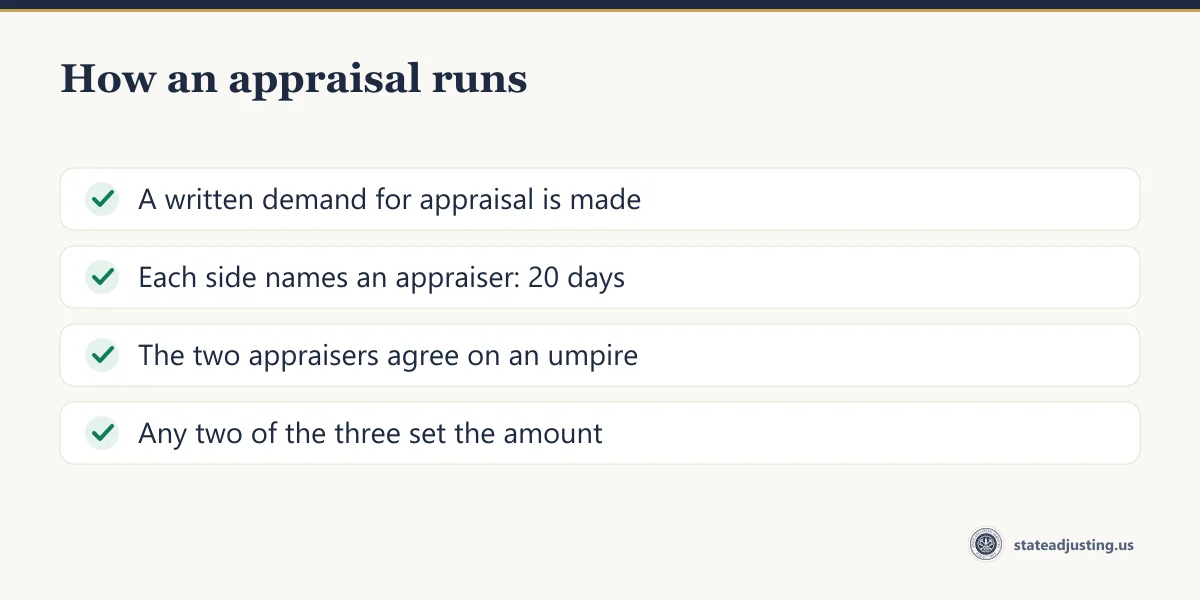
Two practical notes. Most forms require a competent appraiser and many now add impartial, sometimes with a duty to disclose any interest in the outcome — which means the person you appoint should be able to build and defend a line-item estimate, not simply advocate for a number. And the umpire is only reached on the items the two appraisers cannot settle between them; in most files they agree on the large majority of the scope and the umpire breaks a much shorter list than either side expected.
What does appraisal cost, and who pays?
Under the wording in most forms, each party pays its own appraiser and the two share the umpire's fee and the other expenses of the appraisal equally. Those costs are not added to the award and not reimbursed by the carrier. Appraisal is a real expense that you carry whatever the outcome.
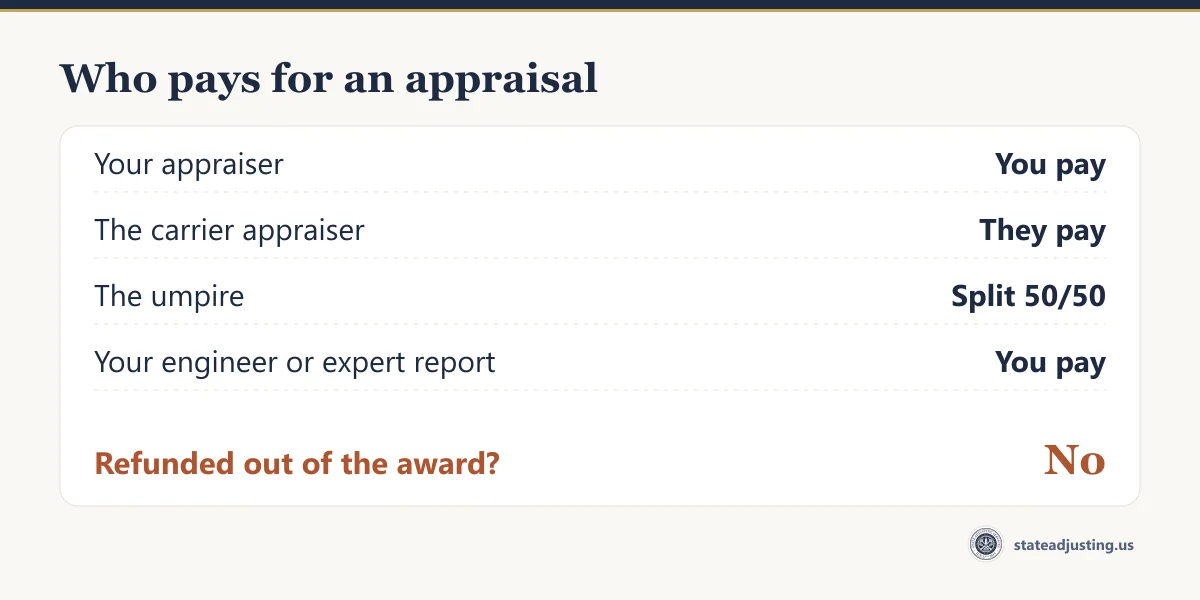
That single fact decides most appraisal questions before anything else does. Appraisers charge either by the hour or on a stated basis agreed in advance; umpires charge for their time; an engineer's report, if the file needs one, is separate again. Ask your appraiser for the fee basis in writing, add a realistic half-share of the umpire, and set the total beside the gap between the two estimates. If the gap is a few thousand dollars, the arithmetic often says no. If it is tens of thousands, it usually says something different. Do the subtraction on paper rather than in your head — it is the honest test of whether the disagreement is worth the process.
When is appraisal the right move — and when is it not?
It fits a narrow, well-defined problem: both sides agree the loss is covered, both have written a full estimate, and the two numbers will not converge. It fits badly when the disagreement is about coverage, when your own documentation is thin, or when the gap is smaller than the cost of closing it.
It tends to fit when:
- Coverage is not in dispute — a claim has been accepted and paid in part, and the argument is about how much.
- Both sides have a complete line-item estimate, so there is something concrete to compare.
- The gap is large enough to survive the cost of the process, and is made of measurable items rather than opinions.
- Ordinary steps have already been used. A properly built supplement resolves a great many disagreements at a fraction of the cost, and should generally come first.
It tends not to fit when:
- The claim has been denied outright rather than underpaid — that is a coverage decision, and the first steps are different ones, which we set out in what to do in the first week after a denial.
- The real argument is about causation: whether hail, wind or age put the damage there.
- Your side of the file is still incomplete. Appraisal compares documents; the party with the weaker documentation does not improve inside the process.
- A policy deadline is close. Suit-limitation and proof-of-loss provisions run on their own clocks, and appraisal does not automatically pause them.
What to prepare before you demand appraisal
Everything that makes your number checkable. An appraisal is decided on documents and an inspection, so the file you hand your appraiser is very close to the outcome you get.
- A complete line-item estimate with units, quantities and unit prices in the format the carrier uses — not a lump sum and not a contractor's proposal.
- The carrier's estimate, in full, including every revision. The disagreement can only be measured line against line.
- Dated photographs of every area in dispute: a wide shot that places it on the building, then close-ups with something in frame for scale.
- Measurements and a diagram for anything counted — squares, linear feet, sheets, rooms.
- The documents behind contested items: the code section or permit condition, the manufacturer's installation instruction, the supplier's dated quote.
- The claim correspondence in date order, so the impasse itself is on the record rather than in memory.
- The appraisal paragraph from your own policy, printed. The deadlines, the umpire mechanism and the cost split all come from that page.
What to do next
If your claim is stuck, establish first which of the two problems you actually have. If the carrier says the damage is not covered, appraisal is not the tool. If the carrier agrees it is covered but its estimate is short, then compare the two estimates line by line, write down the gap, and put the cost of appraisal next to it. In many files a documented supplement closes the difference before the clause is ever needed.
Keep the deadlines in view while you do it. Proof-of-loss and suit-limitation provisions run from the date of loss, not from the date the argument began. If either is close, get advice quickly rather than continuing to negotiate. The Illinois Department of Insurance also takes consumer complaints about claim handling.
We handle residential and commercial property claims across Illinois, and stuck claims are a large part of the work — our storm damage and hail damage pages set out how we scope each one, the process page describes how a claim runs with us in it, and past clients describe how it went on our reviews page. If you would like somebody to read your file and tell you where the gap really is before you commit to appraisal, our free claim review costs nothing. When we are engaged, our fee is a percentage of what we recover, agreed in writing and regulated by Illinois law, with $0 owed upfront. We answer the phone Monday to Friday, 8:00 AM to 5:00 PM, on (630) 297-8136.
Questions we get about this
Is an appraisal award binding on me and my insurance company?
As to the amount of loss, generally yes — that is the point of the clause. A written agreement signed by any two of the three sets the figure, and the carrier then pays it under the policy terms, with the deductible and any limits applied. Setting an award aside afterwards is a court matter available on limited grounds, which is legal ground rather than adjusting, so take advice before assuming an award can be revisited.
Can my insurance company force me into appraisal?
In most forms either party may demand appraisal, so a carrier can invoke it too. What it cannot do is use appraisal to decide a coverage question, because the clause is written for the amount of the loss. Read your own appraisal paragraph when a demand arrives: it sets the deadlines you have to meet to appoint your appraiser, and missing them can leave the choice being made for you.
How long does an insurance appraisal take?
The policy usually fixes only the first two steps — commonly 20 days to name appraisers and 15 days for them to agree on an umpire. Everything after that depends on scheduling the inspection and on how far apart the two estimates are. Files where the appraisers agree on most of the scope close much faster than files where the umpire has to price a long list of contested items.
Do I still pay a public adjuster if my claim goes to appraisal?
Our fee is a percentage of the recovery, agreed in writing and regulated by Illinois law, with nothing owed upfront — that arrangement does not change because a claim reaches an impasse. The appraisal process itself carries separate costs: under most policy wording each side pays its own appraiser and the umpire's fee is shared equally, and those are not reimbursed out of the award.