Can your insurer depreciate labor on an Illinois home claim?

Can your insurer depreciate labor on an Illinois home claim? If your homeowners policy doesn't define actual cash value, the Illinois Supreme Court's answer is no: only the structure and materials take the deduction. If your policy's definition names labor, that ruling doesn't settle it for you. So the answer sits in one definition in your policy and a few lines of your estimate.
Actual cash value is the first payment on most replacement cost policies, and depreciation is the amount held back from it. We are licensed Illinois public adjusters, not attorneys, so this page explains how to read your documents and isn't legal advice. Every estimate below is an example we made up to show the arithmetic.
Which sentence in your policy decides it?
The definition of actual cash value decides it, or the absence of one. Look in the Definitions section, in Loss Settlement and in every endorsement listed on your declarations page. Then match what you find to one of these three rows.
No definition of actual cash value anywhere
This is the policy in the Sproull decision, 2021 IL 126446, filed September 23, 2021. The court held that "depreciation may not be applied to the intangible labor component."
A definition that mentions depreciation and never mentions labor
Sproull ruled on an undefined term, so it doesn't answer this wording directly. Your exact sentence matters here, and an attorney can tell you how Illinois courts would read it.
A definition saying labor, or all components of the cost, can be depreciated
Sproull doesn't reach this contract. The insurer in that case told the court it had already amended its Illinois policy to say so. What remains open is whether the deduction was figured correctly.
Read the edition in force on the date of loss, because a renewal packet can add an endorsement that changes the definition. Keep the ruling's scope in mind as well. The question the court answered concerned a damaged structure under a homeowner's policy, so it didn't decide contents or commercial building claims. If your claim is one of those, the policy wording is your starting point. Our guide to reading a homeowners policy shows where these sections usually sit.
What does labor depreciation look like on an estimate?
Usually it has no label at all. Most estimate lines price material and installation as one figure, and the depreciation column shows one deduction against it. You can't see labor being reduced, so you look for the pattern instead.
The opinion describes that pattern. The written estimate in the case had 26 lines, and depreciation for materials and labor was applied to seven of them, including painting walls and ceilings. None of the labor-only items were depreciated, such as moving contents, removing and replacing drywall and sealing surfaces. The court also noted that the estimating program allows depreciation of materials only, and that "A separate box must be checked to depreciate labor."
| Example line | Cost new | Depreciation | What to notice |
|---|---|---|---|
| Tear off old shingles | $1,350 | $0 | Labor and disposal. A zero here says nothing about the other lines. |
| Laminated shingles, installed | $6,400 | $2,560 | Material and labor share one price. Exactly 40% came off the whole line. |
| Underlayment, installed | $900 | $360 | The same 40% again, on another combined price. |
| Flashing, installed | $420 | $84 | A different percent, since this part has a different age or life. Test it separately. |
| Paint ceiling, two coats | $780 | $312 | Mostly a labor job, and paint is a low material cost. A large deduction deserves a question. |
How do you test one line yourself?
Compare two percentages. If the deduction on a line equals the age of the item divided by its expected life, it was probably taken from the entire price, labor included. You need the estimate and the insurer's depreciation worksheet. This test uses the shingle line above.
- $2,560 / $6,400Depreciation divided by the line's full cost gives 40%.
- 10 / 25 yearsAge divided by expected life, taken from the worksheet, also gives 40%. The two match.
- $2,700 x 40%If materials were $2,700 of that line, depreciating materials alone would take $1,080, which is about 17% of the line.
A match is a reason to ask, and it doesn't prove anything by itself. A condition adjustment or a maximum depreciation setting can move the percentage, and you may not have the split between material and labor until someone gives it to you. Our post on reading the carrier's estimate explains the other columns on the page.
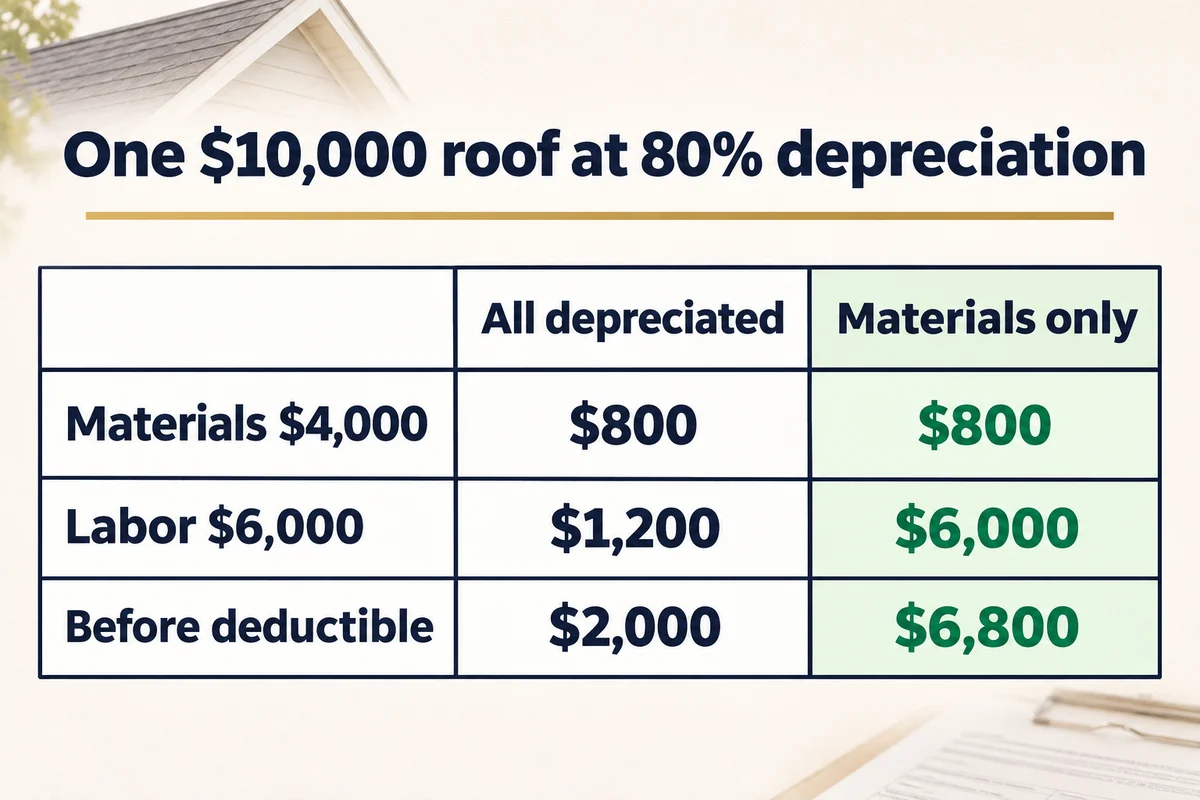
The size of the gap comes straight from the case. The insurer offered the court a $10,000 roof with $4,000 of materials and $6,000 of labor, and an 80% factor applied to everything left $2,000. Depreciating materials alone leaves $800 plus the $6,000, or $6,800. That's a $4,800 difference on one roof, before the deductible. The insurer called the higher figure an overpayment. The court answered that "the labor cost of installing old materials would be the same as the cost to install brand new materials."
When does the difference actually cost you money?
It depends on whether a second payment is coming. On many replacement cost claims the depreciated labor comes back with the holdback once the repair is done, so what you lose is cash at the start. On other claims nothing comes back, and the first figure is the final one.
| Your situation | What happens to the labor deduction |
|---|---|
| Replacement cost, repair finished on time | It normally returns when you collect the recoverable depreciation, up to what you actually spend. Until then, you're funding that part of the work. |
| Replacement cost, repair stopped or never started | It stays off. See what happens when you keep the money and don't repair. |
| Roof on an actual cash value schedule | There's usually no second check, so the deduction is permanent. Read the wording of your roof endorsement, since it may define the term itself. |
| Small loss close to the deductible | The first check can nearly vanish. In Sproull, $1,711.54 of damage less a $1,000 deductible and $394.36 of depreciation left $317.18. |
The first row can still matter a great deal. A contractor usually wants a deposit, and a smaller first check may be what stands between you and starting the job. The plaintiff in the case made that argument about policyholders being left short of funds. Time limits for the second payment are set by each policy, so check yours. The one in Sproull allowed two years to finish and 30 days to give notice afterward.
What should you ask the insurer for in writing?
Ask for the worksheet, because Illinois gives you a right to it. On residential fire and extended coverage, 50 Ill. Adm. Code 919.80(d)(8)(A) says that on your request the company "shall provide a copy of the claim file worksheet(s) detailing any and all deductions for depreciation," including the property's age, condition and expected life. An email is enough to start, and it gives you a dated record.
Claim number: [number]. Date of loss: [date].
Under 50 Ill. Adm. Code 919.80(d)(8)(A), please send me the claim file worksheets detailing all deductions for depreciation on this claim, including age, condition and expected life.
Please also tell me, line by line, whether any depreciation was applied to labor. If it was, please identify the policy provision and form number you are relying on.
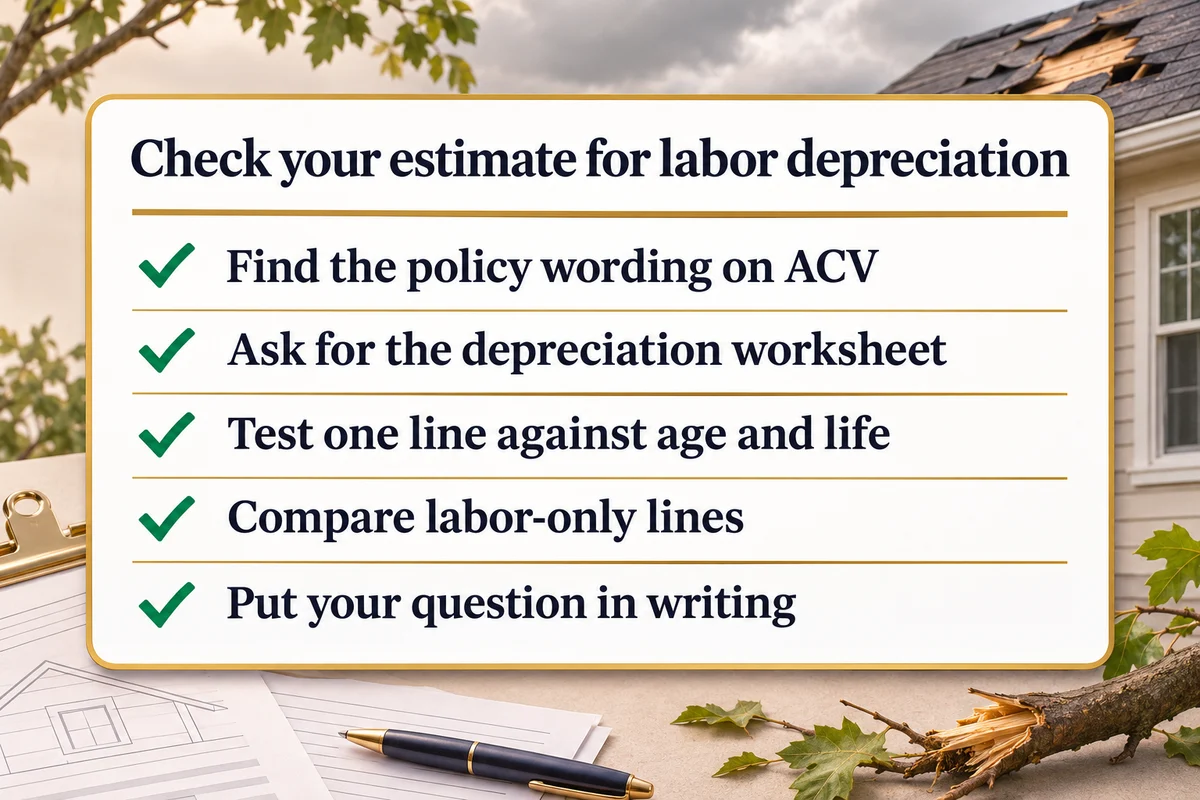
What you do with the reply depends on what it says. If the worksheet shows labor was depreciated and your policy has no definition, ask for a corrected first payment and quote the holding. If you want everything behind the numbers, you can request your complete claim file. If the insurer doesn't respond, a complaint to the Illinois Department of Insurance is available to any policyholder. On an older claim, the 2021 date doesn't reopen anything by itself, so talk to an attorney about time limits and read our notes on Illinois claim deadlines.
Getting a second reading of your estimate
Depreciation is one column, and the scope beside it is often where the larger differences are. A line that's missing altogether never gets depreciated or paid. When we read a file for a hail damage claim or a storm damage claim, we check both against the policy and the damage. Our process page shows how a file runs from there.
To have us look, send the estimate, the worksheet and your declarations page through the contact page, or call (630) 297-8136. The review is free. Our hours are Monday through Friday, 7:00 AM to 7:00 PM, plus Saturday and Sunday, 9:00 AM to 5:00 PM. Hiring us costs $0 upfront: our fee is a percentage of what's recovered, set out in a written agreement, and there's no fee if nothing is recovered. What an insurer finally pays depends on the policy and the damage, and nobody can promise that figure.
Questions we get about this
Can insurance companies depreciate labor in Illinois?
Where a homeowners policy doesn't define actual cash value, the Illinois Supreme Court held in 2021 that depreciation may not be applied to the labor component of a damaged structure. A policy that defines the term to include labor is a different contract, so your own wording governs.
How do I know if my insurer depreciated labor?
Estimates rarely label it. Ask for the depreciation worksheet, then divide a line's depreciation by its full cost and compare that with the item's age divided by its expected life. A match suggests the whole price was depreciated, which is a reason to ask the insurer in writing.
Does the Illinois labor depreciation ruling apply to contents or commercial buildings?
The question the court answered concerned a damaged structure under a homeowner's policy. It didn't decide contents or commercial building claims, so start with the wording of that policy and ask an attorney how it would be read.
Will I get depreciated labor back after repairs?
On many replacement cost policies, yes, as part of the withheld depreciation, up to what you actually spend and within the policy's time limits. On an actual cash value roof schedule there is usually no second payment, so the deduction stays.