Emergency Mitigation and Board-Up Bills: What the Carrier Pays

Emergency mitigation — tarps, board-up, extraction, drying — is paid under the policy's reasonable repairs provision when the loss itself is covered. It is not a separate pot of money: it sits inside your dwelling limit and inside the same deductible. Carriers rarely refuse mitigation outright. They argue about how long the equipment ran, whether a line was already paid in the repair estimate, and what the crew charged for it.
Emergency mitigation is the work done in the first hours after a loss to stop it getting worse: a tarp over the open slope, plywood over the broken glass, water pulled off the floor before it reaches the subfloor. It is also the part of a claim where a homeowner signs a contract at eleven at night, in the rain, without reading it — and where the argument about who pays the last two thousand dollars is decided.
We are licensed Illinois public adjusters, not attorneys. Nothing here is legal advice, and your own policy and declarations page govern your claim. What follows is how mitigation bills are normally handled, and what actually moves the parts that get held back.
What does the policy actually say about emergency work?
Two provisions, doing different jobs. Your duties after a loss require you to protect the property from further damage and to keep an accurate record of what you spend doing it. A separate reasonable repairs provision then pays the reasonable cost of necessary measures taken solely to protect covered property from further damage — but only if the peril causing the loss is covered.
Read together, that is a duty with funding attached rather than an optional extra. There is a matching exclusion on the other side: neglect, meaning the failure to use reasonable means to save and preserve the property at and after the time of the loss. A homeowner who leaves an open roof open through a second storm is not simply losing the tarp money — the additional interior damage can be argued away with it.
Is emergency work a separate coverage with its own limit?
No. Reasonable repairs does not increase the limit of liability on the damaged property — the emergency invoice consumes part of the same Coverage A limit as the permanent repair. There is no extra deductible either: one occurrence, one deductible, however many invoices arrive. Debris removal is the exception that behaves differently.
| Cost | Where it is paid from | The practical consequence |
|---|---|---|
| Tarp, board-up, extraction, drying, temporary heat | Reasonable repairs, inside the dwelling limit | Reduces what is left for the permanent repair if the limit is tight |
| Permanent repair of the same damage | The estimate, inside the dwelling limit | Priced as line items, depreciated the ordinary way |
| Removing debris of covered property | Debris removal, an additional coverage | Commonly an extra 5% of the limit when the loss plus removal exceeds it |
| Repairing the thing that failed | Often outside the claim entirely | The plumber's own repair is normally excluded; the water damage is not |
The limit point is quiet and occasionally expensive. On a house insured close to its rebuild cost, a $9,000 emergency invoice is $9,000 that the permanent repair can no longer reach. That only bites where the limit was already short — which is a separate problem worth checking on its own, and one we set out in what happens when Coverage A is short.
What do carriers actually argue about?
Almost never the principle. The four recurring disputes are duration, duplication, necessity and rate — and each is answered by a different document. None of them is answered by sending the invoice again with a note saying it was an emergency.
| The dispute | What the carrier is saying | What answers it |
|---|---|---|
| Duration | The equipment ran past the point the material was dry | The daily drying log with moisture readings against a stated drying goal |
| Duplication | This line is already in the repair estimate | Nothing — if it is genuinely on both, the deduction is correct |
| Necessity | Nine air movers were not needed in three rooms | Photographs of the affected area, the category of water, the room dimensions |
| Rate | The charge is above the regional price list | An itemised invoice in the same unit terms, or a written explanation of the difference |
| Coverage | The underlying loss is not covered | A coverage argument about the loss itself — the mitigation follows it |
Duration is the biggest single line on most water invoices, because equipment is billed per piece per day. Restoration contractors work to a published industry standard — the drying goal is set from a dry reference material in the same building, and readings are taken daily until the wet material reaches it. That log is the whole argument. A crew that produces it usually gets paid for the days it shows; a crew that produces an invoice and nothing else usually does not.
Duplication is the one worth accepting gracefully. If the emergency invoice charges to remove wet drywall and the repair estimate also charges to remove wet drywall, the carrier is not being difficult. Paying it twice is not owed, and pressing for it damages credibility on the items that are.
The document you sign in the first hour
The most expensive thing most homeowners sign in a claim is a one-page work authorization handed over on the night of the loss. It is a contract. Depending on what is printed on it, it can assign your insurance benefits to the contractor, direct the carrier to pay him instead of you, leave the price open, and make you personally liable for whatever the carrier declines to pay.
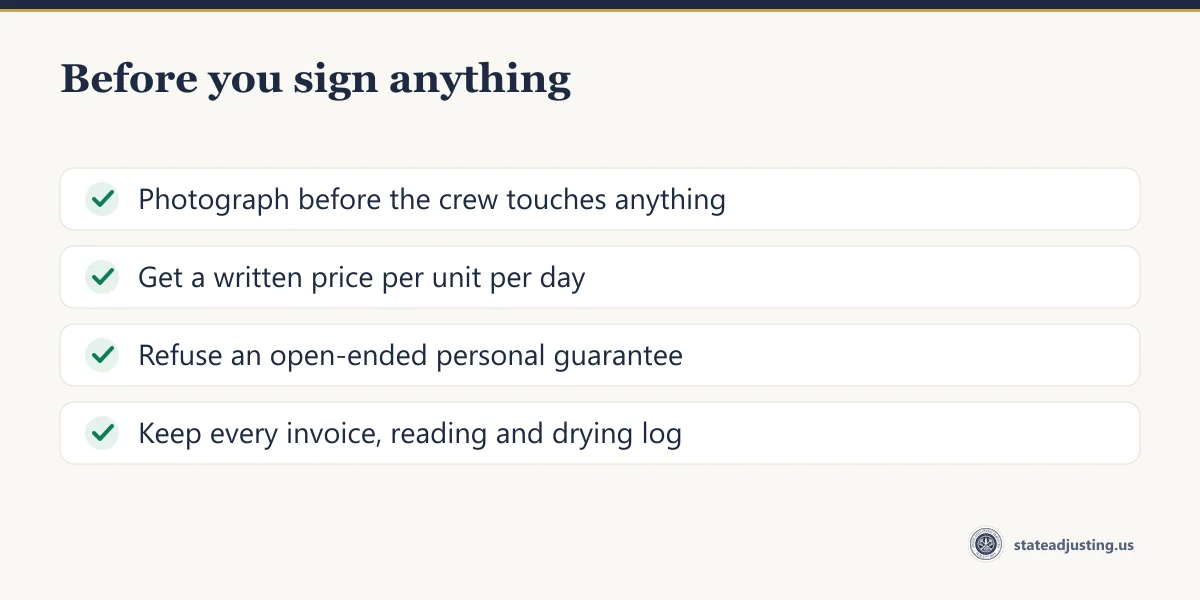
- Open price. "At prevailing rates" or "per industry standard pricing" is not a price. Ask what the equipment costs per unit per day and what the response call costs.
- Assignment of benefits. Signing your claim proceeds over to the contractor means the negotiation about his invoice happens without you, on your claim.
- Direct pay. Narrower and often reasonable — the carrier pays him directly for his work only. Read which of the two you are actually signing.
- Personal guarantee. The clause that makes the shortfall yours. Every dollar the carrier holds back lands here.
- No scope. An authorization that does not say what work is authorised authorises all of it.
Illinois generally requires a written contract and a consumer rights pamphlet for home repair work over $1,000 under the Home Repair and Remodeling Act (815 ILCS 513), and a contract signed at your home after a solicitation ordinarily carries a three-business-day right to cancel under 815 ILCS 505/2B. Asking for the pamphlet at midnight is not rude. It is the same check we describe in how to tell a contractor from a claim scheme.
A worked example
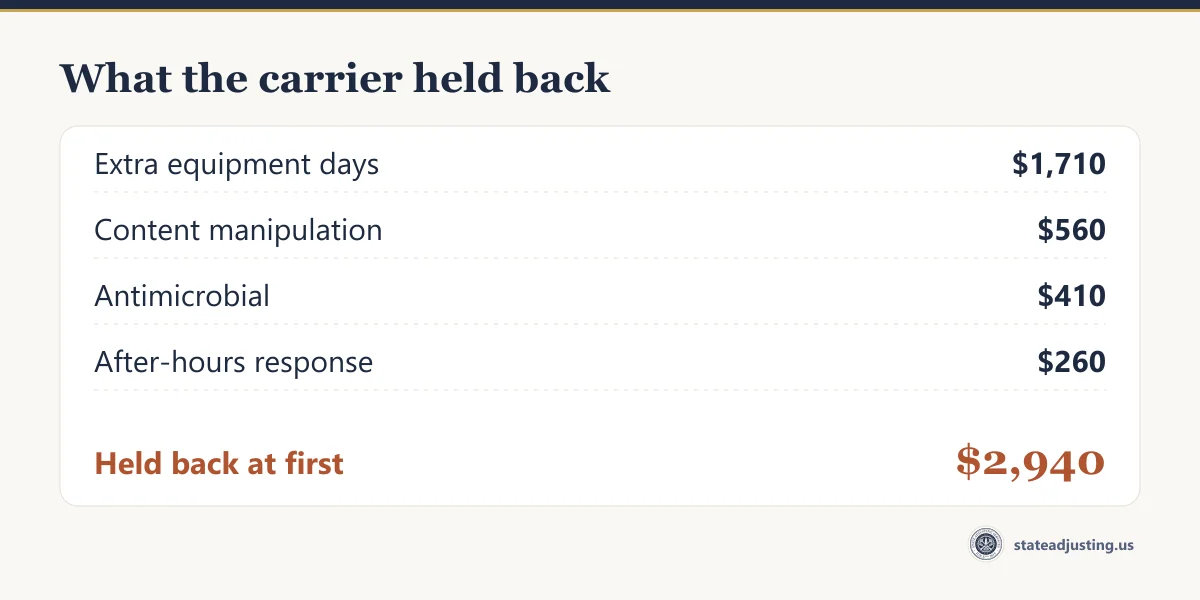
Illustrative arithmetic on a January windstorm, not a result of ours. Wind opened part of a roof at night and rain entered three rooms. The restoration crew arrived at 9:40 PM and invoiced $8,960 across six lines: roof tarp on 18 squares $2,640, board-up of 96 square feet of openings $780, extraction in three rooms $1,150, drying equipment for six days $3,420, antimicrobial application $410, and content manipulation $560.
The carrier paid $6,020 and held back $2,940.
| Held back | Amount | Reason given | Outcome |
|---|---|---|---|
| Equipment days five and six | $1,710 | Past the drying goal | Log showed the subfloor wet on day five — $855 restored |
| Content manipulation | $560 | Also in the repair estimate | Correct — not pursued |
| Antimicrobial | $410 | No documented need | Photographs of saturated carpet pad — restored |
| After-hours response | $260 | Rate above the price list | Carrier's own notice logged at 9:40 PM — restored |
| Total held back | $2,940 | $1,525 restored |
Final position: $7,545 of the $8,960 paid, $1,415 not. The permanent repair had already absorbed the $2,500 deductible, so the mitigation money came through without a second deduction. And because the homeowner had signed a direct-pay authorization with a personal guarantee, that remaining $1,415 was his to settle with the contractor — a bill created by a signature, not by a denial.
What to do in the first 72 hours
- Photograph before anyone touches anything. Mitigation destroys the evidence of the loss by design. Wide, then close, with a tape in frame — the method is in what to photograph before you touch anything.
- Report the loss the same day and say plainly that emergency work is starting. Notice is a policy duty and the timestamp becomes evidence later.
- Read the authorization before signing it. Price, scope, assignment, guarantee. Ask for the two Illinois documents.
- Ask for the drying log daily, with moisture readings and the drying goal, and for an itemised invoice rather than a lump sum.
- Keep your own receipts. Tarps, plywood, fuel for a generator, a space heater — materials you buy yourself are ordinarily reimbursable and are the easiest part of the file to lose.
- Keep the failed part and anything about to be discarded. On a water loss it decides the cause argument — see sudden versus gradual water damage.
If an emergency invoice on your claim has been cut and nobody has told you which of the four disputes each deduction belongs to, that is the point to get another set of eyes on the file. We handle storm damage claims, water damage claims and fire and smoke claims across Illinois, and our claims process page shows how a scope is documented and negotiated. Where a client chooses to use our construction partner for the permanent repair, that is always their choice and never a condition.
We will review the emergency invoice and the carrier's response at no cost and no obligation: send the declarations page, the invoice, the drying log if there is one, and the carrier's estimate. If we take the claim on, our fee is a percentage of the recovery, agreed in writing, capped by Illinois law and paid out of the settlement — nothing upfront, and no recovery, no fee. Reach us Monday through Friday, 7:00 AM to 7:00 PM, and Saturday and Sunday, 9:00 AM to 5:00 PM, at (630) 297-8136 or through our contact page.
Questions we get about this
Does insurance pay for emergency board-up and tarping?
Generally yes, where the loss that made them necessary is covered. The policy carries a reasonable repairs provision that pays the reasonable cost of necessary measures taken solely to protect covered property from further damage, and a matching duty requiring you to protect the property and keep a record of what you spend. If the underlying peril is not covered, the mitigation follows it. Your own policy wording governs.
Is there a separate deductible for emergency mitigation work?
No. One occurrence carries one deductible however many invoices arrive, so the emergency invoice and the permanent repair are settled against the same deduction. Reasonable repairs also sits inside the dwelling limit rather than adding to it, which only matters where the limit was already close to the cost of rebuilding.
Why did the insurance company cut part of my water mitigation invoice?
Usually for one of four reasons: equipment billed past the point the material reached its drying goal, a line already charged in the repair estimate, work whose necessity is not documented, or a rate above the regional price list. The daily drying log with moisture readings answers the first, photographs answer the third, and a duplicated line is generally a correct deduction rather than a dispute worth having.
Should I sign the restoration company’s work authorization?
Read it first. That one page can assign your insurance benefits to the contractor, direct payment to him, leave the price open and make you personally liable for anything the carrier declines. Ask for a written price per unit, a defined scope, and the written contract and consumer rights pamphlet Illinois generally requires for home repair work over $1,000. A contract signed at your home after a solicitation ordinarily carries a three-business-day right to cancel.