Your Contractor's Estimate Is Higher Than the Carrier's: How That Gap Gets Closed
When your contractor's estimate is higher than the insurance company's, the two documents are usually not describing the same job. Most of the difference is scope and quantity — items and amounts on one estimate and not the other — plus overhead and profit, which first estimates often leave off entirely. That part closes with documentation, line by line. A genuine disagreement about unit prices is normally the smallest piece and the hardest to move.
A contractor's estimate that is higher than the carrier's is the moment most homeowners conclude something has gone wrong. Usually nothing has yet. Two people looked at the same house, wrote down what they saw and priced it — and the gap between them is not one disagreement but five kinds of disagreement stacked on each other. Each closes by a different route, and four of the five have nothing to do with arguing about price.
We are licensed Illinois public adjusters, not attorneys. Nothing here is legal advice, and your own policy and declarations page govern your claim. What follows is how the gap is normally taken apart, and what actually moves each part of it.
Are you comparing the same two numbers?
Often, no. A contractor quotes the full cost to do the job. A carrier's estimate contains several different totals, and the cheque in the envelope is the smallest one. Before treating a difference as a dispute, find the replacement cost total on the summary page and compare the contract to that — not to the cheque.
| Number | What it states | Why it looks like a gap |
|---|---|---|
| Contractor's contract price | The whole job, including the contractor's own overhead and profit | It is a single turnkey figure with no deductions shown |
| Carrier's RCV | Replacement cost of the scope the carrier wrote | This is the number to compare against |
| Carrier's ACV | RCV less depreciation for age and wear | Always lower; not a reduction in what is owed |
| The first cheque | ACV less the deductible, and less any prior payment | Commonly 55–75% of RCV, and mistaken for the offer |
| Recoverable depreciation | Released after the work is done and invoiced | Invisible on day one, so the job looks unfunded |
Reading the summary page from the bottom up removes a surprising share of apparent gaps before anyone writes a letter. We set out how each of those lines is built in how to read the carrier's estimate, and how the withheld portion is collected in recoverable depreciation.
What is the gap actually made of?
Take the two documents apart line by line and every difference falls into one of five categories. This matters because the categories are not equally winnable, and they are not answered by the same evidence. Sending a bigger estimate addresses none of them.
| Kind of gap | What it looks like | What closes it |
|---|---|---|
| Scope | An item appears on one document and not the other | Photographs, measurements and a written request per line |
| Quantity | Both list the item; the amounts differ | The estimate's own sketch, checked against field measurements |
| Price | Same item, same quantity, different unit price | Rarely moves; ask which price list and date were used |
| Terms | Overhead and profit, depreciation, sales tax, waste | Reading the summary page and asking for the missing line |
| Coverage | The item is excluded, capped or called maintenance | A coverage argument — not a supplement |
Scope and quantity are usually the largest share, and the categories carriers move on, because they are questions of fact rather than of opinion.
How does a missing line item get added?
By a written supplement that treats each item separately: what it is, where it is, why it belongs to this loss, the quantity, and the evidence attached to that line. A supplement is not a request to raise the total. It is a request to add named items, decided item by item.
The items that go missing are predictable — the ones not visible from the driveway, or not needed on an undamaged house: tear-off of a second layer, ice barrier at the eaves, drip edge, ridge and hip cap, decking, detach-and-reset of anything mounted on the roof, gutters, the slope nobody walked, and painting carried to a natural break rather than stopped at a patch line. A contractor prices those because the job cannot be built without them. An estimate written from photographs may not.
- One request, itemised. Ten items in one letter, each with its own evidence, rather than ten letters or one lump sum.
- Evidence attached per line, not per letter — a photograph that shows the rear slope is evidence for the rear slope and nothing else.
- Quantities that can be checked: linear feet of eave and ridge, squares of roof, room dimensions. Say where the measurement came from.
- Ask for a written decision on each item, naming the provision if anything is refused. A partial approval is normal and is not a final answer on the rest.
The mechanics of filing one — including what makes a supplement different from reopening a closed file — are in how a claim gets reopened when hidden damage appears.
Why do unit prices almost never move?
Because the carrier is not pricing by opinion. Estimating software prices from a regional list tied to a month, and the code identifying that list sits in the estimate's header. The adjuster is generally not free to pay above it for a standard item, so an argument that a price is too low is really an argument about the list — a hard argument, and usually the smallest money on the page.
Two versions of the price question do move. The first is the wrong list: an estimate written on a list from months before the loss, in a period when material costs moved. Ask which list and date were used. The second is the wrong item: a low unit price is often a cheaper line selected — a repair where a replacement is required, a laminated shingle priced as a three-tab, a detach-and-reset where a remove-and-replace is needed. That is a scope question in a price question's clothes, and it is winnable.
Where does overhead and profit fit?
Overhead and profit — the cost of running the job and the margin on it, commonly written as 10% and 10% — is a general contractor's line, not a tradesman's markup. Where a repair is complex enough to need a general contractor to coordinate it, it is customarily included. Where it is absent from an estimate that clearly needs one, it can be the single largest component of the gap.
The working threshold most carriers apply is three or more trades. That is practice rather than an entitlement written into the policy, and it is worth stating plainly: a claim is not automatically owed 20% because somebody asked. Count the trades honestly, then ask for the line if the count supports it. And note the direction the arithmetic runs — on a $27,850 scope, 20% is $5,570, so this one line can be larger than every missing item combined.
The mirror image matters too. A contractor's turnkey price already contains his own overhead and profit, so adding a 20% general contractor line on top of a single-trade roofing contract is double-counting — the kind of request that costs credibility on the items genuinely owed.
A worked example
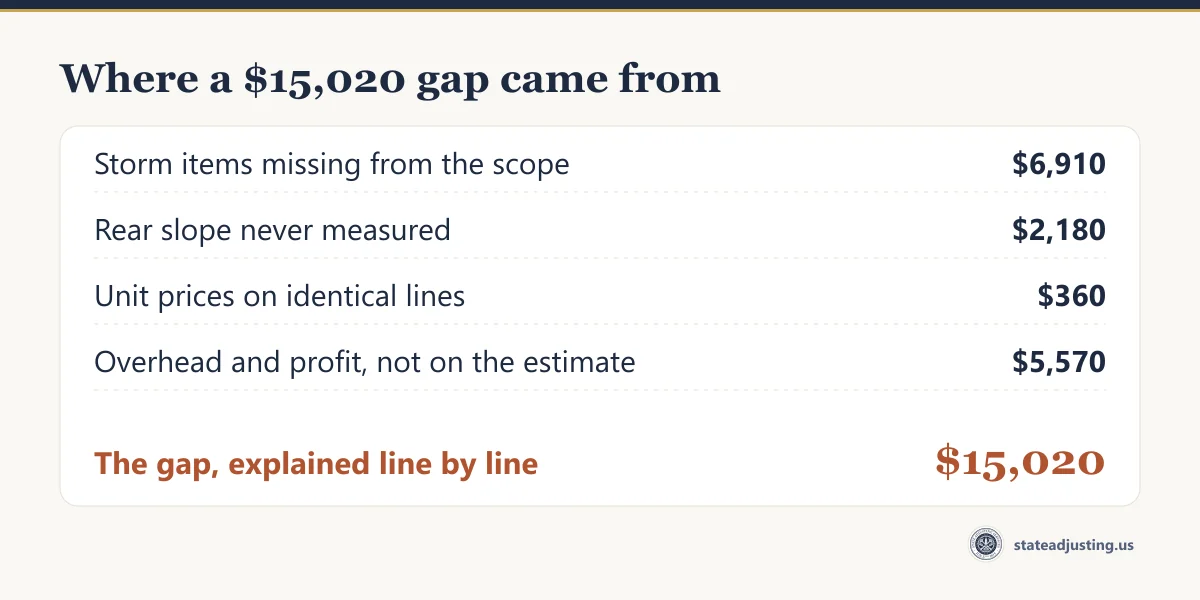
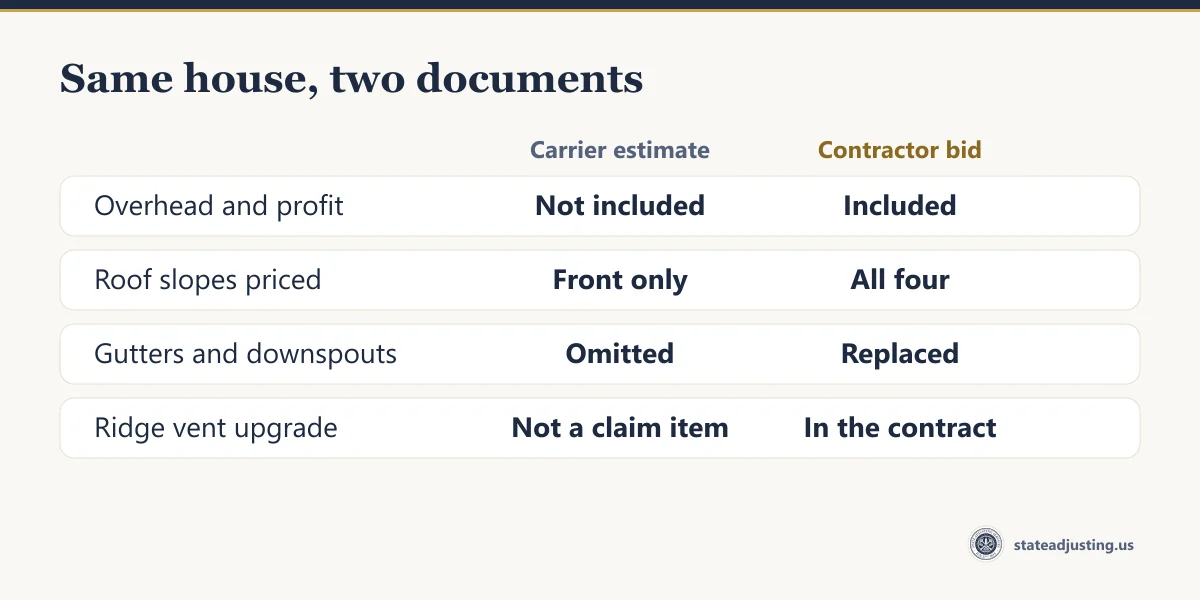
Illustrative arithmetic on a wind and hail claim, not a result of ours. The first estimate was written after an inspection of the front elevation only. The contract was $34,520 turnkey, including a $1,100 ridge vent upgrade the homeowner chose and no policy pays for — so its repair portion was $33,420, against a first estimate of $18,400. An apparent gap of $16,120.
| Component of the gap | Amount | Category |
|---|---|---|
| Ice barrier, drip edge, ridge cap, decking, detach-and-reset, gutters, ceiling paint to a natural break | $6,910 | Scope |
| Rear slope never measured | $2,180 | Quantity |
| Unit prices on identical lines | $360 | Price |
| Overhead and profit, absent from the first estimate | $5,570 | Terms |
| Ridge vent upgrade chosen by the homeowner | $1,100 | Not a claim item |
| Apparent gap | $16,120 |
Corrected, the line items came to $27,850. Overhead and profit at 10% and 10% added $5,570, taking replacement cost to $33,420 — the contract's repair figure, reached without anyone negotiating a price. Then the settlement ran the ordinary way: $6,180 of depreciation withheld left $27,240 in actual cash value, less a $2,500 deductible, for a first cheque of $24,740. The $6,180 was released after the work was completed and invoiced.
| Settlement | Amount |
|---|---|
| Corrected replacement cost | $33,420 |
| Less recoverable depreciation | −$6,180 |
| Less deductible | −$2,500 |
| First cheque | $24,740 |
| Second cheque on completion | $6,180 |
| Homeowner's share (deductible + chosen upgrade) | $3,600 |
Nothing in that file was ever denied. The $15,020 that moved was documentation, and the $1,100 that did not move was never insurance money to begin with.
What does not close a gap
- Emailing a bigger estimate with no explanation. Two totals in an inbox is not a comparison; the carrier has no line to approve.
- "My contractor says it should be more." The policy pays the reasonable cost to repair the covered damage. A contract price is useful evidence of what the work costs, not an amount the carrier agreed to.
- Having the contractor argue the claim. In Illinois a licensed roofing contractor may not negotiate or represent a claim — see why a roofer cannot negotiate your claim. He can supply measurements, photographs and an itemised scope, which is what is actually needed.
- Signing a contract for whatever the carrier approves. That is a blank cheque in both directions and removes any incentive to scope the job properly.
- Treating a coverage refusal as a scope problem. If code upgrades were excluded, no supplement fixes it; that is a question about ordinance or law coverage on your declarations page.
One honest counterweight: sometimes the contractor is simply expensive. If the scope matches line for line and the difference is a consistent markup across every item, the gap belongs to the contract rather than to the claim. A second itemised bid on the same scope settles that quickly.
When does appraisal fit?
Appraisal resolves the amount of a loss when the parties agree the loss is covered and disagree on how much. A pure scope-and-price gap is exactly what it was written for, so it can fit once the file has stopped moving. It is the wrong lever when the dispute is whether an item is covered at all, and it is not free — each side pays its own appraiser and shares the umpire. The appraisal clause explained covers the steps and the clocks.
What to do next
- Get both documents in full — the carrier's complete itemised estimate with the sketch and photo report, and an itemised contractor scope. Not a one-page total from either side.
- Line them up in a spreadsheet and mark every difference as scope, quantity, price, terms or coverage. The spreadsheet is the negotiation.
- Check the summary page first for O&P, sales tax, waste, prior payments and the price list date. Some of the gap usually disappears here.
- Send one itemised supplement with evidence attached per line, and ask for a written decision naming a provision for anything refused.
- Keep the two roles separate. Your contractor builds the repair; the claim is negotiated by you or by a licensed public adjuster. Our construction partner page explains how we keep that line clean, and using them is always your choice.
If your contractor's estimate is thousands above the carrier's and nobody has told you which of the five categories the difference sits in, that is the point to get another set of eyes on the file. We handle hail damage claims and storm damage claims across Illinois, and our claims process page shows how a scope is documented and negotiated.
We will compare the two estimates at no cost and no obligation: send the declarations page, the carrier's estimate and your contractor's itemised scope, and we will tell you plainly where the difference is and which parts of it are worth pursuing. If we take the claim on, our fee is a percentage of the recovery, agreed in writing, capped by Illinois law and paid out of the settlement — nothing upfront, and no recovery, no fee. Reach us Monday through Friday, 7:00 AM to 7:00 PM, and Saturday and Sunday, 9:00 AM to 5:00 PM, at (630) 297-8136 or through our contact page.
Questions we get about this
Why is my contractor's estimate higher than the insurance company's?
Usually because the two documents describe different jobs rather than different prices. The most common causes are line items the carrier's estimate omits, quantities taken from a partial inspection, and overhead and profit left off entirely. A genuine unit-price disagreement is normally the smallest part of the difference. Comparing the contract to the carrier's replacement cost total, rather than to the first cheque, removes a further share of the apparent gap.
Will the insurance company pay my contractor's price?
Not automatically. The policy generally pays the reasonable cost to repair the covered damage, so a contract price is evidence of what the work costs rather than an amount the carrier has agreed to. In practice the two figures converge when the carrier's scope is corrected item by item. Your own policy wording governs, and no outcome can be promised in advance.
Can my roofer negotiate the difference with my insurance company?
Not in Illinois. A licensed roofing contractor is barred from representing or negotiating a claim on a homeowner's behalf. He can and should supply measurements, photographs and an itemised scope, which is the evidence a supplement is built from. Negotiating the claim is the homeowner's own role, or that of a licensed public adjuster.
What is overhead and profit and am I owed it?
Overhead and profit is a general contractor's cost of running a job and the margin on it, commonly written as 10% and 10%. It is customarily included where the repair is complex enough to require a general contractor to coordinate several trades, and the working threshold most carriers apply is three or more trades. It is practice rather than an entitlement written into the policy, and a single-trade repair usually does not carry it.