Why a Roofer Cannot Negotiate Your Claim in Illinois
In Illinois a licensed roofing contractor may inspect your roof, write an estimate for the work and build the repair. What a roofer may not do is represent or negotiate your insurance claim — the Roofing Industry Licensing Act says so directly (225 ILCS 335/9.5). Adjusting a property claim on a policyholder's behalf is the work of a licensed public adjuster or an attorney. Two jobs, two licences, two different state agencies.
"We'll handle the insurance company for you." It is the most reassuring sentence a homeowner hears in the week after a hail storm, and in Illinois a roofer cannot legally negotiate your insurance claim — which makes it a sentence worth stopping on. Not because the person saying it is necessarily dishonest. Plenty mean it kindly, and plenty have said it for years without anyone objecting. But the state drew a line through the middle of that offer, and the claim it runs through is yours.
This guide covers what the statute actually prohibits, the long list of things a roofer is still free to do, what falls out of a claim when a roof bid quietly becomes the claim, and what to do if you have already signed paperwork that says a contractor will deal with your carrier. Two limits first. We are licensed Illinois public adjusters, not attorneys, so this is how the rules work in practice, not legal advice about your situation. And this is not an argument that contractors are the problem — we work beside one every week, and the separation described here is exactly why that arrangement works.
Why can't a roofer negotiate your insurance claim in Illinois?
Because the Roofing Industry Licensing Act says so. Section 9.5 bars a person licensed under the Act from representing or negotiating — or advertising or offering to represent or negotiate — on behalf of an owner or possessor of residential or commercial property on any insurance claim connected with repairing or replacing a roof system, or the indoor damage resulting from it.
Two words carry the weight: represent and negotiate. The prohibition is not about talking to insurers. It is about standing in the policyholder's place. And because the section also reaches advertising and offering, "insurance claim specialists" painted on a truck door is the same problem as the conversation at the door — the offer itself is covered, not only the follow-through.
Underneath that sits a second licence. Adjusting a property claim for a policyholder is licensed activity in Illinois, administered by the Department of Insurance, with its own application, examination and bond. Roofing is licensed separately by the Department of Financial and Professional Regulation. A roofing licence is not an adjusting licence, and it does not quietly become one because the contractor has read a thousand carrier estimates and is good at it. Some of them genuinely are.
The reason for the line is easier to see from the money than from the statute. A contractor who negotiates your settlement is negotiating the price of their own work, using your policy, with a third party paying. Even in the most honest version of that arrangement the incentive points one way: toward a scope that can be built profitably at a number the carrier is already close to, and away from the parts of the loss that pay for something other than roofing. That is not a character flaw. It is arithmetic, and it is the arithmetic the separation exists to keep out of your claim.
One more thing worth being clear about, because it is often assumed the other way round: the prohibition is enforced against the roofing licence, through the state. It does not make you an offender for having signed something, and it does not void your insurance claim.
What is a roofer actually allowed to do on your claim?
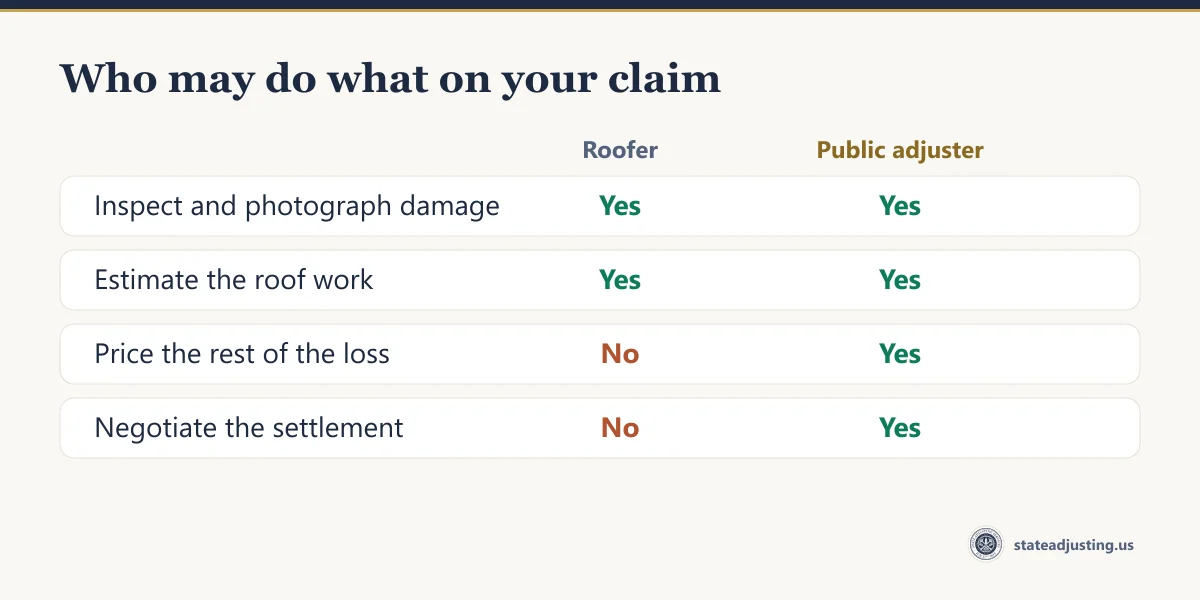
A great deal. A roofer can inspect the roof, photograph and measure the damage, tell you plainly what they found, write a detailed line-item estimate for the work they would perform, hand that estimate to you and to your insurer, meet the carrier's adjuster on site, walk the slopes with them and disagree out loud about what they see. Then build it.
| Task | Roofing contractor | Public adjuster |
|---|---|---|
| Inspect the damage, photograph and measure it | Yes | Yes |
| Write a line-item estimate for the roof work | Yes | Yes |
| Meet the carrier's adjuster on site and walk the damage | Yes | Yes |
| Read the policy and tell you what it owes | Not their role | Yes |
| Price the parts of the loss that are not roofing | Not their role | Yes |
| Represent you in the settlement negotiation | No | Yes |
| Build the repair | Yes | No — we do not do construction |
The useful distinction is between an estimate and an argument. Handing the carrier a written price for your own work is quoting a job, and every trade does it. Negotiating a claim is a different activity: it argues what the policy owes, whether the scope on the file matches the damage, whether depreciation was applied to labour it should not have touched, whether matching applies to the siding, whether an ordinance-or-law limit is in play, whether the loss date on the file is the right one. Those are policy questions. A roofing licence answers none of them, and a contractor who says "don't worry, I'll get it approved" is describing the second activity while holding a licence for the first.
What falls out of the claim when a roof bid becomes the claim?
The parts of the loss that are not roofing. A property claim can also owe gutters, siding that has to match, interior damage where water came through, detached structures, debris removal, code-required upgrades where the policy carries ordinance-or-law coverage, and the depreciation withheld from the first cheque. A roof bid prices a roof, because that is what it was written to do.
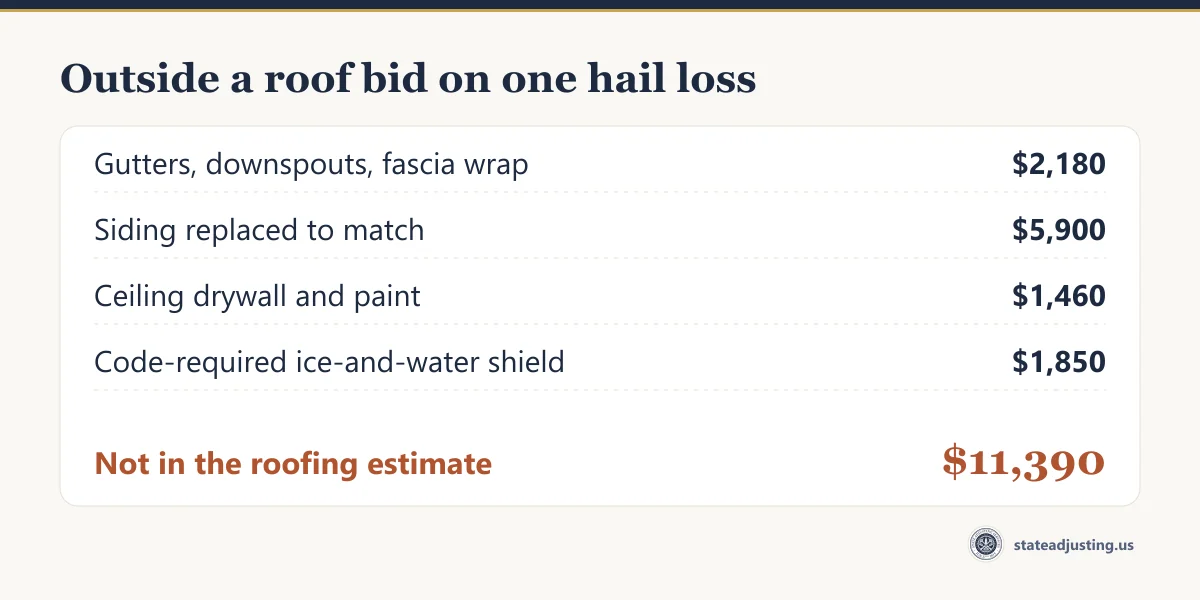
Here is that gap as arithmetic, on an illustrative hail loss on a two-storey Illinois house. These are worked example figures chosen to show the mechanics — not a result from any client file, and not a price list.
| Line | Amount | Why it belongs to the same loss |
|---|---|---|
| Roof replacement — the contractor's bid | $21,400 | The document the roofer was asked to produce |
| Gutters, downspouts and fascia wrap | $2,180 | Dented on the same elevations the hail struck |
| North and west siding, replaced to match | $5,900 | Where the policy owes a uniform result rather than a patch |
| Ceiling drywall, insulation and paint, two rooms | $1,460 | Interior damage where water entered through the roof |
| Ice-and-water shield required by current code | $1,850 | Payable only if ordinance-or-law coverage applies |
| Outside the roof bid | $11,390 | None of it appears in a roofing estimate |
Nobody hid any of that. It simply was not in the document. The same is true of the procedural moves that decide how much of an approved claim actually reaches you: going back for the withheld recoverable depreciation, filing a supplement when the deck is opened and the damage turns out to be worse, claiming additional living expenses if the house is unliveable, inventorying contents, invoking the appraisal clause when the file will not move. A contractor is not licensed to run any of it, is usually not paid to, and — on the honest end of the trade — will tell you so.
Matching is where this is most visible on hail claims, because it is the item most often argued and least often in a roof bid. We set out how Illinois policies treat it in our guide to roof and siding matching. Your own policy language governs, as always.
"My roofer does this all the time." What does that mean for you?
Usually it means nobody has objected yet. Enforcement runs against the licence, through the state, and complaints are rare mostly because homeowners have never heard of the rule. The exposure that matters to you is not enforcement, though. It is that you are relying on a representative you cannot verify, under an arrangement nobody wrote down properly.
- The claim stays yours. Your carrier's file is in your name, and the duties in the policy — prompt notice, proof of loss, producing documents, meeting the deadlines — remain yours whoever is making the phone calls. If a clock runs out while somebody else is "handling it", it runs out on your claim. We set out which clocks exist in deadlines that end claims in Illinois.
- There is no engagement to read. A public adjuster works under a written contract, with the licensee named, the fee stated as a percentage of the recovery and the whole arrangement regulated under Illinois law. A contractor's version of the same promise is normally one sentence buried inside a construction contract, with nothing said about what happens if it goes badly.
- The clause rarely travels alone. The same page often carries an assignment of your policy benefits, or a price defined as whatever the carrier approves. We took those apart in storm chasers at the door.
- The incentives are narrower than the loss. The roof is the contractor's revenue. Every hour spent arguing about siding, ceilings, contents or living expenses is an hour spent on somebody else's line item.
How to check who is licensed for which job
- Ask for the roofing licence number and look it up yourself. Roofing work in Illinois is state-licensed under 225 ILCS 335, and the number belongs on the contract, the bid and the advertising. The IDFPR licence search will confirm it.
- Ask for the public adjuster licence number of anybody who offers to deal with your carrier for you, and check it with the Illinois Department of Insurance. Ours is on our contract before you sign it.
- Compare the legal entity names across the truck, the business card, the certificate of insurance, the licence record and the contract. All five should be the same company.
- Ask one direct question: "Who will be speaking to my insurance company, and under which licence?" A straight answer takes four seconds. A vague one is the answer.
- Treat "we'll handle it", "we'll manage the claim", "we'll get it approved" and "we maximise your claim" from a roofing company as descriptions of work that licence does not cover.
What if you have already signed one?
Nothing irreversible has happened, and your claim is not tainted by it. Take three steps in order.
- Read the contract, particularly the paragraph above your signature. Find who is authorised to speak with the insurer, how the contract price is set, whether benefits were assigned, and what cancelling costs. If you signed at your door within the last three business days, Illinois consumer law gives a cancellation right for most home-solicited sales, and notice of it belongs in the paperwork.
- Call your carrier and ask who is currently listed as authorised on the file. Then confirm in writing who you want them to communicate with. Authority you granted can generally be withdrawn in writing — read what the contract says that costs before you send it.
- Separate the builder from the claim, rather than firing the builder. If the contractor is licensed, insured, and the work is good, keep them. What needs to change is who argues the policy. That is the whole logic of how we work with our construction partner: they build, we adjust, and using them is always the client's choice rather than a condition of anything.
If you believe a roofing licensee crossed the line, IDFPR takes complaints about its licensees and the Department of Insurance takes complaints about how a claim is being handled. If the situation has turned into a legal question rather than a claim question, that is the point to speak with an attorney — it is not something we do.
What to do next
If a storm has just gone through, the order that protects you is documentation, then notice to your carrier in your own name, then a scope, then a price — signatures last. Photograph everything before anything is covered or cleaned up, keep the receipts for tarps and emergency work, and do not agree to a price for a repair whose full extent nobody has established yet.
We handle hail damage, wind damage and storm damage claims across Illinois, residential and commercial, and a large share of that work is reading an estimate somebody else has already written and finding what is not in it. Our process page sets out how a claim runs with us on it, and past clients describe the experience on our reviews page. If a contractor has handed you paperwork and you want somebody to read it before you sign, our free claim review costs nothing and carries no obligation. When we are engaged, our fee is a percentage of what we recover, agreed in writing and regulated by Illinois law, with $0 owed upfront. We answer the phone Monday through Friday, 7:00 AM to 7:00 PM, and Saturday and Sunday, 9:00 AM to 5:00 PM, on (630) 297-8136.
Questions we get about this
Can a roofing contractor negotiate my insurance claim in Illinois?
No. Section 9.5 of the Roofing Industry Licensing Act (225 ILCS 335/9.5) bars a licensed roofing contractor from representing or negotiating — or advertising or offering to represent or negotiate — on behalf of a property owner on any insurance claim connected with repairing or replacing a roof system. Negotiating a claim for a policyholder is the work of a licensed public adjuster or an attorney.
Can my roofer talk to my insurance adjuster at all?
Yes. A roofer can meet the carrier’s adjuster on site, walk the damage with them, point out what they found, and provide a written line-item estimate for the work they would perform. The line falls between quoting their own work and negotiating what your policy owes. The first is what every trade does; the second requires a different licence.
Who licenses public adjusters in Illinois, and how do I check one?
The Illinois Department of Insurance licenses public adjusters, while roofing contractors are licensed by the Department of Financial and Professional Regulation. Ask anyone offering to deal with your carrier for their public adjuster licence number and the exact licensed name, then confirm both with the Department of Insurance before you sign anything.
My roofer has already been handling my claim. What should I do now?
Read the contract you signed, especially the paragraph above your signature, and check whether you assigned your policy benefits or agreed to a price set by whatever the carrier approves. Then ask your insurer who is listed as authorised on the file and confirm in writing who you want them to deal with. Your claim is not void, but the duties in the policy and the deadlines remain yours.