A second storm hit before the roof was repaired: how the claims split

When a second storm hits before the roof from your first claim was repaired, you usually have two claims, not one: two dates of loss, two estimates and, on most policies, two deductibles. The first claim stays open for the damage it already priced, including the depreciation the carrier held back. The second claim covers only what the new storm did. Most of the money lost in these situations is lost when the two get blended into one estimate, or when the phrase "prior damage" is allowed to swallow the new storm.
Every policy is worded a little differently, and your own form and endorsements decide each point below. We are licensed Illinois public adjusters, not attorneys, so read this as how these claims are commonly handled, not as legal advice.
Two dates of loss on one roof
A storm is an occurrence, and a later storm is another occurrence, even if only a few weeks separate them. What makes them separate is a different date, different weather and damage that is different in place or in kind. Here is a typical Illinois sequence, with example dates:
- Hail. Bruised shingles on the south and west slopes.
- Carrier inspects and writes a repair for those two slopes.
- First check arrives: actual cash value, minus the deductible.
- Roofer booked out. A tarp covers the worst of the west slope.
- Wind. Tabs lifted on the north slope, the tarp torn off.
- Rain through the open west slope stains a bedroom ceiling.
Gold: the first claim. Dark: the second claim.
The October wind is reported as a new claim with its own date. The June claim is not closed by it and is not replaced by it. If a single roof replacement ends up curing both, the estimates still have to show which dollars belong to which date, because the deductible, the depreciation already paid and any roof payment schedule apply claim by claim. Damage from the first storm that sits under hail and wind on your hail damage claim stays in that file whatever happens later.
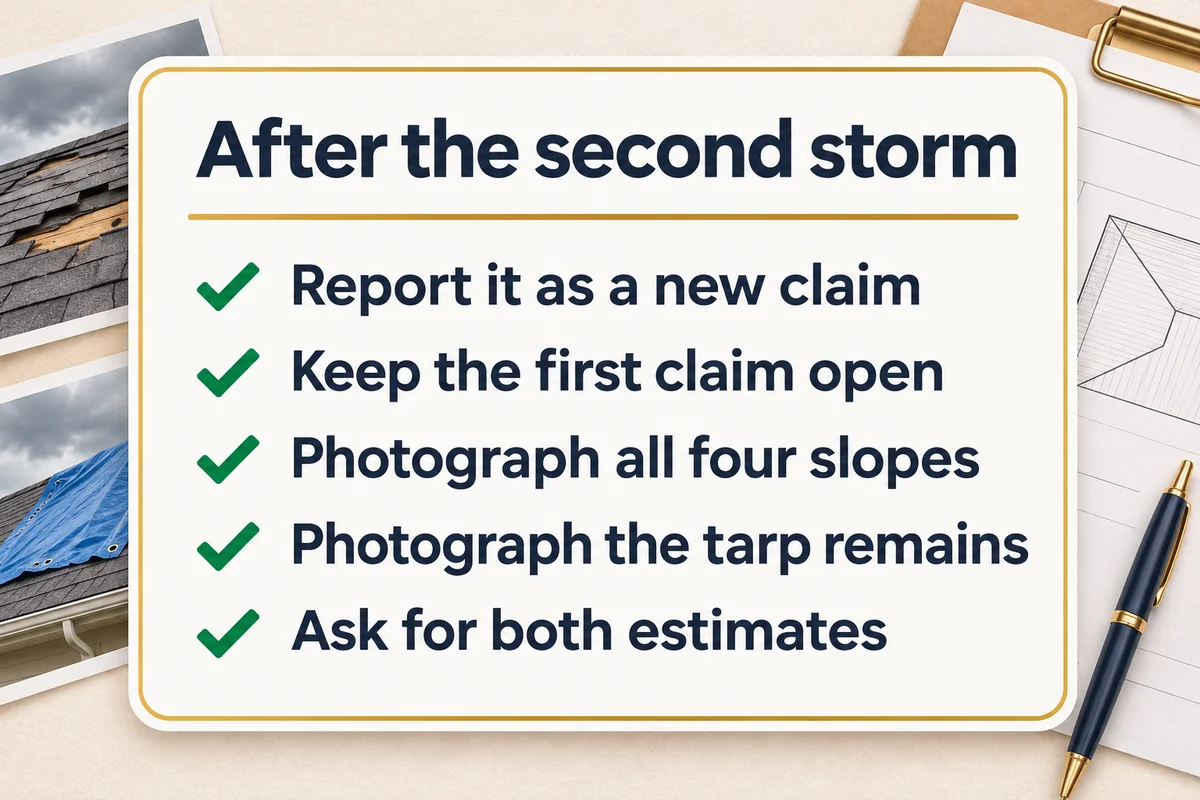
What "prior damage" in the letter is really arguing
The words "prior damage" or "pre-existing condition" in a letter can mean three different arguments, and each one is answered differently. Ask the adjuster which one is meant, in writing, before you respond.
| What the letter says | The argument behind it | What usually answers it |
|---|---|---|
| The damage predates this date of loss | The marks came from an earlier storm, so this claim does not owe them | Agree where it is true, and point to the earlier claim, which already owes them. Then show the damage that was not in the first photos. |
| The roof was in poor condition | Old damage lowers the value, so depreciation is taken for condition | Ask for the depreciation worksheet and check that the condition deduction is not charging you for damage the first claim is paying. |
| The roof was already a loss | A roof that needed replacing before the storm could not be damaged further | Show the roof was working: no leaks, a repair scope rather than a replacement in the first estimate, dated photos. |
The third argument is the one to watch. If the first carrier wrote a repair for two slopes in July, that estimate is evidence the roof was repairable in July. It is hard to call the same roof a total loss before October without contradicting the first file.
Which claim each item belongs to
Sort the damage before anyone writes the second estimate. The first inspection's photos and scope are the baseline, so get a copy and stand where the first adjuster stood. Anything in that scope belongs to the first claim, whether or not the shingles have been replaced yet.
| Item | First claim (June hail) | Second claim (October wind) |
|---|---|---|
| Hail bruises, south and west slopes | Yes, already priced | No, unless the wind added new damage there |
| Lifted or missing tabs, north slope | No, not in the June photos | Yes, new date, new damage |
| Tarp and its installation | Often paid as a reasonable repair | A replacement tarp after the wind tore it off |
| Fresh ceiling stain under the west slope | Only if it was already there in June or July | Yes, if the rain came in after the wind removed the tarp |
| Old dried stain, ringed and in the first photos | Yes, if it was in the first scope | No |
| Hotel or rental if the house became unlivable | From the day you left, if that was after the hail | From the day you left, if the second storm opened the ceiling |
The second estimate should say what it is not paying for, in plain words: north slope wind damage not present at the July inspection, priced here; west slope shingles remain in the June scope and are not priced again. Two sentences like these make the file readable a year later, when someone asks why a single roof was paid in two checks.
A worked example: one roof, two files
The numbers below are an example, not a result from any client, and your deductibles may be percentages rather than flat amounts. Our guide to percentage wind and hail deductibles shows how those are counted.
First claim, June hail
Repair, south and west slopes$9,400
Depreciation held back-$2,600
Deductible-$1,000
First check, paid in July$5,800
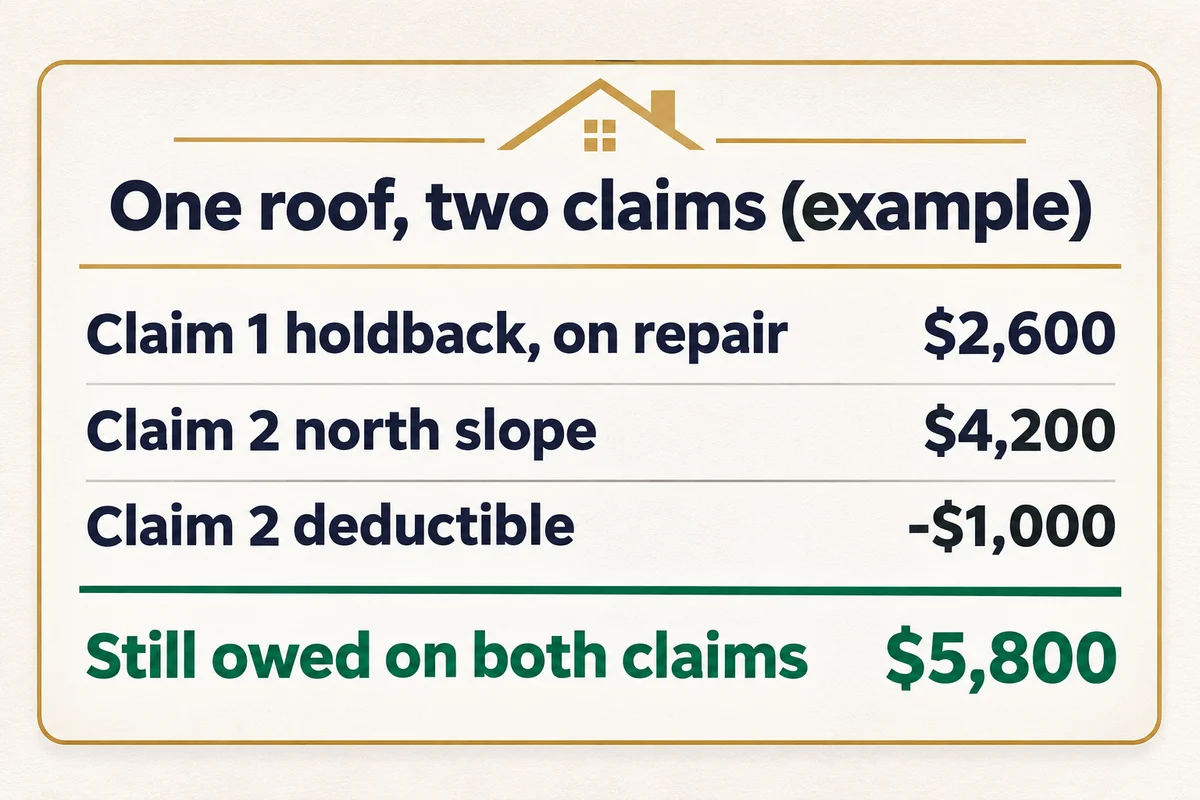
Still owed when the work is done$2,600
Second claim, October wind
Repair, north slope$4,200
Deductible-$1,000
Owed on this claim$3,200
Paid in one or two checks, by the policy
The first claim's $2,600 holdback is still owed once the south and west slopes are actually replaced, and it does not disappear because a second claim opened. Many policies set a window for claiming it, so read the replacement cost section of yours and our guide on collecting recoverable depreciation. With the $3,200 from the second claim, $5,800 is still to come across both files.
Now suppose the roofer quotes $21,000 to replace the whole roof, because new shingles on three slopes will not match the fourth. The two estimates together come to $13,600, so $7,400 of the quote is in neither of them, on top of the two $1,000 deductibles you carry yourself. That gap is a matching question, not a prior damage question, and it is argued on the policy wording and on proof that the shingle cannot be matched. Our article on matching on Illinois roofs covers how that argument is made.
The tarp decides the bedroom ceiling
Most homeowners policies require you to protect the property from further damage after a loss, and many pay the reasonable cost of doing it. Waiting months for a roofer during a busy season is ordinary; leaving an open roof uncovered is not. What happened to the tarp is what decides whether the interior water belongs to the second storm or gets argued away.
The wind tore off a tarp that was there
A properly fastened tarp was in place, photographed, and the October wind removed it. The rain that followed came in because of the second storm, and the interior damage is usually treated as part of that claim.There was never a tarp, or it had failed for weeks
The roof stood open through ordinary rain. The carrier may say the interior is a failure to protect the property, and limit what it pays for water that kept coming in.Keep the tarp invoice, a photo of it in place and a photo of what is left after the storm. If a contractor installed it, ask for a dated note. Our guide to emergency mitigation and board-up bills explains what carriers usually pay for that work.
When the second storm falls in a new policy year
Each policy answers for losses during its own term. If the hail came in the last policy year and the wind in the current one, the hail belongs to the old term and the wind to the new one, even with the same carrier. The deductible, the roof schedule and any cosmetic damage endorsement can differ between the two, so ask for both declarations pages and apply each to its own date.
If you changed carriers in between, the new carrier did not insure the June hail and will not pay for it. Any shortfall on the first storm is a matter for the earlier carrier, on the earlier policy, which is why the first claim should not be closed just because a new one opened. Bring the first estimate, the photos and the check stub to the first conversation with the new adjuster, so the new carrier can see what was already paid and does not price the old damage as yours to absorb.
What to ask for in writing
Illinois rules give a homeowner several documents on request. They come from 50 Ill. Adm. Code 919.80, the claim practice rule for property insurers. For a roof with two claims, these are the ones that matter.
| Ask for | Where it comes from | Why it matters with two storms |
|---|---|---|
| A copy of each estimate the settlement is based on | 919.80(d)(7)(C) | You need the first scope to see what is already priced and the second to see what was left out. |
| The depreciation worksheet, with age, condition and expected life | 919.80(d)(8)(A) | A condition deduction is where old damage can be charged to you a second time. |
| A written answer to your contractor's estimate | 919.80(d)(7)(C) | The company has to review it and respond promptly in writing when it is higher than theirs. |
| A written explanation if the claim stays unresolved | 919.80(d)(7)(B) | Required after 75 days from the report, or 25 days after proof of loss, whichever is less. |
| Weather records for both dates | The NOAA Storm Events Database, searchable by county and date | Shows that two separate events hit your area on two different days. |
If the second inspection comes back with a single estimate under one date, ask for it to be split into two before you sign anything, and keep the first claim number on every letter about the first slopes.
If the claims are already tangled
Sorting two dates of loss on one roof is detailed work, and it is easier before the shingles come off and the photos become the only evidence. We review the paperwork free of charge, and our fee is a percentage of the recovery set by Illinois law, agreed in writing, with nothing upfront. Our wind damage claim page explains how we handle storm roofs, and you can reach us by phone at (630) 297-8136, seven days a week.
Questions we get about this
If a second storm hits before I repaired the roof, is it one claim or two?
Usually two. A later storm on a different date with different damage is a separate occurrence, so it is reported as a new claim with its own date of loss and, on most policies, its own deductible. The first claim stays open for the damage it already priced. Your own policy wording governs.
Can the insurance company deny the new damage because the old damage was never repaired?
It can say the damage it sees came from the earlier storm, and that part belongs to the first claim, not the second. New damage from the new storm, such as lifted tabs on a slope the first estimate did not include, is a separate question. Dated photos from the first inspection are the main way to show the difference.
Do I lose the depreciation held back on my first claim if a second storm hits?
Not because of the second storm. The recoverable depreciation on the first claim is normally paid once the work in the first scope is done, and many policies set a time window for claiming it. Check the replacement cost section of your policy and keep the first claim number on every request.
Do I pay two deductibles for two storms on the same roof?
On most homeowners policies, yes, because the deductible applies per occurrence. Each storm's deductible is taken from its own claim. If your wind and hail deductible is a percentage of the dwelling limit, each storm's deductible is calculated under the policy in force on that storm's date.