Percentage Wind and Hail Deductibles: Why Yours May Not Be a Flat $1,000

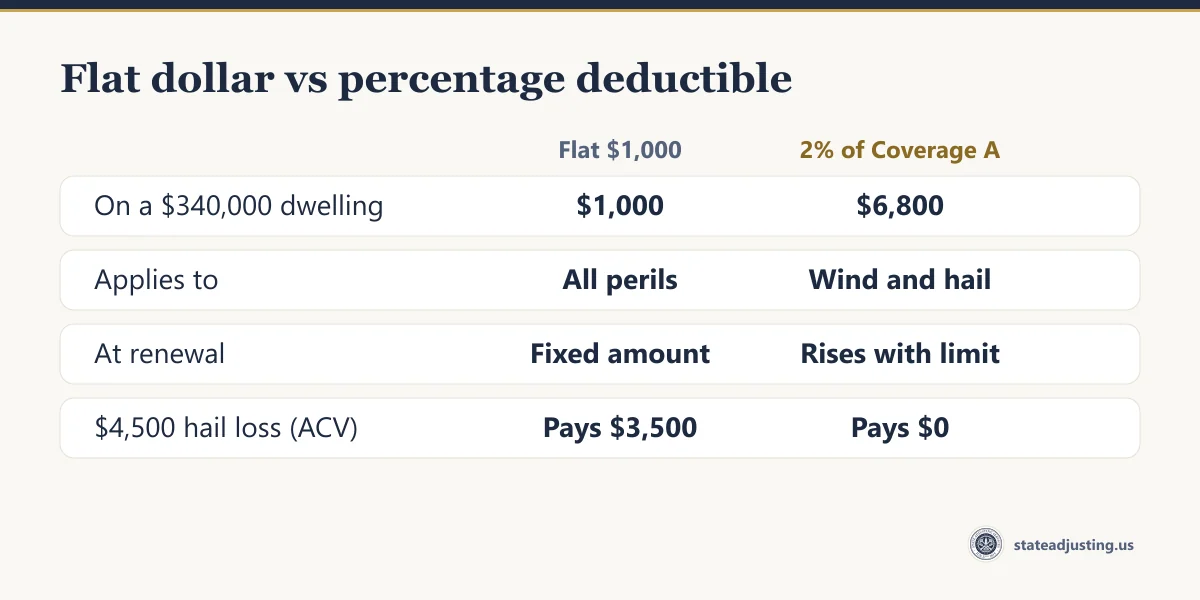
A percentage wind and hail deductible is a share of your dwelling limit, not of your loss. On a $340,000 Coverage A limit, a 2% deductible is $6,800, and it is subtracted from every wind or hail claim before you see a cent. It is printed on your declarations page.
A percentage wind and hail deductible is the reason a homeowner who has paid premiums for eleven years opens the first claim cheque after a hailstorm and finds thousands of dollars less than expected. Nothing went wrong. The policy did exactly what it says. The deductible on the declarations page simply was not the flat $1,000 everybody assumes it is.
We see these on Illinois homeowners policies regularly, and most often on renewals rather than on the original policy — the endorsement gets added, the premium stays flat or drops slightly, and the change is disclosed in the paperwork that arrives every year and that almost nobody reads. This guide explains how the number is calculated, where to find yours, why it grows on its own, and what it does to a small claim. We are licensed Illinois public adjusters, not attorneys, so this is how these clauses behave in practice. Your own policy governs.
What is a percentage wind and hail deductible?
It is a deductible expressed as a percentage instead of a dollar figure, applied only to losses caused by wind or hail. Every other peril — fire, theft, sudden water discharge — keeps the ordinary flat deductible, usually called the all-other-perils or AOP deductible. One policy, two deductibles, and the storm one is almost always the larger.
The distinction matters because the two numbers are rarely close together. A policy can carry a $1,000 AOP deductible and a 2% wind and hail deductible at the same time. A kitchen fire costs you $1,000. A hailstorm on the same house costs you several thousand. Both are correct, both are in the same document, and only one of them is the number most people remember.
There is a related clause you may have read about that does not apply here: the named-storm or hurricane deductible used along the Gulf and Atlantic coasts. Illinois policies use the wind and hail version, which needs no named storm to trigger — an ordinary spring hail event is enough.
How is the amount actually calculated?
The percentage is applied to Coverage A, the dwelling limit on your declarations page. Not to the market value of the house, not to the size of the damage, and not to the amount of the estimate. Multiply the dwelling limit by the percentage and that is your deductible, identical for a $9,000 hail claim and a $90,000 one.
| Coverage A (dwelling limit) | 1% | 2% | 5% |
|---|---|---|---|
| $200,000 | $2,000 | $4,000 | $10,000 |
| $340,000 | $3,400 | $6,800 | $17,000 |
| $500,000 | $5,000 | $10,000 | $25,000 |
| $750,000 | $7,500 | $15,000 | $37,500 |
Two wording variants are worth knowing. Some endorsements set the deductible as "the greater of $1,000 or 1% of Coverage A", which behaves like a flat deductible on smaller homes and like a percentage on larger ones. Others apply the percentage to the total of all Section I coverages in one occurrence rather than coverage by coverage — meaning one deductible for the whole storm, not one for the roof and another for the fence. The Deductible clause in your form says which, and it is short enough to read in a minute.
Here is what that does to a real-shaped hail claim. Dwelling limit $340,000, wind and hail deductible 2%, so $6,800. The carrier's estimate prices the roof, gutters, downspouts and screens at $24,600 replacement cost and withholds $4,900 of depreciation. Actual cash value is $19,700. Subtract the deductible and the first cheque is $12,900.
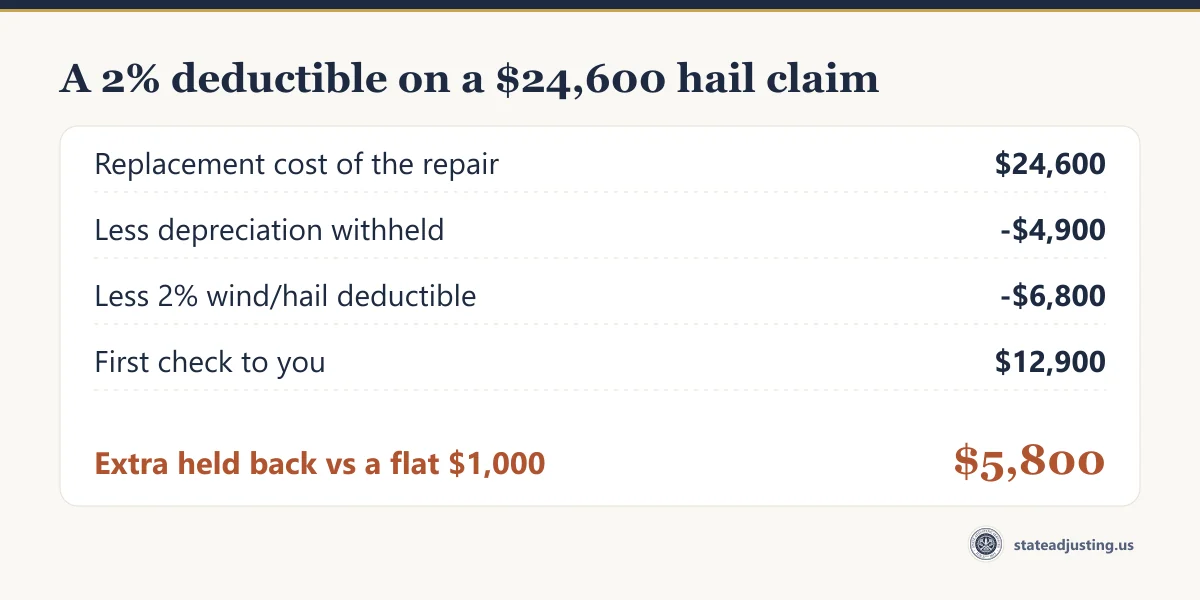
Had the policy carried a flat $1,000 deductible, the same claim would have paid $18,700 first. The percentage held back an extra $5,800 — money the homeowner now has to find before the roof can be replaced, because the roofer's price does not change. If the depreciation is recoverable, it comes back after the work is finished and documented; the deductible never does. We wrote about that second cheque in recoverable depreciation, and about how these totals are laid out in reading the carrier's estimate.
Where do I find mine?
On the declarations page, in the deductible block, usually within the first two pages of the policy packet. If a percentage applies, it is stated there — and the endorsement that created it is listed by form number in the forms and endorsements schedule further down. Both are worth photographing now, before you need them.
- The deductible block. Look for two entries, not one: "Section I Deductible" or "All Other Perils", and separately "Windstorm or Hail". A percentage will be printed as a percentage, and some carriers helpfully print the dollar equivalent beside it.
- Coverage A. The dwelling limit sits a few lines above. Multiply it yourself and confirm the arithmetic matches whatever the carrier printed.
- The forms schedule. A wind and hail deductible arrives as a named endorsement with a form number and edition date. If you want the exact wording, that number is what to ask for.
- The renewal notice. Compare this year's declarations page to last year's. A change of deductible structure shows up as a different line, not as a warning.
- Your lender's file. Some mortgage servicers cap the deductible they will accept on a policy securing their loan. If yours does, a percentage deductible on a rising limit can quietly breach it.
Why does the number grow every year?
Because the percentage is fixed and the dwelling limit is not. Most homeowners policies increase Coverage A automatically at renewal to keep pace with construction costs. The percentage stays at 2%, the limit climbs, and the deductible climbs with it — with no letter, no phone call and no signature.
| Renewal | Coverage A | 2% wind and hail deductible |
|---|---|---|
| Year 1 | $280,000 | $5,600 |
| Year 3 | $302,800 | $6,056 |
| Year 5 | $327,500 | $6,550 |
| Year 6 | $340,600 | $6,812 |
That table is arithmetic, not a forecast: it is $280,000 compounding at 4% a year, which is a plausible inflation-guard rate rather than a promise about yours. The point is the shape. Six renewals moved the deductible by roughly $1,200 while the policyholder's understanding of it stayed frozen at whatever they were told when they bought the house. The rising limit is usually the right call — it is what keeps you from being underinsured — but it has this second effect, and nobody mentions it.
Does it apply once, or to every storm?
Per occurrence, in almost every homeowners form. Two separate hailstorms in one summer are two losses and two deductibles, even if the second one damages the roof the first one already damaged. A small number of policies use an annual or calendar-year wind and hail deductible instead, where the first storm exhausts it. Read yours; the difference is thousands of dollars.
This is also where the date of loss stops being a formality. When two storms hit weeks apart, the carrier has to allocate the damage between them, and that allocation decides how many deductibles you absorb. Dated photographs taken after the first storm are what separate one claim from two — the same argument we make about documentation in hail claims and storm claims generally.
What the percentage does to a small claim
It erases it. A wind loss that would have produced a modest cheque under a flat deductible produces nothing under a percentage one, and the homeowner pays for the repair in full while still holding an active policy.
Take $5,400 of wind-damaged siding on that same $340,000 house. Depreciation of $900 brings actual cash value to $4,500. Under a $1,000 flat deductible the claim pays $3,500. Under the 2% deductible of $6,800 the loss never reaches the threshold and the claim pays $0. Nothing was denied and nothing was disputed — the arithmetic simply ended below the line.
Two things follow from that. First, before you conclude a loss is too small to bother with, have it priced properly rather than eyeballed: soft metals, vents, gutters, screens, detached structures and code-required items add up faster than a roof-only glance suggests. Second, if the priced damage genuinely sits below your deductible, know that before you file rather than after.
Can a contractor cover my deductible?
No, and the offer should end the conversation. The deductible is the policyholder's share of the loss, and a contractor who says they will absorb it is describing a contract price that has been written high enough to swallow it — which puts a false number in front of your carrier with your signature under it. The larger the deductible, the more attractive that offer sounds, which is exactly why percentage deductibles attract it. We set out the mechanics, including a worked example of how the padding shows up, in storm chasers at the door.
What to do next
Start with the document. Pull the declarations page, find the two deductibles, multiply the dwelling limit yourself, and write the dollar figure somewhere you will find it after a storm rather than during one. Then ask your agent to quote the same policy with a flat wind and hail deductible and put the two premiums side by side against the dollar difference in the deductible. Whether that trade is worth making depends on your roof, your budget and your appetite, and it is a decision to take before the next hail season rather than after it.
If a storm has already happened and the first cheque looks wrong, check the arithmetic in this order: replacement cost, less depreciation, less deductible. Most of the surprise is in the deductible and the depreciation rather than in the line items — though what is missing from the line items is a separate and often larger issue.
State Adjusting Services is a licensed Illinois public adjuster. We read the policy, price the loss and negotiate it with the carrier for wind, hail and storm claims across Illinois, and our fee is a percentage of the recovery agreed in writing — $0 upfront, and no recovery means no fee. We cannot make a deductible smaller; nobody can. What we can do is make sure everything above it is on the estimate. If you want a free review of your policy and your claim, get in touch or read how the process works first. Our office is open Monday through Friday, 7:00 AM to 7:00 PM, and Saturday and Sunday, 9:00 AM to 5:00 PM.
Questions we get about this
Is a percentage wind and hail deductible based on my home’s value or on my claim?
Neither. It is a percentage of Coverage A, the dwelling limit printed on your declarations page. A 2% deductible on a $340,000 dwelling limit is $6,800, and it stays $6,800 whether the hail damage totals $9,000 or $90,000.
Does the wind and hail deductible apply to every claim?
No. It applies only to losses the policy attributes to wind or hail. Fire, theft, sudden water discharge and other perils use the all-other-perils deductible, which is usually a flat dollar amount and usually much smaller. Your declarations page lists both.
Can I change my deductible back to a flat dollar amount?
Sometimes. Ask your agent to quote the same policy with a flat wind and hail deductible, then weigh the premium difference against the dollar difference in the deductible. Not every carrier offers a flat option on every property, and that answer belongs to the carrier.
My hail damage looks smaller than my deductible. Should I still report it?
Have the damage priced properly before you decide, because roof, gutters, screens, soft metals, vents and detached structures add up faster than a quick look suggests. If the priced loss really does sit below the deductible, the claim would pay nothing.