Sworn Statement in Proof of Loss: How to Fill One In
A sworn statement in proof of loss is a one-page form on which you state, under oath, what your loss was and how much you are claiming. It is due within 60 days of the carrier's written request — not 60 days from the date of loss. The danger is not the form. It is swearing to a number you have not documented, or one that came from somebody else.
Most homeowners never see a sworn statement in proof of loss. On small, tidy claims the carrier writes an estimate, issues a cheque and never asks for one. The form tends to appear when something has changed: the loss is large, the file has stalled, the numbers are contested, or a denial is being prepared. That is why a proof of loss request reads like a formality and is not one.
We are licensed Illinois public adjusters, not attorneys. Policy wording varies between carriers and between editions of the same form, and your own policy governs. What follows is how these documents are usually handled, not a rule of law or legal advice.
What is a sworn statement in proof of loss?
It is your formal statement of the claim: what was damaged, when, by what cause, who else has an interest in the property, and the amount you are claiming. You sign it under oath, normally in front of a notary. Unlike a phone call or an email, it is evidence — and it is yours, not the carrier's.
Three documents get confused with each other, and keeping them apart is most of the battle:
- Notice of loss is the first call or online report. It starts the file. It is not sworn and it commits you to nothing.
- The estimate is a priced scope of work, written by a contractor, a carrier's adjuster or a public adjuster. It is an attachment.
- The proof of loss is the sworn one-page summary that sits on top of the estimate and says: this is my loss, this is my number.
Carriers print their own versions, but the content is not invented by the carrier. It comes from the Your Duties After Loss condition in your own policy, which lists exactly what a proof of loss has to set out.
When is it due, and what starts the clock?
The widely used homeowners form gives you 60 days after the carrier's request — not 60 days after the loss. If nobody asks for one, none is due. Once the request is made, that clock runs, and missing it stops being a paperwork problem and becomes a policy-condition problem.
Four practical points follow from that.
- Date the request and keep it. The email, the letter, the envelope. If the deadline is ever argued about, the argument is about the date the request was made.
- A request is not an admission. Proof of loss forms often arrive alongside a reservation of rights letter, or with a denial. Asking for one does not mean coverage is accepted, and sending one does not mean you agree with anything the carrier has said.
- Filing it buys time as well as spending it. In Illinois, the policy's own deadline for filing suit is tolled from the date proof of loss is filed until the date the claim is denied in whole or in part (215 ILCS 5/143.1). The clocks on a property claim are covered in our guide to deadlines that end claims in Illinois.
- Extensions exist, in writing. If the scope is genuinely unfinished, ask for more time in writing and get the answer in writing. An adjuster saying "take your time" on the phone is not a record of anything.
What does the form actually ask for?
Eight things, in the order the policy lists them. Most of the form is short answers. The value is in knowing which line each fact belongs on, and which blank is the one people fill in carelessly.
| What the form asks | Where it goes wrong |
|---|---|
| The time and cause of loss | A guessed date. On a hail or wind claim the date decides which storm the damage is attributed to, and archived weather records get checked against your answer. |
| The interests of all persons in the property, and all liens | Leaving off the mortgage servicer. It appears on the cheque regardless, and an omission here looks like something it usually is not. |
| Other insurance that may cover the loss | Forgetting a flood policy, an association master policy, or a separate commercial policy on the same building. |
| Changes in title or occupancy during the policy term | The occupancy question, answered casually. An empty house carries its own conditions, and an inaccurate answer is worse than an inconvenient accurate one. |
| Specifications of the damaged building and detailed repair estimates | Writing "see attached" with nothing attached, or a single-line bid nobody can check against the sworn figure. |
| An inventory of damaged personal property | A room-by-room summary where a line-item list is required — see our guide to contents inventories. |
| Receipts for additional living expenses and records supporting lost fair rental value | Rebuilt from memory months later, when hotel folios and card statements would have proved it. |
| Evidence supporting a credit card, fund transfer, forgery or counterfeit money claim | Rarely applies to a property loss. If it does not apply, leave it blank rather than fill the space. |
Which number goes on the "amount claimed" line?
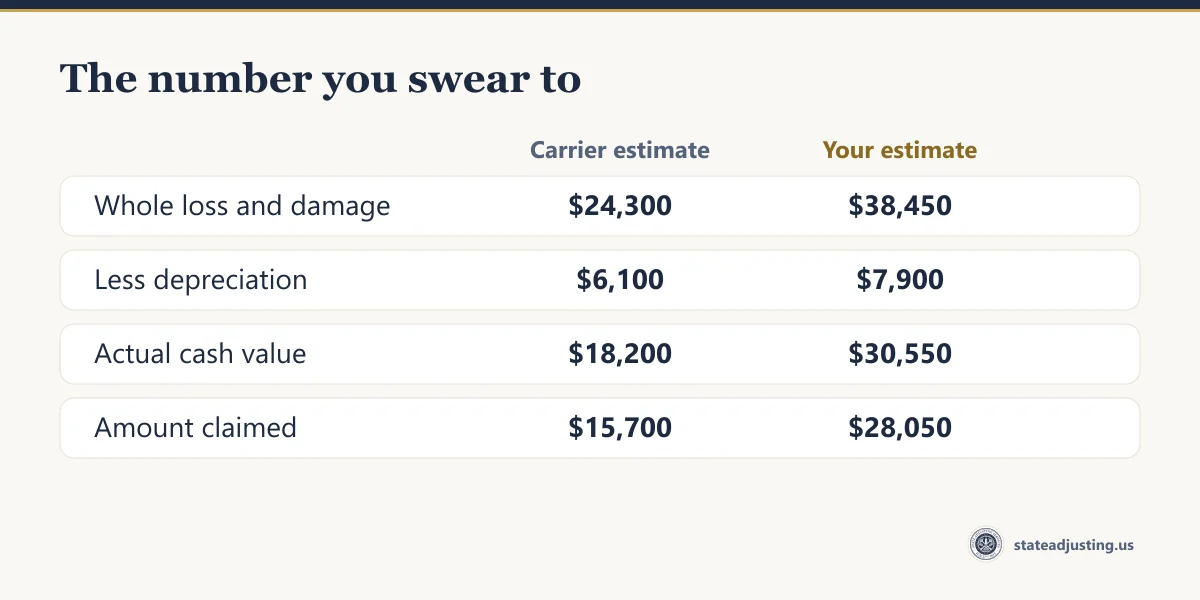
Yours — the one you can document. The money block on the form is short: the whole loss and damage, less depreciation, less the deductible, and the amount claimed. Filling it in with the carrier's figures states under oath that the carrier's estimate is your loss, and every later argument gets harder.
Line by line, what each blank means:
- Whole loss and damage. The replacement cost of the damage, before depreciation and before the deductible. Not the policy limit, and not the value of the house.
- Less depreciation. The wear taken off to reach actual cash value. Where depreciation is recoverable, the amount claimed on this form is normally the actual cash value figure, and the withheld portion is claimed after the work is done.
- Less the deductible. Once for the occurrence, not once per category. Roof, interior and contents from one storm share a single deductible.
- Less amounts previously received. Not on every form, but where it exists, state prior payments. An undisclosed advance is the kind of arithmetic error that reads as something worse.
Here is what the choice looks like on a single wind and hail loss. The figures are an illustrative worked example to show where the money sits — not a past result of ours and not a quote.
| Line on the form | Carrier's estimate | Documented estimate |
|---|---|---|
| Whole loss and damage | $24,300 | $38,450 |
| Less depreciation | $6,100 | $7,900 |
| Actual cash value | $18,200 | $30,550 |
| Less deductible | $2,500 | $2,500 |
| Amount claimed | $15,700 | $28,050 |
| Difference | $12,350 | |
Nothing in that $12,350 has been denied. It is the gap between two scopes, and the sworn form is where a homeowner accidentally settles it. If you cannot yet tell which of two estimates is the defensible one, our walkthrough of how to read the carrier's estimate takes the summary page apart.
What if the estimate is not finished?
Then say so on the form instead of inventing a number. The policy asks you to swear to what you set out "to the best of your knowledge and belief" — that phrase is in the condition itself. The honest answer to an unfinished scope is a documented figure, plus a written note that the loss is still being scoped.
In practice: attach the estimate you have, state on the form or in the covering letter that the figure is based on the scope known to date, and ask in writing for an extension if the missing piece is close. Be clear-eyed about the limits of that. A note reserving the right to amend does not bind the carrier, and whether it preserves anything is a legal question rather than a certainty. If a large amount turns on it, that is a conversation to have with an attorney before you sign.
The better answer, where the calendar allows, is to finish the scope. Tear-off, moisture readings and a proper attic inspection routinely change a number by five figures, and damage found after the fact is what the supplement process exists for. What you should not do is leave the amount blank and let somebody else complete it later.
What makes a sworn proof of loss risky?
The oath. Every homeowners policy carries a concealment or fraud condition, and a sworn document is where an intentional misstatement is easiest to establish. The risk is not being wrong about a repair price. It is stating as fact something you do not actually know: a date, an ownership interest, an item you cannot show you owned.
The condition in the widely used form removes coverage where an insured has intentionally concealed or misrepresented a material fact, engaged in fraudulent conduct, or made false statements relating to the insurance. Read against that, the "knowledge and belief" wording is protective rather than decorative: it asks for what you know. An estimate presented as an estimate is not a false statement. A guess written as a certainty is a different document.
Three habits keep the form clean:
- Do not round up. A figure that matches the attached estimate to the dollar is defensible. One that does not match anything invites the question of where it came from.
- Do not list what you cannot evidence. Photographs, receipts, card statements, warranty records, delivery emails. If an item survives none of that, it is a conversation with the adjuster, not a sworn line.
- Never sign a blank or half-blank form. A contractor or a public adjuster may prepare the document, but the person swearing to it is you. Read every line, including the ones somebody else filled in.
The carrier says the proof of loss is defective. Now what?
Ask, in writing, exactly which item is deficient and what would cure it. Carriers can reject an incomplete proof of loss, and a rejection that names nothing specific cannot be answered. Then send a corrected version inside whatever time is left, by a method that proves the delivery date.
Most rejections come down to a short list: no notary, an unsigned line, missing attachments, blanks left empty, or an amount that does not reconcile with the estimate attached to it. All five are cheaper to avoid than to argue about. Send the corrected form by certified mail or by an email you can prove was delivered, and keep a copy of exactly what went out, attachments included.
If the disagreement turns out to be about the amount rather than about coverage, the proof of loss is often the step before appraisal — the policy's own mechanism for resolving a dispute over how much. If it is about coverage, appraisal is the wrong lever, and the next request to make is a written decision that names the provision the carrier is relying on.
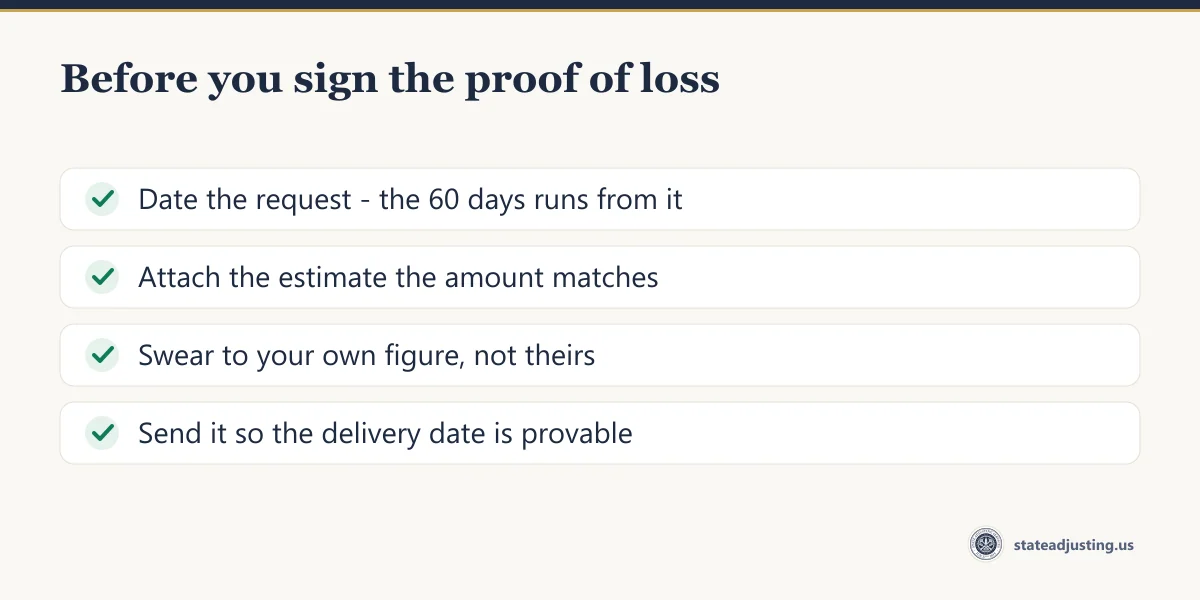
Before you sign: seven checks
- Confirm the request is real and dated. Note the date the carrier asked, and count 60 days from it.
- Read your own Your Duties After Loss condition. It is two paragraphs, it lists the eight items, and it is the actual instruction sheet for the form.
- Attach the estimate the number comes from. The sworn figure and the attachment must agree.
- Check the date and cause of loss against the record. Weather archives, the fire report, the plumber's invoice.
- List every interest and every other policy. Mortgage servicer, co-owner, association, flood policy.
- Take the deductible once, and disclose prior payments. Then check the arithmetic twice.
- Keep proof of what you sent and when. A copy of the signed form, the attachments, and the delivery record in one place.
What we can do
A proof of loss request usually means the file has reached the point where the number stops being negotiable in conversation. We read the policy, the estimate and the request together, document the loss properly, and prepare the form so the sworn figure is one that can be defended line by line. If you have an open storm damage claim and a 60-day letter on the kitchen table, that is the point to call rather than after it is signed. Our claim process page sets out how a file is handled from the first call, and our FAQ answers the questions we get asked most.
The review is free and there is no obligation. We are paid a percentage of the recovery, regulated by Illinois law and agreed in writing before we start: nothing upfront, and no recovery, no fee. Send us the request and the estimate — contact us or call (630) 297-8136, Monday to Friday, 8:00 AM to 5:00 PM.
Questions we get about this
How long do I have to file a sworn statement in proof of loss?
The widely used homeowners form gives you 60 days after the carrier requests one, not 60 days from the date of loss. If no request is made, no proof of loss is due. Keep the dated request, because any later argument about the deadline is an argument about when the request was made. If the scope is genuinely unfinished, ask for an extension in writing and get the answer in writing. Your own policy wording governs.
Do I have to send a proof of loss if the carrier has not asked for one?
Usually not under the standard homeowners condition, which ties the 60 days to the carrier request. Filing one anyway is sometimes deliberate rather than pointless: in Illinois the policy deadline for filing suit is tolled from the date proof of loss is filed until the claim is denied in whole or in part under 215 ILCS 5/143.1. Whether that helps in a particular file is a question for an attorney.
What number should go on the amount claimed line?
The figure you can document and attach, not the one from the carrier estimate. The block runs whole loss and damage, less depreciation, less the deductible, and the amount claimed. Copying the carrier figures states under oath that the carrier estimate is your loss, which makes every later argument harder. Where depreciation is recoverable the amount claimed is usually the actual cash value figure, with the withheld portion claimed after the work is finished.
Can a proof of loss be corrected after it has been signed?
Carriers commonly accept an amended or supplemental proof of loss, particularly where hidden damage is found after a tear-off or an inspection. There is no guarantee, and a note reserving the right to amend does not bind the carrier, so the safer course is to attach a complete estimate the first time. If the carrier rejects a form as defective, ask in writing which item is deficient and what would cure it, then resend by a method that proves the delivery date.