Vacant and Unoccupied Property: The Clause That Quietly Ends a Claim

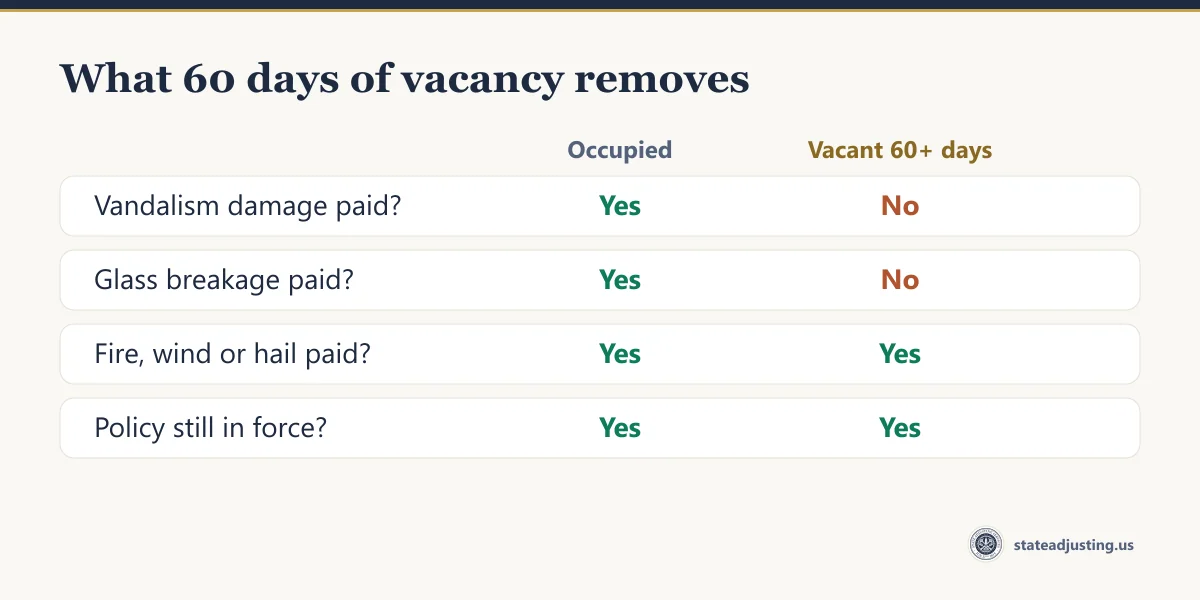
A vacant house does not lose its insurance — it loses specific perils. On the standard homeowners form, once a dwelling has been vacant more than 60 consecutive days, vandalism and malicious mischief stop being covered, and glass breakage usually goes with it. Fire, wind and hail still pay. Freeze damage is decided by a different clause with no 60-day grace period.
A vacant or unoccupied property is one of the few situations where a policy that looks perfectly healthy on the declarations page pays nothing for the loss that actually happens. There is no warning on the renewal. The clause sits inside the exclusions, and the clock starts the day the last person moves out — usually after a death in the family, a sale that is taking longer than anyone expected, a divorce, a job transfer, or a rental that has been empty between tenants for a season.
This guide sets out what the clause removes and what it leaves alone, the difference between vacant and unoccupied, how carriers establish the count, what the commercial version does differently, and what to arrange before a building sits empty. We are licensed Illinois public adjusters, not attorneys, and none of this is legal advice. Policy wording varies between carriers; what follows describes the widely used industry forms that most homeowners and commercial property policies are built on. Your own policy governs.
What is the difference between vacant and unoccupied?
Unoccupied means nobody is living there but the furnishings are still in place — a house while the family is away for the winter. Vacant means no people and no contents: nothing left to live with. The 60-day clause on a homeowners form is written around the word vacant, not unoccupied, and that difference is worth real money.
The homeowners form does not define "vacant" anywhere in the policy. That is why the argument is almost always about furniture rather than about people. The working test everyone ends up applying is a practical one: could somebody move in tonight and live there normally? A house with beds, a working kitchen and clothes in the closets is unoccupied. A house cleared out for staging, with the utilities in the estate's name and nothing but a lockbox on the door, is vacant.
Both forms also carve out construction explicitly: a dwelling being built is not treated as vacant, and on the commercial side a building under construction or renovation is not treated as vacant either. That carve-out is often the strongest position an empty building has, and it is the one people forget to claim.
| Situation | Usually reads as | Why |
|---|---|---|
| Family away four months, furniture and clothes in place | Unoccupied | The contents still make it livable |
| Parent moved to assisted living, house emptied and listed | Vacant | No people and nothing to live with |
| Rental empty two weeks between tenants | Unoccupied, and short | The 60-day count has not run |
| Rental cleared out and empty six months | Vacant | Both tests met, clock expired |
| Gut renovation, walls open, crew on site | Neither | Forms carve out buildings under renovation |
| New build, finished but not yet moved into | Not vacant under the form | But theft of materials is separately excluded |
| Estate house, furniture still in it, nobody visiting | Unoccupied | The vandalism clause is written around vacancy |
What does the vacancy clause actually take away?
Not the policy. On the standard homeowners form it removes one peril outright — vandalism and malicious mischief, plus any damage done in the course of it — once the dwelling has been vacant more than 60 consecutive days immediately before the loss. Many forms cut the separate glass-breakage coverage at the same mark. Fire, lightning, wind and hail are untouched.
Read the second half of that provision carefully, because it closes the obvious workaround. The exclusion reaches vandalism and any ensuing loss caused by an intentional and wrongful act committed in the course of it. So if intruders pull a supply line off the wall and the house floods for a week, the flooding follows the vandalism out of the policy. It is not a separate water loss.
The cruelty of the clause is the overlap. The one peril an empty house is most exposed to is exactly the one the clause removes. Copper stripping, squatters, broken windows, spray paint and smashed fixtures are what happens to buildings nobody visits, and on day 61 they stop being insured while the fire coverage nobody is worried about carries on unchanged.
One distinction is worth pushing on. Stripping a furnace, copper lines or fixtures out of an empty house is theft of building property, not malicious mischief, and the two are separate provisions with separate wording. Carriers do sometimes deny the entire file under the vandalism exclusion when a good part of it is a theft loss. Whether that holds depends on the exact wording and on what the damage shows, and it is worth answering rather than accepting. Our vandalism and theft claim page covers how those losses are documented.
Why the freeze exclusion catches more empty houses than the vacancy clause
Because it has no waiting period. The freezing exclusion applies whether the house has been empty for six days or six months. It removes freeze damage to plumbing, heating, air conditioning and sprinkler systems — unless you used reasonable care to either maintain heat in the building, or shut the water off and drain the systems and appliances. Two options, and a record proves either one.
"Reasonable care" is where these files are won and lost, and it is a documentary question, not an argument. A thermostat set to 55 degrees with a gas bill that shows winter consumption is a very different file from a house whose utilities were shut off in October. A plumber's winterisation invoice, dated photographs of drained lines and antifreeze in the traps, or a caretaker's signed log do the same work from the other direction.
Two details people get backwards. If the building has an automatic fire sprinkler system, most forms flip the requirement — you must keep the water supply on and maintain heat, so draining the sprinkler is the wrong move. And sumps, sump pumps and related equipment are usually carved out of the freezing provision entirely; sump failure and backup are handled by a separate endorsement if you bought one. Our ice and snow claim page covers the winter losses this sits next to.
How do carriers establish that a building was vacant?
With records, not with a hunch. The clause requires more than 60 consecutive days immediately before the loss, so the carrier has to show a period rather than a suspicion. An exclusion is the carrier's argument to make, and it has to be made with dated facts. In practice the file gets built from a short and predictable list.
- Gas and electric consumption by month. A flat, near-zero winter line is the single strongest document in either direction.
- Municipal water usage on the same billing history.
- The USPS mail-hold or forwarding date, which puts a hard start on the timeline.
- The real-estate listing — photographs, "vacant" in the agent remarks, lockbox and showing instructions.
- Alarm arming history, smart-thermostat records and camera logs.
- Neighbour and first-responder statements taken during the investigation.
- Your own recorded statement. Occupancy questions sound like small talk and are not — see what a recorded statement establishes.
What resets the count is narrower than people hope. The clause runs on consecutive days immediately before the loss, and occupancy resumes when somebody lives there again — not when someone drives past, mows the lawn or collects the mail. A contractor working in the house does not make it occupied either, but it may make the building one under renovation, which the forms treat separately. Those are two different arguments, and the renovation one is usually the better of the two.
The count also runs to the date of loss, not the date you found it or reported it. A pipe that froze in the last week of January and was discovered in March is dated at the freeze, and everything about the timeline is measured from there. That cuts both ways, which is why the date the carrier wrote on the file is worth checking before anything else.
What does the commercial vacancy condition do differently?
It is harsher, and unlike the homeowners version it is defined in the policy. On the standard commercial property form, if a building has been vacant more than 60 consecutive days, six causes of loss pay nothing — vandalism, sprinkler leakage, building glass breakage, water damage, theft and attempted theft — and everything still covered, fire and wind included, is paid at 85% of what it would otherwise be.
| Homeowners form | Commercial property form | |
|---|---|---|
| "Vacant" defined in the policy | No | Yes |
| Owner's test | — | At least 31% of the square footage rented or used for customary operations |
| Tenant's test | — | The unit holds enough business personal property to conduct customary operations |
| Waiting period | 60 consecutive days | 60 consecutive days |
| Removed entirely | Vandalism and malicious mischief, glass breakage on many forms | Vandalism, sprinkler leakage, glass breakage, water damage, theft, attempted theft |
| Everything else | Paid normally | Paid, reduced by 15% |
| Under construction or renovation | Not treated as vacant | Not treated as vacant |
The 15% haircut is the line that surprises commercial owners, because it applies to the perils they were never worried about. On a $400,000 fire loss at a mostly empty strip centre, that reduction is $60,000 — taken off a claim that is otherwise fully covered, for a reason unrelated to how the fire started. The 31% occupancy test is worth measuring properly rather than estimating: one more leased suite can be the difference between a full payment and that reduction.
A worked example
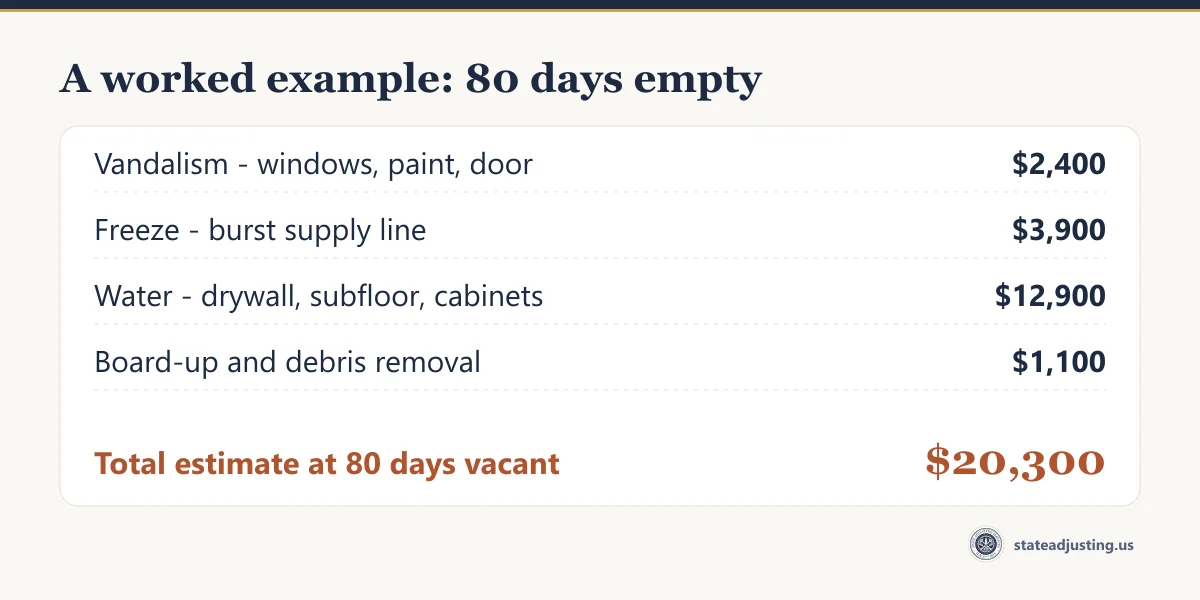
The figures below are an illustration to show how the provisions interact — not a client file and not a promise of any outcome. An estate house in Illinois is cleared of contents on 1 October and listed for sale. The utilities stay on in the estate's name but the thermostat is switched off. On 20 December someone forces the back door, breaks two windows and sprays the walls; a supply line in the laundry freezes the same week and runs until a neighbour notices on 27 December.
From 1 October to 20 December is 80 days — past the 60-day mark. The repair estimate comes back like this:
| Line | Amount | Which provision decides it |
|---|---|---|
| Vandalism — two windows, interior paint, forced door | $2,400 | Vacancy clause: excluded at 80 days |
| Freeze — burst supply line and manifold | $3,900 | Freezing exclusion: decided by the heat |
| Water damage — drywall, subfloor, cabinets | $12,900 | Freezing exclusion: decided by the heat |
| Board-up and debris removal | $1,100 | Follows whichever loss is covered |
| Total estimate | $20,300 |
The $2,400 of vandalism is gone either way; 80 consecutive days is 80 consecutive days. But the other $17,900 is not decided by the vacancy clause at all. It turns entirely on the thermostat. Heat off, water on, nothing drained: the freezing exclusion applies and the figure is $0. Heat maintained at 55 degrees with a gas bill that shows it, or a drained system with a plumber's invoice: this becomes an ordinary covered water loss and $17,900 changes sides. Same house, same night, same policy — the difference is one line on a utility statement.
What to do before a property sits empty
Every one of these is cheaper than the loss, and all of them are things you can only do beforehand.
- Tell the carrier in writing, before the 60 days run. Ask what they want in place. Most will offer a vacancy permit endorsement, a vacant dwelling policy, or a builder's-risk or renovation form. It costs money and it is priced for a reason.
- Decide the heat question and document the answer. Either keep heat in the building and keep the utility bills, or have the systems professionally drained and keep the invoice. Doing neither is the common outcome, and it is the expensive one.
- Answer renewal questions accurately. If the renewal asks whether the property is owner-occupied and the answer has changed, updating it is protection, not exposure. A wrong answer on an application is a second problem stacked on top of the vacancy one.
- Inspect on a schedule somebody can testify to. Dated photographs, a signed log, a lawn or snow-service invoice. Checks do not stop the vacancy clock, but they shorten how long damage runs before it is found — which is what actually determines the size of a water loss.
- If it is a renovation, keep proof that it is one. Permits, signed contracts, dated progress photographs. The construction carve-out is the strongest ground an empty building can stand on, and it needs evidence like anything else.
What to do if a claim is already denied for vacancy
Get the denial in writing and find the exact provision it cites. Vacancy and freezing are different arguments that need different proof, and denial letters routinely blur them into one paragraph — a letter that does that is answerable on its own terms. Then rebuild the occupancy timeline out of documents rather than recollection: utility statements, the mail-hold date, service invoices, photographs with dates.
Separate the perils before you argue about any of them. A denial that stretches the vandalism exclusion over a theft of building components, or over a fire or wind loss, is reaching past what the clause removes. Check the date of loss the carrier used, because the whole 60-day count hangs off it. Our guide to the first week after a denial covers the order to do this in, and water damage claims covers the evidence a freeze file needs.
If you are holding a vacancy denial, or you are about to leave a property empty and want to know what your policy does at day 61, we will read the policy and the estimate and tell you what we see. That review is free, we work on a percentage of the recovery agreed in writing and regulated by Illinois law, and there is nothing to pay upfront. You can see how we work a claim or send us the file. We are in Lincolnshire and serve all of Illinois, Monday through Friday, 7:00 AM to 7:00 PM, and Saturday and Sunday, 9:00 AM to 5:00 PM.
Questions we get about this
Does homeowners insurance cover a vacant house?
It keeps covering most perils. On the standard homeowners form, a dwelling vacant for more than 60 consecutive days loses coverage for vandalism and malicious mischief, and on many forms the separate glass-breakage coverage as well. Fire, lightning, wind and hail continue to be covered. The policy is not void; specific perils are removed. Your own policy wording governs.
How long can a house be unoccupied before insurance is affected?
The 60-day clause is written around a house being vacant — empty of people and of contents — rather than merely unoccupied. A furnished home whose owners are away for months is normally unoccupied, not vacant. The separate freezing exclusion has no waiting period at all and can apply after a few days if no heat was maintained and the water was not shut off and drained.
Is a house being renovated considered vacant?
Generally no. Homeowners forms state that a dwelling being constructed is not considered vacant, and the commercial property form says buildings under construction or renovation are not considered vacant. That carve-out has to be evidenced like anything else, so keep the permits, the signed contract and dated progress photographs.
What is a vacancy permit endorsement?
It is an endorsement a carrier can add to restore some or all of the coverage the vacancy provisions remove while a building is empty, usually for a set period and an additional premium. Some carriers instead move the property onto a vacant dwelling policy or a builder’s-risk form. Ask before the 60 days run, in writing, because the terms and the cost differ by carrier.