Theft and Vandalism Claims: Special Limits and Proof of Ownership

A break-in produces two claims under one policy. Damage to the building is paid like any other covered loss. Stolen personal property runs into special limits — commonly $1,500 on jewelry, $2,500 on firearms and silverware, $200 on cash — that cap the payment whatever the items were worth. One occurrence, one deductible.
A theft and vandalism claim is the one property claim where the paperwork decides more than the damage does. The structural repairs are visible, measurable and rarely argued. Everything that was carried out of the house has to be proved twice — that you owned it, and what it was worth — and then it meets a schedule of special limits that most homeowners have never read. That is where a $23,800 list becomes a $9,400 payment with nothing denied.
We are licensed Illinois public adjusters, not attorneys. Nothing here is legal advice, and your own policy and declarations page govern. What follows is how the widely used homeowners form treats theft and vandalism, and what a policyholder can do about the parts that go wrong.
What does a homeowners policy cover after a break-in?
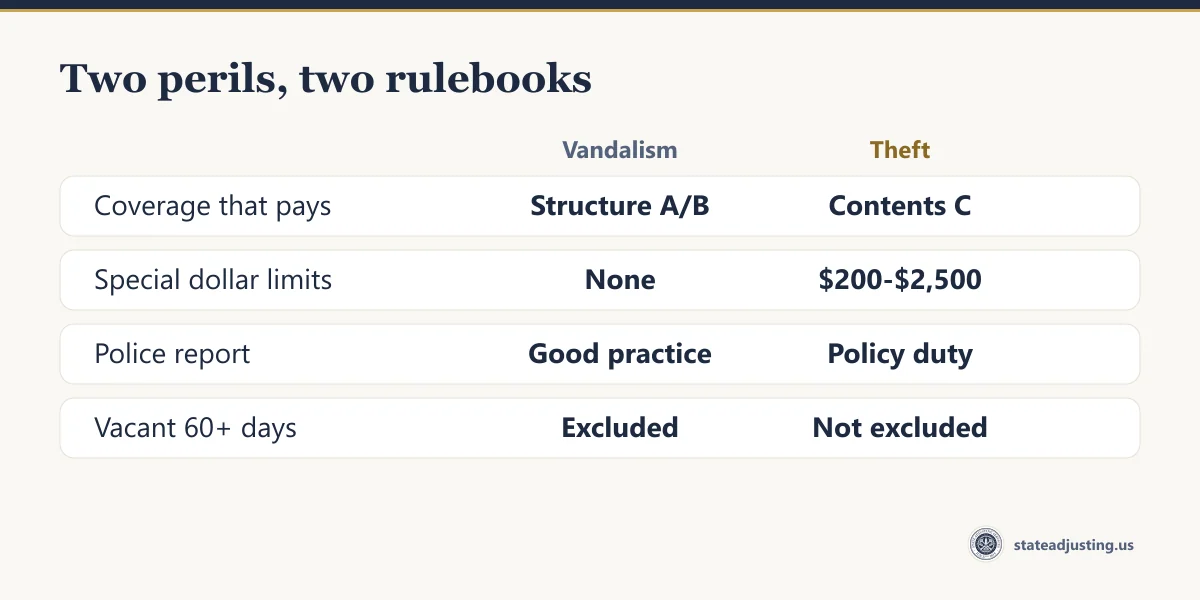
Two separate named perils, usually on the same night. Vandalism or malicious mischief pays to repair what was broken — the forced door, the smashed window, the spray paint. Theft pays for what was taken. They sit in different parts of the policy, carry different limits, and need different evidence.
The vandalism side behaves like a storm claim. It is building damage, paid under Coverage A for the dwelling or Coverage B for a detached structure, with no per-category dollar caps, at replacement cost once the repair is done. The theft side is Coverage C, personal property, and that is where the policy gets specific.
What are the special limits, and which apply only to theft?
Special limits of liability are per-category caps inside Coverage C. Some apply to any cause of loss. Others apply only when the cause is theft — which is why the same jewelry box is treated very differently in a fire than in a burglary. The figures below are the ones commonly printed in the widely used form; editions and carriers vary, so read your own.
| Category | Common limit | Applies to |
|---|---|---|
| Money, bank notes, coins, bullion, stored-value cards | $200 | Any covered peril |
| Securities, deeds, manuscripts, passports, tickets, stamps | $1,500 | Any covered peril |
| Jewelry, watches, furs, precious and semiprecious stones | $1,500 | Theft only |
| Firearms and related equipment | $2,500 | Theft only |
| Silverware, goldware, platinumware, pewterware, trophies | $2,500 | Theft only |
| Business property on the residence premises | $2,500 | Any covered peril |
| Watercraft and trailers, with their equipment | $1,500 | Any covered peril |
Three consequences follow, and they are the reason theft settlements disappoint people who did nothing wrong.
The cap is the amount of insurance, not a penalty. A $1,500 jewelry limit is not a reduction of your claim and not a denial you can appeal. It is the amount of theft cover you bought for that category. Arguing value on a capped item changes nothing; the only lever is whether the item belongs in that category at all.
The category is decided by what the item is, not what it cost. A gold-plated trophy sits with the silverware. A watch sits with the jewelry whether it cost $400 or $14,000. A camera does not sit in either, so it is paid on its own merits — which is why the electronics on a theft list often settle more cleanly than the heirlooms.
Theft-only limits do not travel to other perils. The same jewelry destroyed in a house fire is not subject to the $1,500 cap, because that cap is written for theft. We covered how that plays out on the contents side in fire claims and contents inventories.
Does a theft claim require signs of forced entry?
Not under a homeowners policy. The form covers theft, and it does not define theft as requiring visible marks of forcible entry. Absence of forced entry goes to proof — it makes the loss harder to evidence — but it is not a policy condition you have failed. That distinction matters, because it is the single most common thing homeowners are told at the scene.
Commercial policies are different. A commercial crime form typically defines burglary as taking property from inside the premises with visible signs of forced entry. A business owner reading that definition genuinely does face a forced-entry test that a homeowner does not.
What is excluded on the homeowners side is narrower and more specific: theft committed by an insured; theft in or to a dwelling under construction, and of materials and supplies for use in construction, until it is finished and occupied; and theft from the part of a residence you rent to somebody who is not an insured. Away from home there are further limits, including theft from a residence that is not your residence premises unless an insured is temporarily living there.
Property that is simply missing is a separate problem. A homeowners policy insures theft, not mysterious disappearance, and many forms exclude misplacing or losing property outright. If nobody can say the item was taken, the claim usually fails on that point rather than on the special limits.
What counts as proof of ownership?
Two separate showings, and carriers ask for both: that the item existed and was yours, and what it was worth. Receipts do both at once, which is why they are asked for first. Most people do not have them for the things worth the most, so the file gets built from everything else.
| What it proves | What actually works |
|---|---|
| Ownership of a purchased item | Receipt, order confirmation email, credit-card or bank statement line, warranty or product registration, serial number recorded anywhere |
| Ownership of a gift or inherited item | Dated photographs of it in the house or being worn, an appraisal, an estate inventory, a prior insurance schedule, statements from people who saw it |
| That it was in the house on the day | Pre-loss photographs and video of the rooms, a prior contents inventory, the police report listing it, delivery records |
| Value | Appraisal for jewelry and art, current retail for like kind and quality, model and specification for electronics, purchase price with a date for depreciation |
The habit that pays for itself is a walk-through video of every room, every drawer and every closet, filmed once and kept somewhere other than the house. It converts an argument about memory into a document. The same discipline applies after the loss — see what to photograph before you touch anything, which for a break-in means the point of entry first, before it is boarded up.
Notifying the police is not a formality either. It is written into the policy's duties after loss as a specific requirement for theft, alongside notice to the carrier and protecting the property from further damage. Get the report number, list the items you know about, and file a supplement as you find more — an amended police report dated two weeks later is normal and reads better than a list that grew only in the claim file.
What does a break-in actually settle for?
A worked example, using illustrative figures rather than any real client's claim. An occupied Illinois house, forced rear door, four rooms disturbed, $1,000 deductible.
| Structure — Coverage A | Amount |
|---|---|
| Rear door, frame and jamb | $1,850 |
| Broken window and glazing | $620 |
| Drywall repair and repaint, two rooms | $2,340 |
| Interior door replaced and painted | $480 |
| Replacement cost | $5,290 |
| Less depreciation held back | −$610 |
| Actual cash value now | $4,680 |
| Stolen — Coverage C | Claimed | Paid | Why |
|---|---|---|---|
| Jewelry, appraised | $9,800 | $1,500 | Theft special limit |
| Two shotguns | $3,800 | $2,500 | Theft special limit |
| Sterling flatware | $4,200 | $2,500 | Theft special limit |
| Cash in a drawer | $900 | $200 | Any-peril limit on money |
| Laptop and tablet | $2,100 | $1,150 | No special limit — ACV |
| Television | $1,400 | $700 | No special limit — ACV |
| Tools | $1,600 | $850 | No special limit — ACV |
| Total | $23,800 | $9,400 |
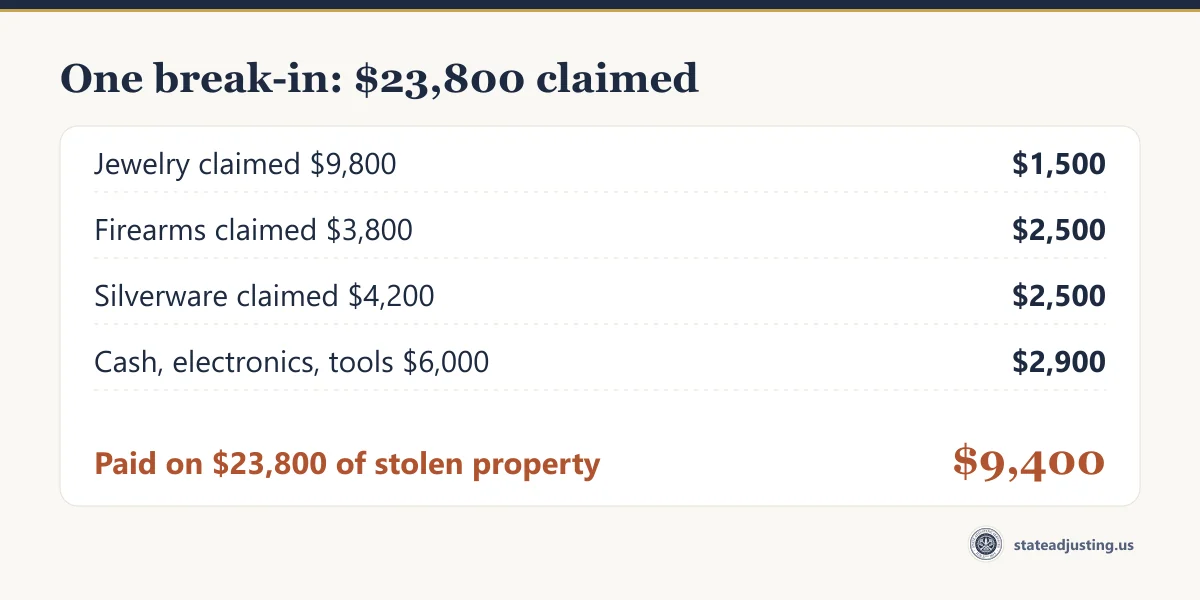
The first payment is $4,680 plus $9,400, less the $1,000 deductible, so $13,080. Later, once the repairs are finished and the replaceable items are actually replaced, the withheld depreciation comes back: $610 on the structure and $2,400 across the laptop, television and tools if the policy carries replacement cost on contents. The capped items produce nothing further, because the cap was already below their value.
That is $16,090 on a $29,090 loss. Of the $13,000 difference, $1,000 is the deductible and $12,000 is the special limits. Nothing was denied and nothing was disputed. On the second payment, see recoverable depreciation and ACV versus replacement cost — the sequence is the same as any other claim.
When does the vandalism side disappear?
The clause that catches people is vacancy. In the widely used form, vandalism and malicious mischief is excluded if the dwelling has been vacant for more than 60 consecutive days immediately before the loss, and glass breakage is cut at the same mark. Theft is not excluded by that clause — it has its own list — so a break-in at an empty inherited house can pay for what was taken and nothing for the wrecked interior. We wrote about how carriers build the vacancy timeline in vacant and unoccupied property.
- Under construction. Theft of building materials and theft in the dwelling are excluded until the house is finished and occupied. A renovation you moved out of is worth checking against this wording.
- Stripped copper, wiring and HVAC. Removing building components is theft of building property, not vandalism, and the damage done in the process is usually the larger number. Which peril the carrier writes it under changes what is paid.
- Rented rooms. Theft from a part of the residence rented to someone who is not an insured is excluded.
- Recorded statements and examinations. Both are more common on theft claims than on storm claims. A recorded statement is routine; see how to prepare for one. A formal examination under oath is a different level, and it is the point to speak to an attorney.
What to do in the first 48 hours
- Call the police before you clean up, and get the report number. Photograph the point of entry and every disturbed room before boarding anything.
- Report to the carrier the same day, with the report number.
- Secure the opening and keep the receipt — reasonable emergency repairs are payable.
- Keep the damaged lock, door hardware and window frame. They are the evidence of the entry.
- Build the list room by room from records, not memory, and supplement the police report as you find more.
- Do not round values up. Inflating a theft list is the fastest way to lose a claim that was otherwise payable, and the concealment and fraud condition applies to the whole policy.
- Cancel cards and place a credit freeze if documents or cards were taken — not an insurance step, but the one with the shortest clock.
Before the next loss, the fix for the special limits is scheduling. A scheduled personal property endorsement lists individual items at an agreed value, commonly with broader cover than the theft peril and often with no deductible on the scheduled item. Some carriers instead sell a blanket increase to the jewelry theft limit with a per-item cap. Either way it is arranged at renewal, with an appraisal, and it is the only thing that moves a $1,500 line.
If your claim is open and the numbers are not adding up, we review property claims in Illinois at no charge and no obligation — send us the estimate and the policy declarations page and we will tell you plainly whether there is anything to pursue. Our fee is a percentage of the recovery, agreed in writing, capped by Illinois law and paid out of the settlement: nothing upfront, and no recovery means no fee. You can see how we work a claim, or read what a vandalism and theft claim involves from the start.
Questions we get about this
Does my homeowners policy need signs of forced entry for a theft claim?
A homeowners policy insures theft and does not define it as requiring visible marks of forcible entry, so the absence of forced entry is a proof problem rather than a policy condition you have failed. Commercial crime forms are different: they usually define burglary as taking property with visible signs of forced entry. Property that is simply missing, with no evidence of a taking, is a separate issue — many forms exclude misplacing or losing property.
Why did my jewelry claim pay only $1,500 when the ring was appraised much higher?
Because of a special limit of liability. The widely used homeowners form commonly caps theft of jewelry, watches, furs and precious stones at $1,500, firearms at $2,500 and silverware at $2,500, whatever the items were worth. It is not a denial or a reduction you can appeal — it is the amount of theft cover bought for that category. The limits are theft-only, so the same jewelry lost in a fire is not capped that way. Scheduling the item at renewal is the fix.
Do I have to file a police report to make a theft claim?
Yes. Notifying the police is written into the policy duties after loss as a specific requirement for theft, alongside notifying the insurer and protecting the property from further damage. Get the report number, list what you know is missing, and file a supplemental report as you find more. An amended report dated two weeks later is normal and carries more weight than a list that grew only inside the claim file.
Is vandalism covered if the house has been empty?
Often not. In the widely used form, vandalism and malicious mischief is excluded if the dwelling has been vacant for more than 60 consecutive days immediately before the loss, and glass breakage is cut at the same mark. Theft is not excluded by that clause, so a break-in at an empty house can pay for what was taken and nothing for the damage done getting in. Your own policy wording and the vacancy timeline the carrier builds both matter.