Wind-damaged shingles: when a claim pays for a repair and when for the roof
No number of missing shingles turns a wind damage claim into a new roof, in Illinois or under any standard homeowners policy. What decides it is the rest of the roof: how many shingles the wind creased or unsealed without tearing them off, whether the ones left can be lifted and replaced without cracking, and whether a replacement will match. The first estimate on wind-damaged shingles usually counts only what is missing. Below is what else to count, how the repair-or-replace argument is really made, and what answers the reasons carriers give. Your own policy governs what is covered.
What wind does to a shingle besides blowing it off
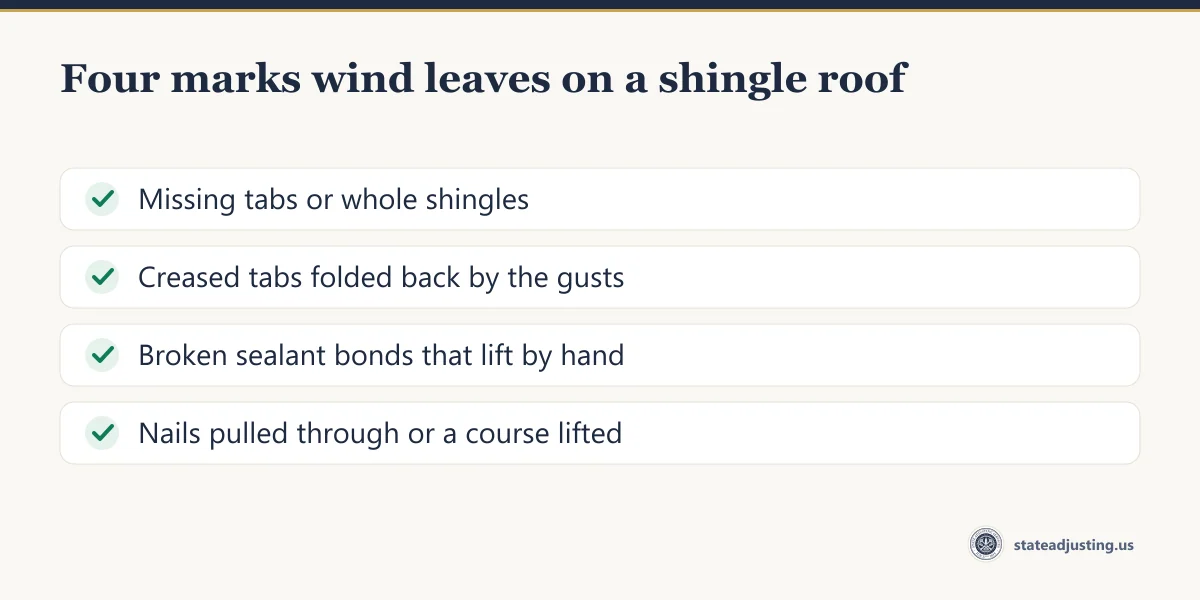
Wind gets under the lower edge of a shingle, flexes it and breaks the strip of sealant that glues it to the course below. A tab that flexes far enough folds and creases. One that keeps going tears off. The torn-off shingles are the ones you see from the driveway, and they are often the smallest part of the damage.
Missing tabs and shingles
Exposed underlayment, a torn edge along the nail line, pieces in the yard or the gutters. Each gap lets water in until it is closed.
Creased tabs
A straight fold line across the tab where it bent back. The tab often lies flat again afterwards, so the crease shows only up close or in low, raking light.
Broken sealant bonds
The tab looks normal but lifts freely by hand because the adhesive strip let go. The only way to find these is to lift tabs gently, slope by slope, and write down which ones come up.
Pulled nails and lifted courses
When gusts get under a whole row, nails back out or tear through, and the row sits proud of the roof line. These need new fastening, not just sealant.
The manufacturer IKO addresses the reseal question directly in its Residential Information Bulletin R-82 (October 2019): once wind has compromised the bonds, the shingles are not likely to re-seal themselves to the original sealing strength. The same bulletin lists creasing from flexing in the wind as damage apart from the broken bond, and recommends hand-sealing to ARMA guidelines only where the broken bond is the sole damage.
Why the first estimate is a count of shingles
Most wind estimates price a repair line: remove and replace a stated number of shingles on a named slope, sometimes with a separate line for hand-sealing. That number is what the field adjuster recorded on the day, and on a short inspection it is mostly what was missing. Every shingle left out of the count is a shingle the estimate treats as undamaged.
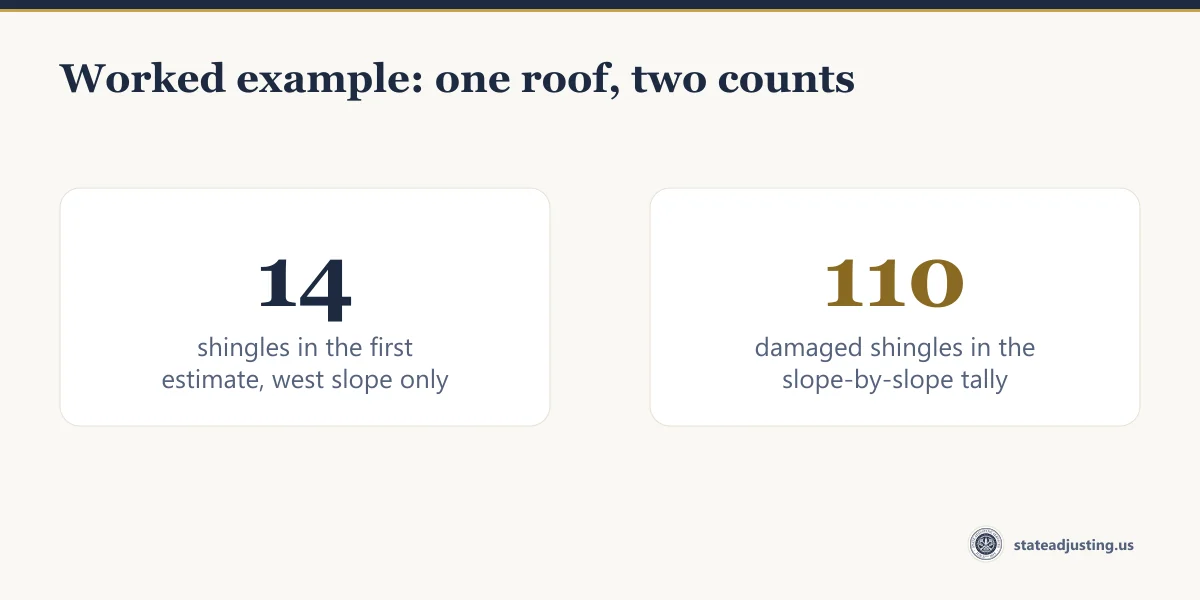
So the count matters more than the price per shingle. Replacing 14 shingles and replacing 110 are different jobs, and somewhere between the two a roofer's answer to the question of whether a slope can be repaired changes. The worked example below is an illustration, not a client file: one hip roof after an autumn west wind, counted slope by slope with tabs lifted by hand.
| Slope | Missing | Creased | Unsealed | Damaged on this slope |
|---|---|---|---|---|
| West, facing the wind | 14 | 23 | 31 | 68 |
| North | 0 | 6 | 12 | 18 |
| South | 0 | 5 | 11 | 16 |
| East | 0 | 2 | 6 | 8 |
| Whole roof | 14 | 36 | 60 | 110 |
The first estimate in this example lists 14 shingles on the west slope. The tally finds 110 on four slopes, and 96 of them are still on the roof. That alone does not prove the roof needs replacing. It changes what the carrier has to answer: no longer whether 14 shingles can be swapped, but whether 110 shingles on four slopes can be repaired, and whether the repair will hold and match.
Can the shingles be repaired without breaking their neighbours?
Replacing one shingle disturbs several. The roofer lifts the course above to reach the nails, pulls them, slides the new shingle in, nails it and reseals everything that was lifted. If the shingles around it crack or tear when they are lifted, the repair causes new damage, and the honest scope is bigger than the count.
Carriers and roofers often decide this with a field brittle test: bend a tab and see whether it cracks. There is no standard for it. In an article for RCI Interface in September 2016, roofing engineer Lyle Hogan wrote that no recognised brittle test exists for asphalt shingles, and that results shift with temperature and with the slope tested. He also makes the point from the other side: shingles that can be lifted to check the nailing can usually be lifted for a repair. So neither a crack nor a clean bend settles it alone. A record does.
A repairability test worth relying on writes down:
- The date, the time and the outdoor temperature. Asphalt stiffens in the cold, so a test on a frosty November morning and one on a warm afternoon can disagree about the same roof.
- Which slopes were tested and where on each, with a photo of every spot.
- How many tabs were lifted, how far, and how many cracked, tore or lost their bond while being lifted.
- Video of the lifts, so somebody who was not on the roof can see the result.
- Whether a replacement shingle of the same size and profile was identified, by product name.
A test like that can come out in the carrier's favour, and then a repair is the right answer. When the carrier's adjuster or engineer calls the roof repairable, you can ask for the same record. Our guide to answering a carrier's engineering report goes through how to reply point by point.
The carrier's reasons, and what answers each
A low wind estimate or a partial denial usually rests on one of a handful of sentences. Each has its own kind of evidence.
| What the letter or estimate says | What answers it |
|---|---|
| The damage is limited to one slope. | A tally with tabs lifted on every slope, each damaged shingle photographed in place. |
| The shingles will reseal on their own. | IKO bulletin R-82 on compromised bonds. Ask what the carrier relies on for the opposite view. |
| The creases are old or from installation. | Creases that line up with the storm's direction on the slopes that faced it, photographed and dated soon after the storm. |
| The roof is worn out, not wind damaged. | The line between wear and a storm event, covered in our post on roof age and cosmetic damage wording. |
| Matching shingles are available. | The product name, a sample laid beside the old shingles, and the points in our guide to matching on Illinois roofs. |
| A test showed the shingles are repairable. | The written test record: date, temperature, slopes, lifts, results and video. |
What to do in the first week after a windstorm
- The same day, photograph every slope you can see from the ground, plus the yard and the gutters. Our list of what to photograph after property damage gives the order.
- Have any opening covered and keep the invoice. Protecting the property from further damage is one of your duties under the policy.
- Report the claim and ask when the carrier's adjuster will inspect.
- Before that visit, have a roofer lift tabs on every slope and count, so your tally exists before the estimate is written.
- When the estimate arrives, compare its count with yours slope by slope, and write down every difference.
We are licensed Illinois public adjusters. On a wind claim we document the roof slope by slope, read the carrier's estimate against the tally and negotiate the scope. We do not do roofing work: Illinois keeps contractors and public adjusters in separate roles, and if you need a roofer, our construction partner page explains that option, which is always your choice. You can read how we handle wind damage claims and how a claim moves with us, or send us your estimate for a free review. There is nothing to pay upfront, and no fee if there is no recovery.
Questions we get about this
How many missing shingles does it take for insurance to replace a roof?
There is no set number in Illinois or in a standard homeowners policy. The decision rests on the total damage, including creased and unsealed shingles still on the roof, on whether the remaining shingles can be repaired without new damage, and on whether replacements match. Your own policy governs.
Will shingles lifted by wind reseal by themselves?
Not reliably. IKO's Residential Information Bulletin R-82 says shingles whose sealant bonds were compromised by wind are not likely to reseal to their original strength, and it recommends hand-sealing to ARMA guidelines where the broken bond is the only damage.
What is a brittle test on a shingle roof?
A field check where a tab is bent to see whether it cracks, used to argue that a roof can or cannot be repaired. It has no recognised standard and the result changes with temperature, so a written record of when, where and how it was done matters more than the verdict.
Does homeowners insurance cover creased shingles?
Wind is a covered peril on most Illinois homeowners policies, and a crease made by wind is wind damage. The dispute is usually whether the crease came from this storm, which is why dated photos taken soon after it help. Your own policy and its endorsements govern.