Chimney fire insurance claim: proving the fire when the carrier blames creosote
A chimney fire insurance claim is usually covered on an Illinois homeowners policy as fire damage to the house. The argument that follows is rarely about whether fire is covered. It is about whether a fire happened at all, and whether the cracked flue tiles are new or were cracked for years. The carrier's word for that second argument is creosote. Both questions are answered by the same piece of paper: a written Level 2 chimney inspection, made before anything is cleaned, patched or relined.
We are licensed Illinois public adjusters, not attorneys. The policy wording below comes from the widely used homeowners form. Your own policy and its endorsements govern.
How do you know the chimney burned if nobody saw flames?
Often you don't, and that is normal. The Chimney Safety Institute of America writes that the majority of chimney fires go undetected. A slow fire has too little air or fuel to roar or throw sparks, and its damage turns up at the next sweep. A loud fire you heard is easier to date: write down the day and the hour, and whether the fire department came.
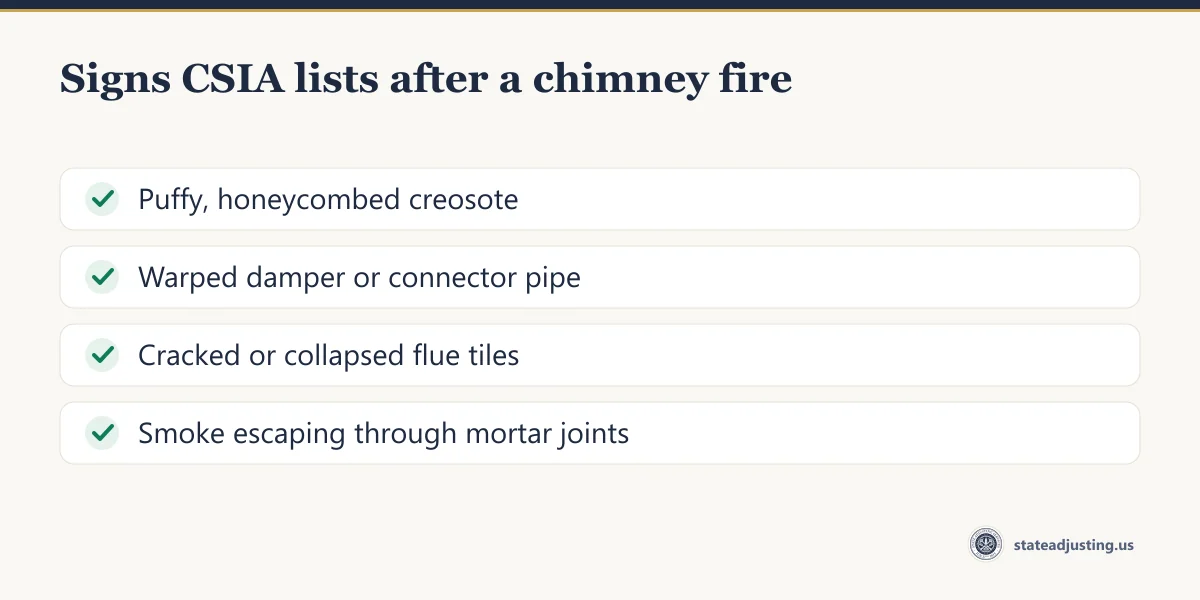
For a quiet one, the evidence sits in the chimney itself. Here is where CSIA's list of signs puts it, from the cap down to the firebox.
- Rain capDiscolored or bent out of shape by heat. An old antenna strapped to the chimney can show heat damage too.
- Crown and outside brickNew cracks in the masonry. Flakes of creosote on the roof or on the ground below, and roofing damaged where hot creosote landed.
- Flue linerClay tiles cracked, collapsed or missing large pieces. In a factory-built chimney, metal warped by the heat.
- Mortar jointsSmoke escaping through the joints or between liner sections, the kind of leak a camera or a smoke test finds.
- Deposits inside the flueCreosote that has gone puffy and honeycombed, which happens when it burns. Unburned deposits lie flat, as a crust or a glaze.
- Damper and connector pipeWarped metal: a damper plate that no longer seats, a stove pipe bent out of round.
Those marks are what a certified sweep looks for. They are also what you want in writing, one by one, with a photograph of each.
Which parts of the policy pay for a chimney fire?
Three passages of the policy do the work. The denial letter, if one comes, will usually quote the third.
The house, chimney included
The chimney is part of the dwelling. In the widely used form the dwelling is insured against direct physical loss unless an exclusion applies, so fire does not need to be listed to be paid. The flue, crown, damper, the roofing around the chimney and any framing the heat reached are all dwelling items, claimed under one date of loss.
Your belongings
Belongings are covered only for the perils the policy names. Fire or lightning is the first of them. Smoke is another, worded as sudden and accidental damage from smoke. Soot pushed into the living room through cracked joints fits that wording, though some company forms add their own exclusions to the smoke peril, so read yours. Our guide to smoke and soot damage when nothing in the house burned shows how soot is scoped room by room.
The exclusion, and the sentence after it
The exclusion the carrier reaches for is wear and tear, marring and deterioration. Read the sentence that follows that group of exclusions. In the widely used form, an ensuing loss to the dwelling or other structures is covered unless another provision excludes it. Put plainly, the policy does not pay to replace a liner because it was old, and fire damage that followed does not lose its coverage because the liner was old.
Whether a crack came from age or from this fire is a question of fact. That is why the inspection report decides more chimney claims than any argument about wording.
The Level 2 inspection: book it before the cleanup
Ask a certified sweep for a Level 2 inspection, and get it done before anyone cleans the flue, relines it or rebuilds the crown. CSIA's procedure for a Level 2 inspection of a masonry chimney, which references NFPA 211, recommends one after a building or chimney fire. It is the level that requires a camera inside the flue.
Under that procedure the inspection reaches:
- Every flue in the chimney and every appliance connected to it, not only the fireplace you use.
- A video scan of the chimney interior, with cracks or gaps in the liner reported.
- The roof: the crown, the flashing, the cap and the top of the liner.
- Accessible attics, basements and crawl spaces, including clearances where the chimney passes through floors and the roof, and any water damage under the flashing.
- The connector pipe and the thimble where it enters the chimney.
The report is only as useful as what it records. Ask the sweep to put these in writing:
- The inspection date, the date of the fire if you know it, and the last date the chimney was swept.
- Each sign of fire found, by location, with a photograph or a frame from the video.
- Whether the crack edges look fresh and clean, or hold old soot and debris.
- The work needed before the chimney is safe to use: cleaning, liner repair, a full reline or replacement.
- Whether the chimney should stay out of use until then.
- The sweep's certification and the company's details.
Find last year's sweep invoice as well. A record that the chimney was swept and inspected with no cracks noted is the strongest answer to the claim that the damage is old. Ask the carrier in writing whether it will pay for the inspection before you book it, and keep the invoice either way. If the carrier sends its own inspector, you can still have your own.
Old cracks or new: how each side reads the same chimney
The carrier's position is often that the damage is deterioration and that creosote proves neglect. Each piece of that has a record that answers it.
| What was found | What the carrier may say | The record that answers it |
|---|---|---|
| Cracked flue tiles | Tiles crack with age and years of heating cycles | The last sweep report with no cracks noted, the Level 2 video, the condition of the crack edges |
| Puffy, honeycombed creosote | Creosote buildup is a maintenance failure | CSIA names this texture as a sign that a fire happened. The fire is the loss; how the deposits built up is a separate point about an exclusion |
| Warped damper or connector pipe | Old, rusted parts | Photographs of the warp and the part itself, kept and not thrown out by the sweep |
| New cracks in the crown or outside brick | Freeze and thaw damage over many winters | Earlier photographs (a listing, a home inspection report, street-view images by date) beside the inspection's heat signs at the same spot |
| A ceiling stain beside the chimney after the fire | A long, slow leak | The date of the fire and the date you first saw the stain, written down when it happened |
Masonry chimney or factory-built: two different repairs
The kind of chimney decides which repair the estimate has to price.
Masonry
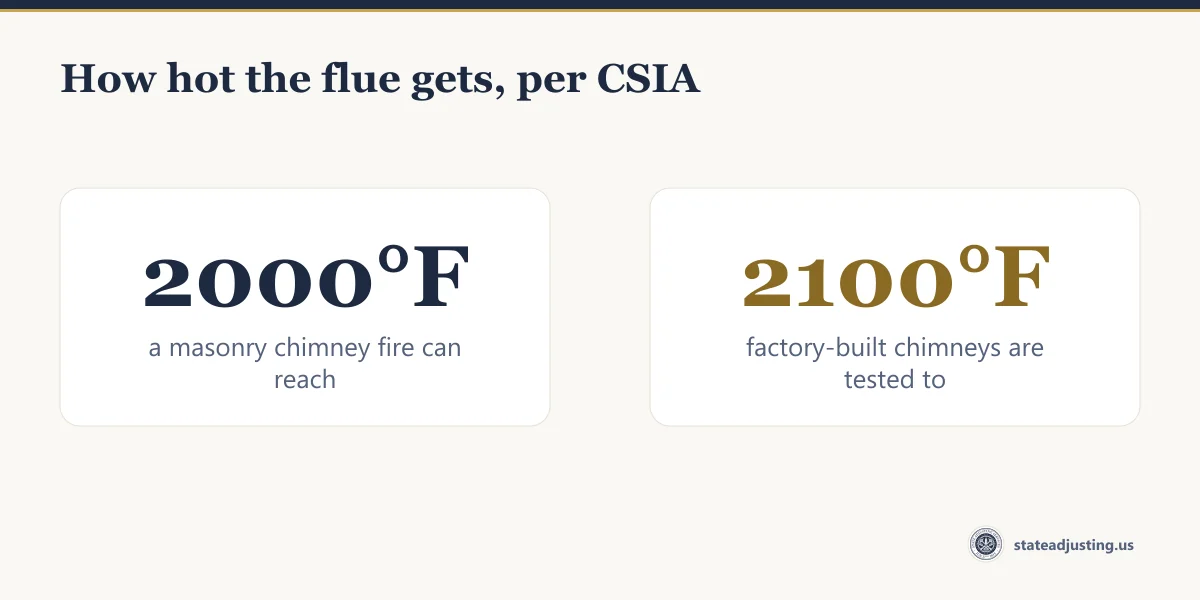
Brick or block around a clay or other liner. CSIA puts a masonry chimney fire at around 2000°F, enough to melt mortar, crack tiles and collapse a liner. The sweep's report names the repair that makes the flue safe again, and that is the scope to set beside the carrier's estimate. A line for cleaning is not a liner repair.
Factory-built metal
A listed metal system, often inside a framed chase. CSIA says these are tested to flue temperatures up to 2100°F and can still be damaged by a chimney fire, and that a damaged one should no longer be used and must be replaced. An estimate that prices a patch on such a system is the line to question, with the sweep's report attached.
What else the same fire can reach
A chimney fire seldom stops at the flue. Put these on the claim together, under the same date of loss:
- Roofing around the chimney, scorched where burning creosote landed.
- Attic framing, sheathing and insulation beside the chimney, wherever the heat crossed the gap to wood.
- Soot and smoke odor on walls, ceilings and carpet in the rooms around the fireplace.
- Belongings in those rooms: upholstery, curtains, clothes in a closet that shares the chimney wall.
- Water that arrives weeks later through a crown or flashing the fire cracked. Note the date you first see it.
- A tarp or cover over the chimney top and other steps to keep water out. Our guide to emergency mitigation and board-up bills explains which receipts to keep.
If the denial letter says creosote or neglect
Ask for the reason in writing, with the exact exclusion it relies on. Illinois rules already require that. Under 50 Ill. Adm. Code 919.50(a)(1), when a first-party claim is denied or paid for less than the amount claimed, the company must give a reasonable written explanation within 30 days after its investigation is complete, setting out the definition, limitation, exclusion or condition the decision rests on.
Then put that sentence next to your evidence. A letter that names only wear and tear leaves open the fire damage that followed, and that is the question to send back in writing. If the decision rests on the carrier's own inspector, ask for that inspector's report and photographs with the rest of the claim file. Our guide to the first week after a denied claim lists the requests to send and the order to send them in.
The first week after a chimney fire
- Stop using the fireplace or stove connected to that chimney until it has been inspected.
- Photograph the cap, the roof around the chimney, the firebox, the damper and any soot in the rooms, before anyone cleans.
- Write down the date, the time, what you heard or saw, and whether the fire department came. If it did, ask the department for its report.
- Find your last sweep invoice and any home inspection report that mentions the chimney.
- Book the Level 2 inspection, and report the claim to your carrier promptly.
- When the carrier's estimate or letter arrives, send it to us with the policy. We review fire and smoke damage claims free of charge. Our fee is a percentage of what is recovered, agreed in writing and capped by Illinois law: $0 upfront, and no recovery means no fee. You can send the documents here, and our claim process page shows what happens after that.
Questions we get about this
Does homeowners insurance cover a chimney fire?
Usually, as fire damage to the house under the dwelling coverage, with fire and smoke damage to belongings under the named perils for contents. The disputes are usually about whether a fire happened and whether the damage is new or old wear. Your own policy and its endorsements govern.
Will my claim be denied because the chimney had creosote in it?
Creosote is what burns in a chimney fire, so finding it does not settle whether the damage is covered. Carriers do argue neglect or wear and tear. The answer is evidence: a Level 2 inspection report, your last sweep record, and photographs taken before anything was cleaned.
What inspection do I need after a chimney fire?
A Level 2 inspection by a certified sweep. The CSIA procedure, which references NFPA 211, recommends one after a chimney fire. It includes a video scan of the chimney interior, the roof, accessible attics and every flue in the chimney.
How do I prove a chimney fire happened if I never saw it?
From the chimney itself. CSIA lists the signs: puffy or honeycombed creosote, a warped damper or metal parts, cracked or collapsed flue tiles, a discolored or distorted rain cap, creosote flakes on the roof or ground, cracks in outside masonry and smoke escaping through mortar joints. Have the sweep document each one before cleanup.