Contents pack-out after a fire or water loss: who pays and what to check

A contents pack-out insurance claim usually carries three separate bills: the crew's labor to box up and move your belongings, the cleaning or replacement of the things that were damaged, and the storage while the house is repaired. Your homeowners policy can pay all three, but not always under the same coverage, and the paperwork you sign on the day the truck arrives decides a lot of what follows. This guide walks through who pays each part, the policy sentences that apply, and what to check before the boxes leave and when they come back.
A pack-out is common after a fire, a smoke loss or a large water loss, when rooms have to be emptied before walls, ceilings and floors can be opened up. The belongings go to a warehouse, get sorted into cleanable and non-salvageable, and come back weeks or months later in a pack-back. We are licensed Illinois public adjusters, not attorneys, and the wording of your own policy governs every answer below.
Moved to reach the walls, or moved because it is damaged
The first question on any pack-out bill is why each item left the house. Furniture moved only so the crew can tear out wet drywall is part of the building repair. A smoke-coated sofa sent away for cleaning is part of the contents claim. The same truck often carries both, and the two halves are paid from different parts of the policy.
Moved so the house can be repaired
Usually the dwelling estimateClean dining chairs and a bookcase standing in front of a wall that has to come out. Nothing is wrong with them; they are in the way.
Packing, moving and later returning them is labor the building repair needs, so it is normally written into the dwelling (Coverage A) estimate alongside the drywall and flooring.
Moved because the item itself was damaged
Usually the contents coverageClothing that smells of smoke, a rug soaked by a burst pipe, dishes coated in soot.
Their cleaning, repair or replacement belongs to personal property (Coverage C), along with any packing that is part of getting them cleaned. This side counts against your contents limit.
Why it matters: the dwelling and contents coverages have separate limits, and a contents limit used up on moving labor leaves less for the things you actually lost. When the estimate shows one lump line called pack-out, ask the adjuster in writing which coverage it sits under and why. Our guide to building the contents inventory after a fire covers the list that the contents side is paid from.
Four sentences in the policy that decide a pack-out
Most homeowners policies are built on the special form published by the Insurance Services Office, or on a carrier form that copies its structure. The quotes below are from the May 2011 edition, HO 00 03 05 11, as filed with the Maine Bureau of Insurance. Your policy may number them differently or change the wording; look for the same headings.
Property removed
We insure covered property against direct loss from any cause while being removed from a premises endangered by a Peril Insured Against and for no more than 30 days while removed.
At pack-out this means a dropped television on the way to the truck can be paid even though dropping is not a fire or water loss. The protection stops after 30 days, and storage often lasts longer. Carriers also read it differently when the damage has already happened and nothing is still threatening the house. For the months in the warehouse, ask the restoration company for proof of the insurance that covers customers' goods in its care.
Reasonable repairs
We will pay the reasonable cost incurred by you for the necessary measures taken solely to protect covered property that is damaged by a Peril Insured Against from further damage.
Getting wet or sooty belongings out quickly, before mould or acid soot sets in, is the kind of protective step this covers. It does not raise any limit, so the cost still comes out of the coverage the damaged property sits under.
Duties after loss: the inventory and showing the damage
Prepare an inventory of damaged personal property showing the quantity, description, actual cash value and amount of loss.
The same condition requires you to show the damaged property as often as the carrier reasonably asks. A pack-out inventory made by the crew can serve as the backbone of this list, but it is your duty, so read it rather than assume it is complete.
Abandonment of property
We need not accept any property abandoned by an insured.
The carrier does not have to take ownership of damaged things you leave behind or throw out. Combined with the duty to show the damaged property, it is the reason non-salvageable items should be kept, or at least fully photographed and listed, until the adjuster has seen them.
One more sentence often matters: additional living expense pays any necessary increase in living costs while the home is not fit to live in. Some carriers place storage there rather than under contents. Our article on additional living expenses explains how that coverage is counted.
What a box label should tell you months later
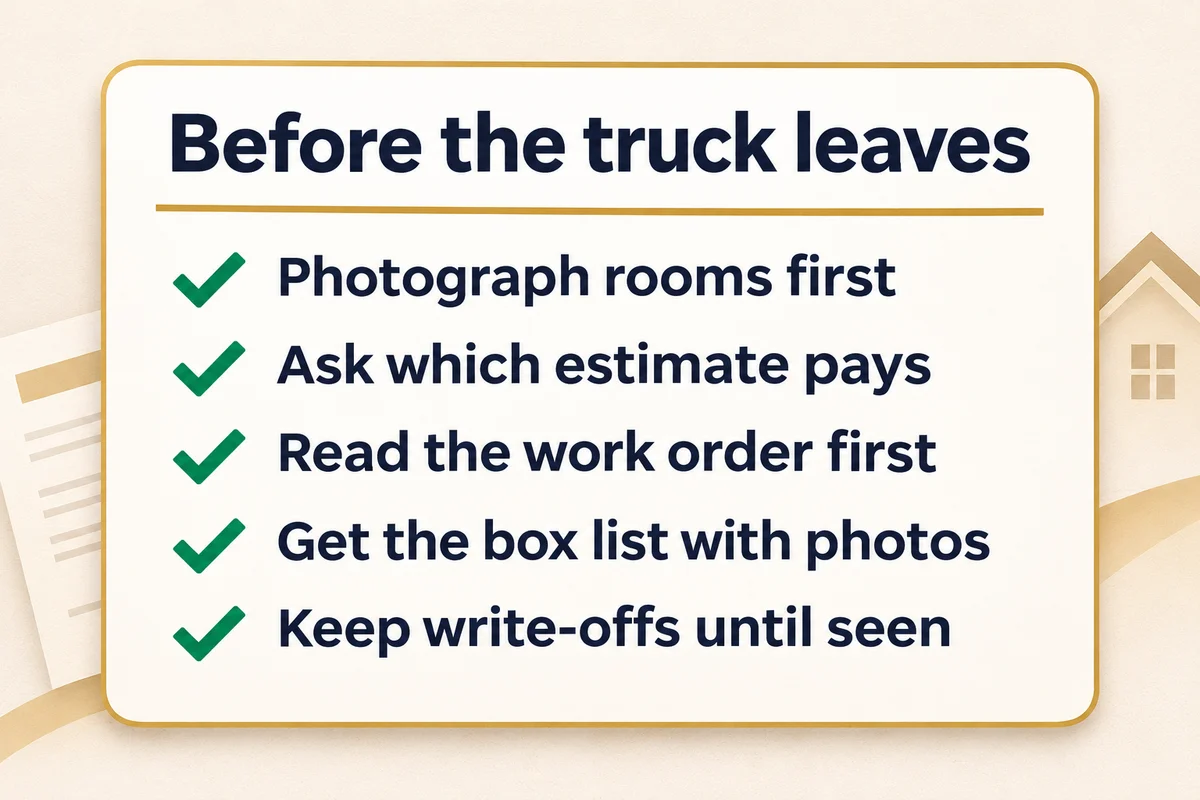
Every box that leaves should be traceable to a room and to a photo. Restoration companies use handwritten sheets, photo labels or bar codes; any of them works if the fields are filled in. Ask to see one finished box before the crew does the rest of the house.
| Box 37 of 112 | |
|---|---|
| Room | Second floor, back bedroom |
| Where in the room | Dresser, top two drawers |
| Contents | Sweaters (9), scarves (4), jewelry box, closed |
| Condition at packing | Smoke odor, light soot on the jewelry box lid |
| Sent for | Cleaning and deodorizing |
| Photo numbers | IMG 0412 to 0415 |
The room and position let you prove where an item was when the fire or water reached it. The condition line stops a later argument that the damage happened in storage, or that it was never there. Counts inside the box are what you check against at pack-back. A jewelry box packed closed should be listed as closed, and valuables such as jewelry, cash and documents are better kept with you: the policy caps what it pays for some of them, such as jewelry stolen or cash lost, and the crew should not be the only witness to what was inside.
The non-salvageable list: what to ask before anything is thrown out
At the warehouse, the crew sorts items into those worth cleaning and those that are not. The second group becomes your largest contents line, so it deserves the most care. Ask for the list in writing with a photo of each item, and keep the items until the adjuster has agreed to the list.
| Kind of item | Why a crew often writes it off | What to ask before disposal |
|---|---|---|
| Mattresses, pillows, upholstered furniture | Smoke odor or water soaked deep into foam, or sewage contact | Was cleaning tried or priced? If cleaning would cost more than replacing, is that written down? |
| Food, medicine, cosmetics | Exposure to heat, smoke or dirty water | Is every item photographed and counted? These are easy to forget on an inventory. |
| Electronics | Soot is acidic and conductive, and water reached the boards | Was it tested, or written off by type? Model and serial numbers recorded? |
| Papers, photos, books | Water and smoke damage that cleaning cannot fully reverse | Can family photos or records go to a document drying service before a decision? |
| Antiques and heirlooms | Finish damage, warping, odor | Can a specialist restorer look at it? Replacement value for a one-off piece needs an appraisal, not a catalogue price. |
The non-salvageable list is priced by the carrier like any other contents loss: replacement cost, less depreciation for age and wear, with the withheld part paid after you replace the item on a replacement cost policy. Our guide to how used household goods are depreciated covers that step.
One pack-out, four lines on the claim
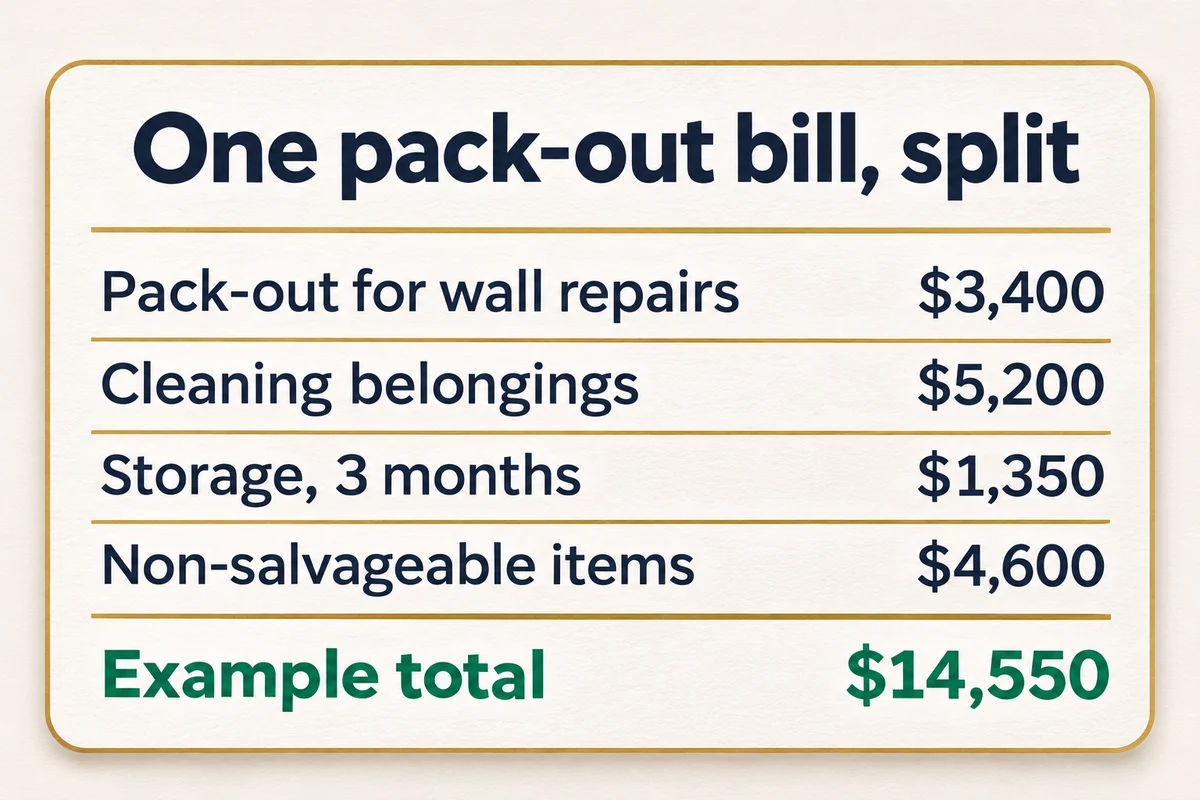
A single pack-out after a kitchen fire might sort out like this. The figures are an example we made up to show the split, not a quote, a price list or a result of ours.
| Line | Where it usually goes | Amount |
|---|---|---|
| Pack-out and pack-back of rooms cleared for wall and floor repair | Dwelling estimate | $3,400 |
| Cleaning and deodorizing belongings sent to the warehouse | Contents | $5,200 |
| Warehouse storage, 3 months at $450 | Contents or living expense, by the carrier's reading of the policy | $1,350 |
| Non-salvageable items at replacement cost | Contents, depreciation held back until replaced | $4,600 |
| Example total before the deductible | $14,550 | |
The sum is $3,400 + $5,200 + $1,350 + $4,600 = $14,550. The deductible normally applies once to the whole loss, not once per line. If the carrier put all four lines under contents, $14,550 would come out of the contents limit instead of $11,150, which matters most on a large loss where that limit is already tight.
What to sign on pack-out day, and what to read first
The crew will usually ask for a work authorization before it starts. Read it for three things. Who it bills: many say the insurer is billed directly, with you responsible for anything the insurer does not pay. Whether it assigns your claim benefits to the company: that hands part of your claim to the vendor, and it is worth understanding before you agree. And who chose the vendor: you can use the company your carrier suggests or another one, and a contractor in Illinois may not negotiate your claim for you, as our article on the insurer's preferred contractor explains.
Before the first box closes, walk every room with your phone and film it slowly, drawers and closets open. Those videos are the only record of the house as it was if the crew's inventory turns out short.
Pack-back day: checks before you sign the delivery sheet
- Count the boxes against the number on the labels before the crew leaves. A missing box is far easier to find while the truck is still in the driveway.
- Open the boxes holding valuables, electronics and fragile items first, and test the electronics that were cleaned.
- Smell the textiles and upholstery. Smoke odor that comes back after cleaning is a reason to send an item back or move it to the non-salvageable list.
- Photograph any breakage on the spot, next to the box label, and write it on the delivery sheet before signing.
- Ask for the final inventory showing what came back cleaned, what was written off and what was disposed of, and compare it with your own list.
- Send the carrier your replacement receipts for written-off items to collect the depreciation that was held back.
Breakage or loss in the vendor's care is normally a matter between you and the restoration company and its insurance, which is why the condition line on each box label matters.
When a pack-out claim needs a second read
We see the same few problems in these files: pack-out labor charged entirely to contents, storage refused as not covered, a non-salvageable list thrown out before anyone priced it, and a contents inventory that stops at what the crew happened to write down. We read the scope against your policy and negotiate the contents and the building claim together, for a percentage of the recovery set by written contract and capped by Illinois law, with nothing upfront.
If your belongings are in storage now, or about to go, send us the carrier's estimate and the crew's inventory through our contact page, or call (630) 297-8136 Monday through Friday, 7:00 AM to 7:00 PM, and Saturday and Sunday, 9:00 AM to 5:00 PM. Our pages on fire damage claims and water damage claims explain how we work each kind of loss.
Questions we get about this
Does homeowners insurance pay for a contents pack-out?
Usually yes when the loss itself is covered. Packing and moving belongings only so the house can be repaired is normally written into the dwelling estimate, while cleaning or replacing damaged belongings is paid under contents. Storage may sit under contents or additional living expense, depending on how the carrier reads your policy. Your own policy wording governs.
Who pays if my belongings are broken or lost in storage?
The standard special form covers property while it is being removed from a premises endangered by a covered peril and for no more than 30 days while removed. After that, loss in the restoration company's care is normally between you and the company and its insurance, so ask for proof of that insurance and note the condition of each box at packing.
Can the restoration company throw out items it calls non-salvageable?
Ask it not to until the adjuster has agreed to the list. The policy requires you to show the damaged property when the carrier reasonably asks, and the carrier does not have to accept property that was abandoned. Keep the items, or at least photograph and list each one, before disposal.
Do I have to use the restoration company my insurer recommends?
No. You can use the company your carrier suggests or one you choose. Read the work authorization before signing, especially any part that bills the insurer directly or assigns your claim benefits to the company.