Damage firefighters cause putting out a fire: what the claim covers

Damage that firefighters cause while putting out a fire normally belongs in the fire claim. A square hole cut in the roof, windows broken to let smoke out, a forced front door, ceilings pulled down and floors soaked by hose water all trace back to the fire, and the standard homeowners form has no exclusion that takes them out. The harder parts are the belongings soaked by the hoses, the things carried out to the lawn, and a bill from a fire department that does not serve your town. Your own policy's wording governs each of these, so below are the lines to find in it and how to keep the firefighting damage inside one fire estimate.
What the crew did to the house, and which line pays for it
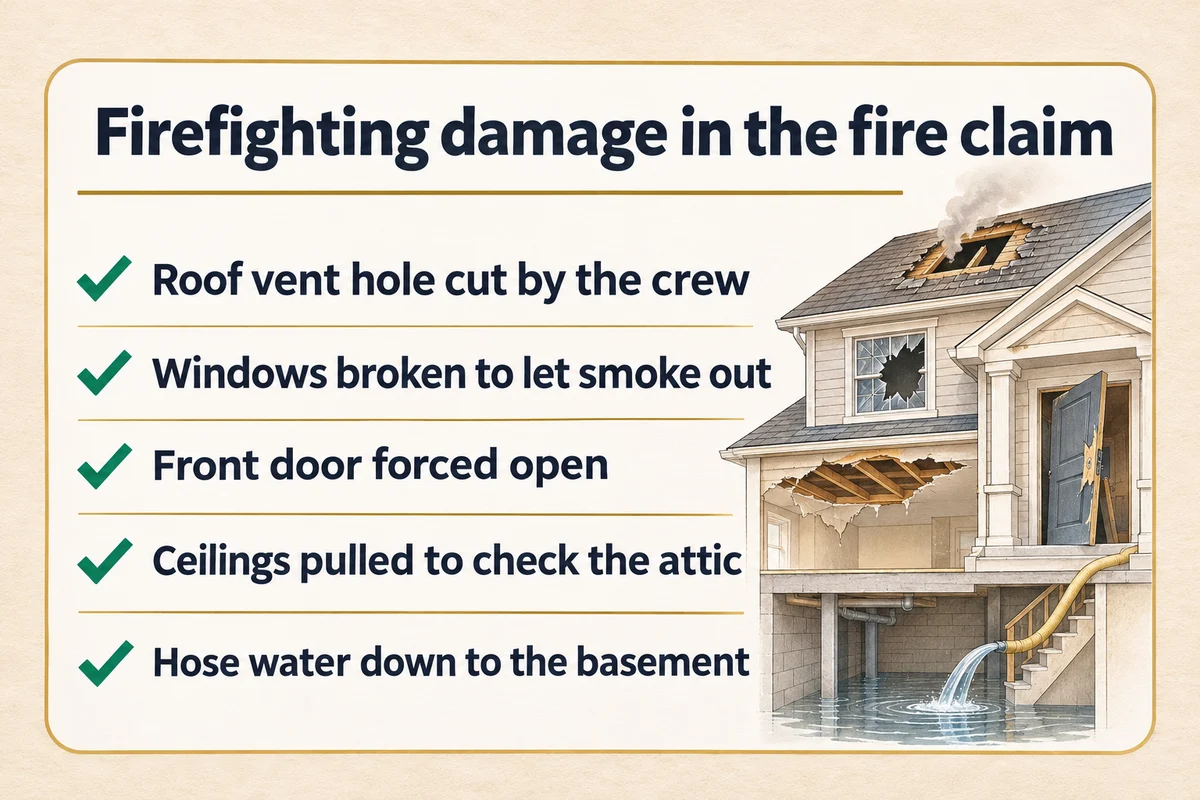
Crews open a burning building on purpose: to let heat and smoke out and to reach fire hiding in the attic or inside a wall. Here is a two-storey house after a kitchen fire that climbed into the attic, with each kind of firefighting damage numbered.
- The vent hole goes through shingles, underlayment and decking. Price the cut and the roofing around it so the new section ties in, not a square patch. Dwelling, Coverage A
- Drywall pulled down with hooks to look for fire above it brings the insulation down too. Both go on the estimate. Coverage A
- Glass broken to vent smoke means a new window, and plywood over the opening until it arrives. Coverage A, plus emergency costs
- A forced door usually means a split frame and a broken lock as well as the door itself. Coverage A
- A wall opened to chase fire inside it includes the wiring and insulation that were cut or soaked. Coverage A
- Water that ran down two floors wets ceilings, walls, flooring and whatever was stored below. Coverage A for the building, Coverage C for belongings
- Things carried out of the house are still yours to claim, and a separate line protects them while they are outside. Coverage C and Property Removed
Why hose water is part of the fire, not a separate water claim
Hose water is part of the fire loss because the dwelling section of the common homeowners form covers every physical loss that is not excluded, and its water exclusion does not mention fire fighting. In the 1991 edition of the Homeowners 3 form from the Insurance Services Office (ISO), in a copy filed with the Nevada Division of Insurance, Coverages A and B begin this way:
We insure against risk of direct loss to property described in Coverages A and B only if that loss is a physical loss to property.
HO 00 03 04 91, Section I, perils insured against, Coverages A and B
The water exclusion in the same form covers three things: flood and surface water, water that backs up through sewers or drains or overflows from a sump, and water below the surface of the ground. A fire hose is none of them. A cut roof, a forced door and a broken window do not appear on the exclusion list at all.
So if an adjuster opens a separate water file for the ceilings the hoses soaked, ask why. Two files can mean two deductibles and two estimates that each leave out the overlap. One fire, one claim and one deductible is what this wording supports; if the carrier splits it, ask in writing for the policy line it relies on. Our guide to reading the carrier's estimate shows where to check that the firefighting damage is in it.
Belongings soaked by the hoses are the harder half
Your belongings sit under Coverage C, which in the standard form covers only the perils it names. Fire or lightning is the first on that list, and smoke has a line of its own:
Smoke, meaning sudden and accidental damage from smoke. This peril does not include loss caused by smoke from agricultural smudging or industrial operations.
HO 00 03 04 91, Coverage C, peril g
Water from a hose is not a named peril of its own. The case for paying it is plain: the fire caused the loss, and the water is how the crew kept the fire from causing more. Put soaked items on the same contents inventory as the burned ones, and photograph them where they sat before anyone moves them. If the carrier calls them water damage, ask which words of the policy it is reading. When a restoration crew moves the soaked items out for cleaning, our article on contents pack-out and storage explains how that bill is split.
Two lines most people never read: the fire department charge and property removed
Both sit among the additional coverages of Section I, and each phrase in them matters.
Fire department service charge
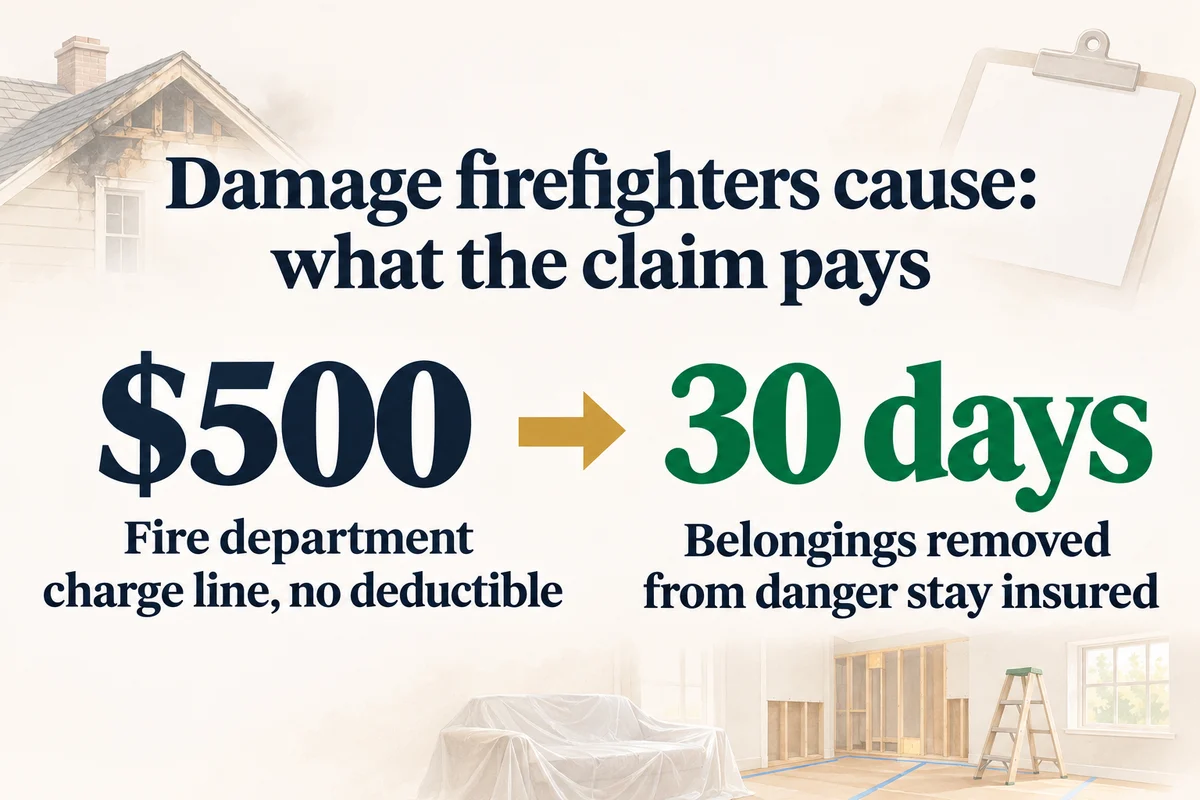
We will pay up to $500 for your liability assumed by contract or agreement for fire department charges incurred when the fire department is called to save or protect covered property from a Peril Insured Against. We do not cover fire department service charges if the property is located within the limits of the city, municipality or protection district furnishing the fire department response. This coverage is additional insurance. No deductible applies to this coverage.
- Up to $500
- The most this line pays in the base form. Some policies raise it, so look at your declarations page and endorsements.
- Assumed by contract or agreement
- Written for a charge you agreed to pay, such as a subscription with a department that is not your own.
- Within the limits of the department that responded
- If your own city or district came, this line does not apply. In that case there is usually no bill to pay anyway.
- No deductible
- Whatever the line pays is paid in full, on top of the dwelling limit.
Property removed
We insure covered property against direct loss from any cause while being removed from a premises endangered by a Peril Insured Against and for no more than 30 days while removed. This coverage does not change the limit of liability that applies to the property being removed.
- From any cause
- While the couch sits on the lawn, rain, theft or a dropped box are all covered, even though belongings at home are insured only against named perils.
- Endangered by a Peril Insured Against
- The fire, or the smoke, is the reason the things were moved.
- No more than 30 days
- After that, the normal named perils apply again, so bring things inside or into storage first.
- Does not change the limit
- It is protection for a time, not extra money.
When an Illinois fire department sends a bill
Most Illinois homeowners never receive one, because a fire protection district may not charge its own residents. The Fire Protection District Act lets a district charge people who live outside it, within limits set out in 70 ILCS 705/11f.
What section 11f allows
- Charges only against persons, businesses and other entities who are not residents of the district.
- No charge to residents, or to people in an unprotected area who pay the district an amount equal to its fire protection tax.
- At most $250 per hour, and at most $70 per hour per firefighter who responds, plus extraordinary expenses for materials used.
- No charge at all when the total would be less than $50.
The arithmetic with the statute's hourly cap and the base form's policy line, which yours may raise:
Such a bill usually reaches an owner whose house sits in an area no district covers, or an owner who lives outside the district, such as a landlord. A rental house is often insured on a dwelling policy, whose wording can differ; our guide to claims on a rented house explains those policies. Send the bill to your carrier with the claim and ask, in writing, whether the fire department line applies. Whether a charge set by statute counts as one assumed by contract or agreement is for the carrier to answer, and disputing a large bill with the district is a question for an attorney.
Four things an adjuster may say, and the line that answers each
| What you may hear | What to point to |
|---|---|
| The water damage is a separate claim. | Coverages A and B insure physical loss unless it is excluded. The water exclusion lists flood, backup and ground water, not a fire hose. Ask which exclusion they mean. |
| We pay for fire damage, not for what the fire department broke. | The same open-perils sentence. A cut roof or a forced door is physical loss, and no exclusion names it. |
| The furniture was ruined by rain on the lawn, not by the fire. | Property Removed: direct loss from any cause, for up to 30 days after it was moved out of danger. |
| The board-up bill is more than we pay. | Reasonable Repairs pays the reasonable cost of measures taken solely to protect the property from further damage. An itemized invoice and photos of each opening support it. |
Before the board-up crew closes the openings
The first day decides how easy the firefighting damage is to prove later.
- Photograph every opening the crew made, from outside and from inside: the roof cut, each window, the door frame, the pulled ceilings, the opened wall. Once plywood and tarps go on, the size and place of each cut are hard to show.
- Photograph each wet room, the basement ceiling and the floor below it, and note how far the water spread.
- List what was carried out of the house, where it was put and on what date. The Property Removed line runs for 30 days from the move.
- Call the carrier and report one fire loss that includes the firefighting damage. Prompt notice is the first duty after a loss in the standard form.
- Let the board-up and drying go ahead. The form asks you to make reasonable and necessary repairs to protect the property and to keep an accurate record of what they cost. It also excludes neglect, meaning a failure to use all reasonable means to save and preserve the property at and after the time of a loss. A roof cut left open for weeks of snow invites that argument. Our guide to board-up and emergency work covers those first invoices.
- Ask the fire department for its incident report. Departments and districts in Illinois are public bodies, so you can request it in writing under the state's Freedom of Information Act; parts tied to an open investigation may be held back.
- Ask your contractor for one estimate that prices the fire damage and the firefighting damage together, room by room.
When to bring us in
A second look is worth it when the firefighting damage reached rooms the fire never touched, when the carrier puts the hose water into a separate claim, when belongings from the lawn are refused, or when the contents list runs to hundreds of items. Our pages on fire damage claims and smoke damage claims describe how we work these losses.
As licensed Illinois public adjusters, we review your policy and the carrier's estimate first, at no cost to you. If we take the claim, our fee is a percentage of the recovery that Illinois law regulates, agreed in writing and paid out of the settlement; with no recovery there is no fee. Reach us through the contact page; the office answers seven days a week.
Questions we get about this
Does homeowners insurance cover damage caused by firefighters?
Usually yes, as part of the fire claim. The dwelling section of the standard homeowners form covers physical loss unless an exclusion applies, and no exclusion names a vent hole cut in the roof, broken windows, a forced door or water from a fire hose. Your own policy's wording governs.
Is water damage from a fire hose a separate water claim?
It does not have to be. The water exclusion in the standard form lists flood and surface water, sewer or drain backup and water below the ground, not water used to put out a fire. Ask the carrier to handle it in the fire claim with one deductible, or to name in writing the policy line it relies on to split it.
Will my policy pay a fire department bill?
The standard homeowners form has a fire department service charge line that pays up to $500 with no deductible, for a charge you agreed to by contract or agreement. It does not apply when the property is inside the city or district that responded. In Illinois, a fire protection district may not charge its own residents.
Are belongings carried out of the house during a fire still covered?
Yes, under the property removed line of the standard form. It covers belongings against direct loss from any cause while they are removed from a premises endangered by a covered peril, for no more than 30 days. Bring them back inside or into storage before that time runs out.