How to Read the Carrier's Estimate: RCV, Depreciation, O&P and the Summary Page

Read it backwards. The summary page at the end shows replacement cost, then subtracts depreciation and your deductible to reach the first check. Then go forward through the line items and check the quantities, the units and what is missing. The big number at the top is not what you are being paid.
Learning how to read an insurance estimate is the single most useful hour a homeowner can spend during a claim. The document that lands in your inbox after the adjuster's inspection is not a letter and not an offer in the ordinary sense. It is a spreadsheet produced by estimating software, usually twenty to sixty pages long, and almost everything that will later be argued about is already visible in it — priced, quantified, and easy to miss.
This guide walks through the four parts of a carrier estimate, what each total on the summary page means, how a single line item is built, when overhead and profit belongs on the job, and what is most often absent. We are licensed Illinois public adjusters rather than attorneys, so this is how these documents behave in practice. Your own policy governs what is actually covered.
What is actually in a carrier's estimate?
Four parts, always in the same order: a header identifying the claim and the pricing database, the line items grouped by room or by elevation, a set of recap pages that total everything by category and by tax, and a summary page. The summary page is the one you should read first.
| Part | What it contains | What to check |
|---|---|---|
| Header | Claim number, date of loss, estimator, price list code | The price list code and its date — that is the pricing you are being paid at |
| Line items | Every task, grouped by area, with quantity, unit price and depreciation | Whether each damaged area appears at all, and the quantities |
| Recap pages | Totals by category, sales tax, overhead and profit | That material sales tax and O&P appear where they should |
| Summary | RCV, depreciation, ACV, deductible, prior payments, net claim | The arithmetic, and which figure the cheque matches |
The price list code deserves a moment because nobody ever looks at it. Estimating software prices work from a regional database that is republished on a regular cycle, and the code printed in the header names the region and the version being used. An estimate written on an old price list quietly prices your repair at older material costs. It is a fair question to ask which price list was applied and why, and the answer is printed on the document you already have.
What do RCV, ACV and "net claim" mean on the summary page?
Replacement cost value (RCV) is what the repair prices out at today. Depreciation is the wear subtracted for the age and condition of what was damaged. Actual cash value (ACV) is RCV minus that depreciation. Your deductible comes off next, and what remains is the net claim — the first cheque.
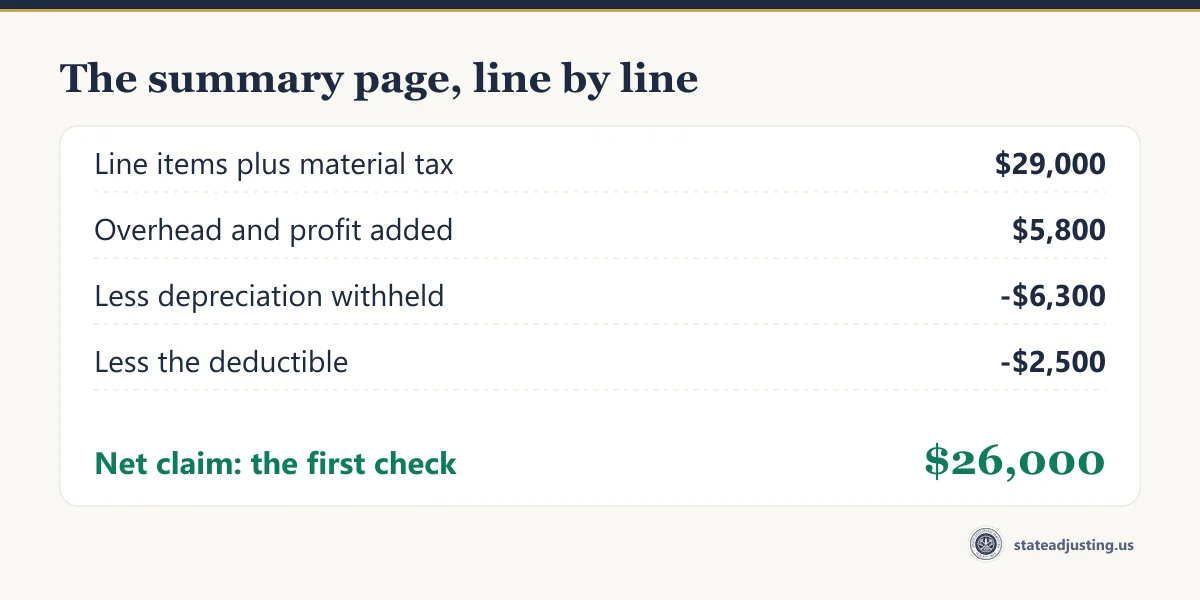
Take a hail loss involving roofing, gutters, exterior paint and an interior ceiling repair. The line items and material sales tax total $29,000. Because four trades have to be coordinated, overhead and profit of ten per cent each is added, or $5,800, bringing replacement cost to $34,800. The estimator withholds $6,300 of depreciation, leaving an actual cash value of $28,500. The $2,500 deductible comes off that, and the first cheque is $26,000.
| Line on the summary | In this example | What it means for you |
|---|---|---|
| Line item total + material tax | $29,000 | The priced work before any markup |
| Overhead and profit | $5,800 | The general contractor's cost of running the job |
| Replacement cost value | $34,800 | The full price of the repair as written |
| Less depreciation | $6,300 | Held back for now; recoverable or not, see below |
| Actual cash value | $28,500 | What the damaged property was worth as it stood |
| Less deductible | $2,500 | Your share, applied once to the loss |
| Net claim | $26,000 | The first payment |
| Net claim if depreciation is recovered | $32,300 | Only if the work is done and documented |
Two traps live on this page. The first is reading the RCV figure as the settlement — $34,800 is the price of the repair, not the money arriving. The second is the prior payments row further down. If an emergency advance was already issued, it is subtracted here, so a small net claim can sit under a perfectly reasonable estimate. Check what the row is netting out before concluding the offer is low. Our guide to actual cash value against replacement cost covers that gap in full.
How do I read a single line item?
Every line has the same shape: a description, a quantity, a unit of measure, a unit price, the resulting RCV, an age or condition entry, a depreciation percentage, and an ACV. Errors usually hide in the quantity and the unit, not in the price, because the price comes from the database and the quantity comes from a person.
| Field | What it is | Where it goes wrong |
|---|---|---|
| Description | The task, often abbreviated | "R&R" removes and replaces; "detach and reset" reinstalls the existing item. The second is far cheaper and wrong if the item cannot survive removal |
| Quantity | How much of the task | Measured from the field sketch. Compare it against your own measurements or the roof report |
| Unit | SF, LF, SQ, EA, HR, DA | Roofing is priced per SQ — one square is 100 square feet. Confusing SQ with SF is a hundredfold error |
| Unit price | From the regional price list | Rarely the argument. If it looks wrong, the price list version is the thing to question |
| Age / condition | Drives the depreciation rate | A roof recorded as older than it is costs you real money on every roofing line |
| Depreciation % | The wear deducted | Check whether it is applied to labour as well as materials |
Waste is the other quiet one. A roof with many hips and valleys consumes noticeably more material than its measured area, and flooring and siding behave the same way. Ask whether a waste allowance was included in the quantities, because a complex roof priced at its bare square footage cannot be built for the money.
What is overhead and profit, and when should it be there?
Overhead and profit — "O&P" on the recap — is the cost of a general contractor running the job rather than a single trade doing one task. It is customarily written as two separate lines of ten per cent each on the subtotal. Where a repair needs several trades sequenced, it is normally part of the price.
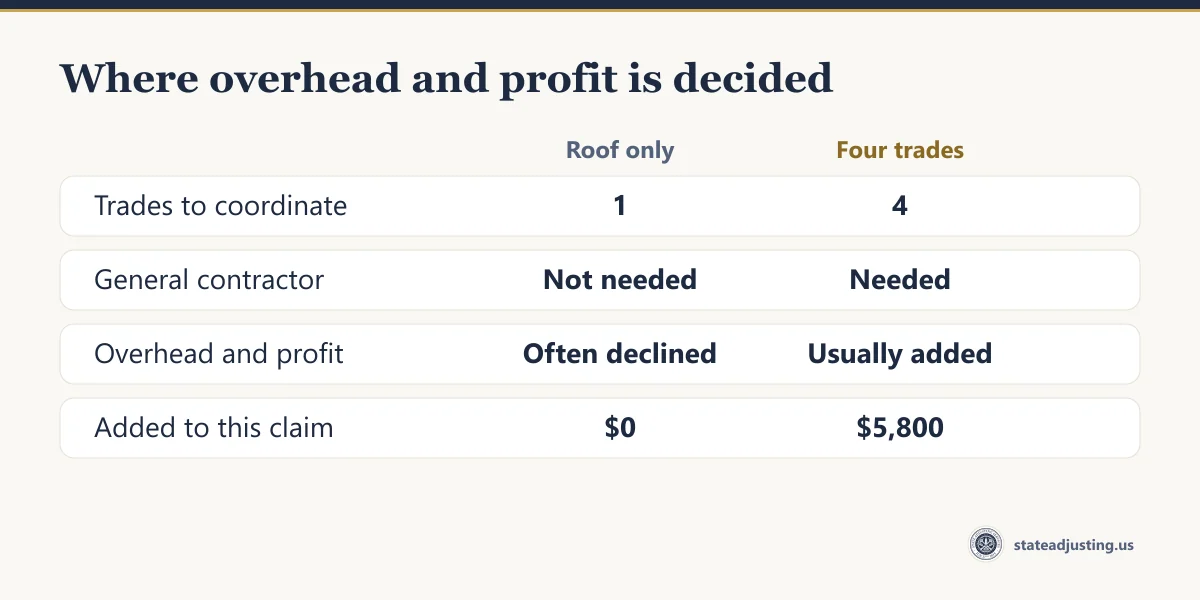
The common industry threshold is three or more trades. A roof replacement on its own is one trade, and carriers frequently decline O&P on it. The same storm that also broke gutters, damaged siding and soaked a ceiling now needs somebody scheduling four trades in order, protecting the interior between them and carrying the liability — and that is what the two lines pay for. On the example above, that distinction is worth $5,800 on a $29,000 job.
None of this is a legal entitlement, and the policy wording plus the facts of the repair decide it. But it is worth knowing that the absence of O&P on a multi-trade estimate is a decision somebody made, not a rule of nature, and it is one of the most common single omissions we see. Sales tax on materials belongs on the recap too, at the local rate. Confirm it is there at all.
Is the depreciation coming back?
That depends on one word on your declarations page. If your policy settles on a replacement cost basis, the withheld depreciation is recoverable: you collect it after the work is completed and documented. If it settles on actual cash value, or a roof schedule applies, the depreciation is gone and the estimate will say non-recoverable.
The estimate itself usually tells you which. Look for a line reading "total recoverable depreciation" near the bottom of the summary — if it is there and it is not zero, there is a second cheque waiting on completed repairs. If the summary shows depreciation with no recoverable line, read your declarations page before you plan the repair budget, because the gap between the two outcomes in our example is $6,300. Going back for that money is a separate task with its own paperwork, and we have written about how recoverable depreciation is actually collected.
Depreciation applied to labour is a live disagreement in the industry and is treated differently by different carriers. Roofing labour does not wear out the way roofing material does. If your line items show depreciation taken against labour, ask on what basis — you are entitled to an explanation of how any figure in the document was reached.
What is most often missing?
Estimates are usually accurate about what they contain and incomplete about what they omit. These are the categories worth checking against your own walk-through before you accept the scope:
- Removal and disposal. Tear-off of every existing layer, dumpster, haul-away. A second layer of shingles that nobody recorded is money the contractor will spend anyway.
- Code-required items. Ice and water shield, drip edge, ventilation, permits. What the current code requires is not always what was on the house.
- Access and protection. Scaffolding, roof loading, covering landscaping and floors, moving contents out of a work area and back.
- Detach and reset work. Satellite dishes, solar equipment, gutters and downspouts that have to come off so another trade can work.
- Rooms nobody entered. Water and smoke travel. If the adjuster inspected two rooms and the damage reached four, the estimate can only describe two.
- Painting to a natural break. Paint stops at a corner, not halfway across a wall, which is a scope question rather than a coverage one.
Hail losses have their own recurring gaps, which we listed separately in what carriers routinely leave out of a hail estimate. The point is not that anything was concealed. An estimator writes what they observed in the time they had, from the ground and the roof, on one visit. Anything they did not see is not in the document, and the burden of raising it sits with you.
What to do next
Work through it in this order. Read the summary page and confirm the arithmetic and which figure the cheque matches. Check the deductible against your declarations page. Confirm every damaged area appears as its own section. Compare quantities against your own measurements. Look for O&P and material tax on the recap. Then find the recoverable depreciation line and note what it is worth.
Then give a copy to whoever is doing the repair, before they price it, and ask one question: can you build this scope for this money? A specific, priced gap is the thing a carrier can act on. "It seems low" is not, and a supplement almost always needs the line and the number, which is why how a claim file is worked starts with the document rather than with the phone call. A disagreement about the amount of the loss also has its own formal route through the appraisal clause if it stalls.
If the estimate does not look like it matches the damage, we review Illinois residential and commercial claims at no charge and no obligation — send us the estimate and tell us what happened. We are paid a percentage of what is recovered, agreed in writing and capped by Illinois law, so there is nothing to pay up front and nothing owed if there is no recovery. If the damage was hail, our hail claims page covers what these files usually involve.
Questions we get about this
What does RCV mean on an insurance estimate?
RCV is replacement cost value: what the repair prices out at today, before anything is subtracted. It is the largest number on the summary page and it is not the amount being paid. Depreciation and your deductible come off it to reach the first cheque, and whether the withheld depreciation ever comes back depends on your policy.
Why is the check smaller than the estimate total?
Three deductions sit between them. Depreciation is withheld for the age and condition of what was damaged, your deductible is subtracted once, and any advance payment already issued is netted out on the prior payments row. On a replacement cost policy the depreciation is normally recoverable after the repairs are completed and documented.
Should overhead and profit be on my estimate?
It depends on the repair. O&P covers a general contractor coordinating the work, and the common industry threshold is three or more trades. A single-trade job is often written without it. If your repair needs several trades sequenced and the recap shows no O&P, that is a decision worth asking about rather than an automatic entitlement.
Can I ask the insurer to explain a line on the estimate?
Yes, and you should. Ask in writing, name the specific line, quantity or omission, and ask how the figure was reached. General objections rarely move a file; a specific priced gap can. Keep the exchange in email so the questions and the answers are both on the record.