Frozen fire sprinkler pipe burst: what the commercial policy pays
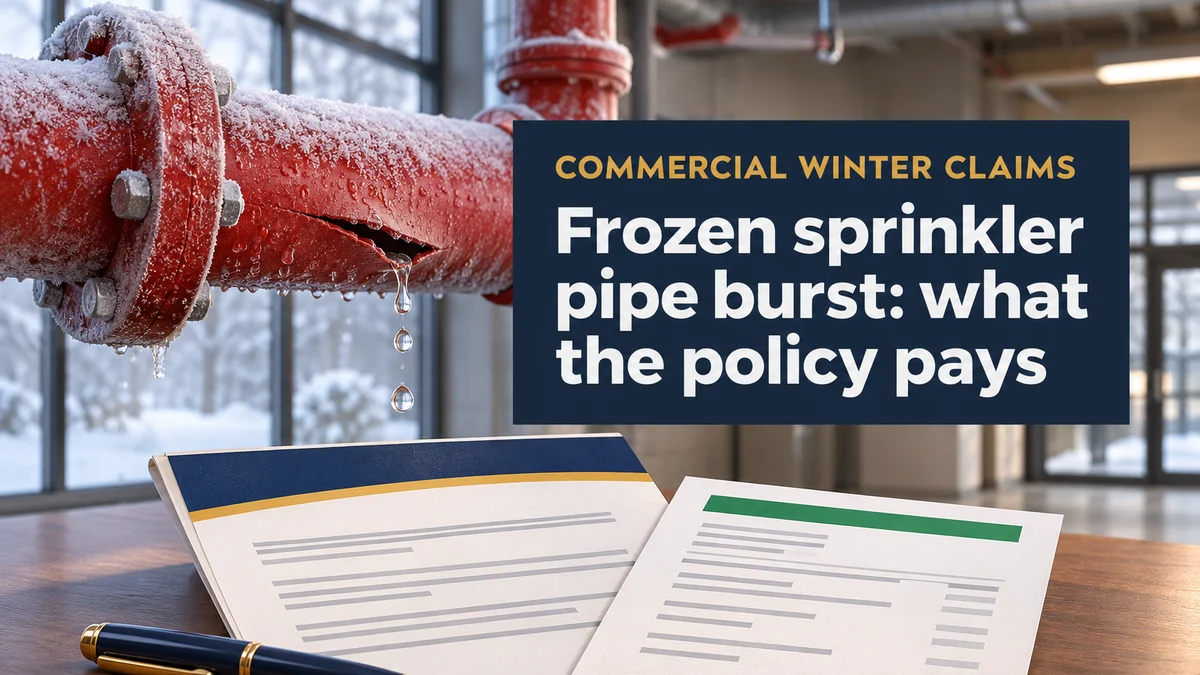
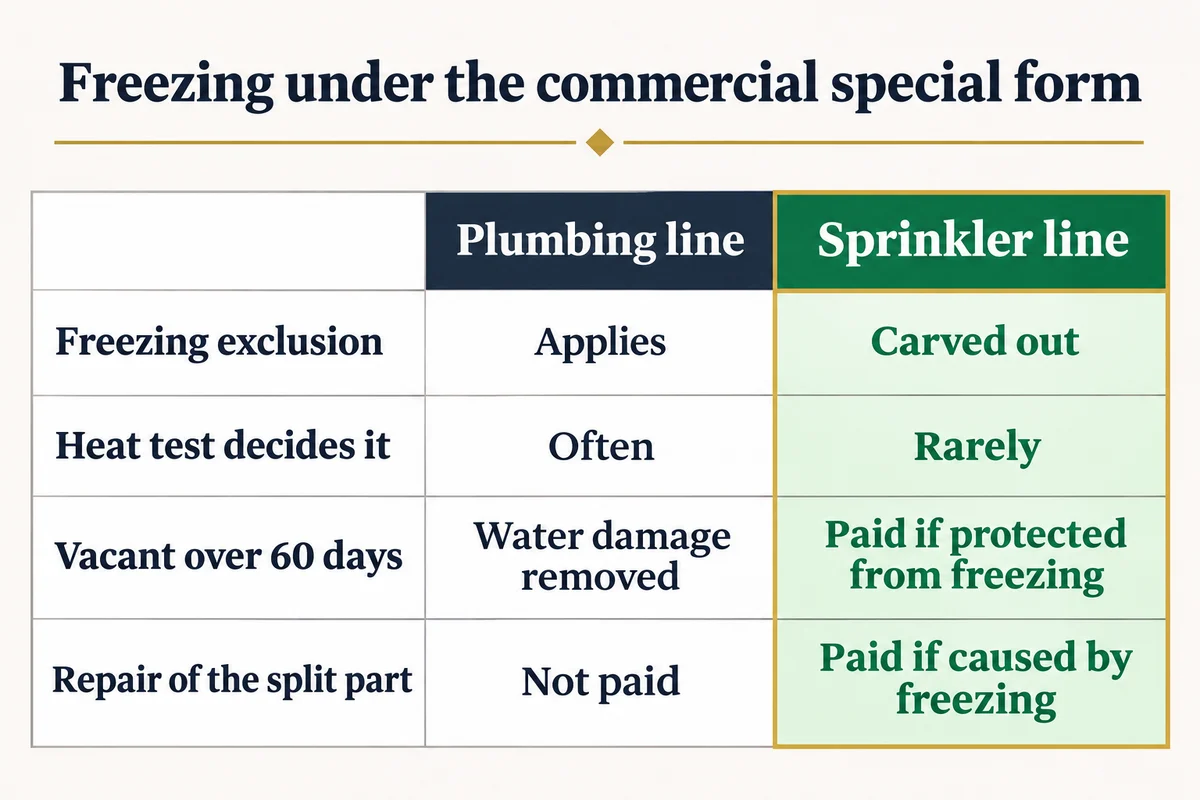
A frozen fire sprinkler pipe that bursts in a store, office or warehouse is usually covered by the building's commercial property policy, and the reason surprises many owners. On the widely used special form, the freezing exclusion that catches ordinary plumbing leaves fire protective systems out of it. So the question the carrier asks first is rarely whether you kept the heat on. It is whether the building had been vacant for more than 60 days, and if so, whether the sprinkler system was protected against freezing.
Those two sentences come from two different forms that sit in the same policy. Here they are side by side, with the words that do the work marked.
Water, other liquids, powder or molten material that leaks or flows from plumbing, heating, air conditioning or other equipment (except fire protective systems) caused by or resulting from freezing, unless: (1) You do your best to maintain heat in the building or structure; or (2) You drain the equipment and shut off the supply if the heat is not maintained.
A sprinkler line is outside this sentence, so the heat test written into it does not decide a sprinkler claim.
(After more than 60 consecutive days of vacancy, the form lists causes it will not pay for, and the second one reads:) (b) Sprinkler leakage, unless you have protected the system against freezing;
This is the sentence that can take the whole sprinkler claim away, and only in a building that counts as vacant.
The first quote is exclusion B.2.g of the ISO Causes of Loss Special Form, edition CP 10 30 09 17, as printed in a sample copy of the form published by New York State's Office of General Services. The second is the Vacancy condition of the ISO Building and Personal Property Coverage Form, edition CP 00 10 10 00, from a copy of the form hosted by the Independent Insurance Agents and Brokers of America. Many carriers write their own versions, and endorsements change both sentences. Your own declarations page and forms govern.
Why keeping the heat on is usually the wrong fight on a sprinkler break
Because the special form's freezing exclusion names fire protective systems as an exception, a frozen sprinkler line is read like any other sudden break: covered unless something else in the policy removes it. A denial letter that quotes the heat sentence against a sprinkler pipe is quoting a sentence that, on this form, does not reach it.
That matters most where sprinkler pipe actually freezes. Wet-pipe lines run through ceiling spaces over loading docks, above suspended ceilings next to outside walls, through unheated attic plenums of strip centers and into stairwells. The rented space below can be warm while the pipe above sits at the outdoor temperature. On a plumbing line, the carrier could argue about whether you did your best to heat that space. On a sprinkler line under the form quoted above, that argument has no clause to stand on.
The heat question does not vanish completely. It can come back in three ways:
- through an endorsement or a carrier's own form that rewrites the freezing exclusion without the sprinkler exception;
- through the vacancy condition, because a system that froze in an unheated empty building was, by definition, not protected against freezing;
- through the fourteen-day exclusion for continuous or repeated seepage, if a cracked fitting dripped for weeks before anyone saw it.
The same form also settles a smaller argument about the system itself. Its limitation C.4 says the carrier does not pay to repair the defect in a system that leaks, but it will pay to repair or replace damaged parts of fire-extinguishing equipment if the damage results in discharge from an automatic fire protection system or is directly caused by freezing. The split fitting and the burst heads are part of the claim, not your maintenance bill. The form's water damage extension adds the cost to tear out and replace the part of the building needed to reach and repair the system.
When does a commercial building count as vacant?
Under the building form, vacant is a measured test, not a feeling. A tenant's unit is vacant when it does not hold enough business personal property to conduct customary operations. For the owner of the whole building, the building is vacant unless at least 31% of its total square footage is rented to a lessee and used for customary operations, or used by the owner for its own operations, or both. Buildings under construction or renovation are not vacant.
That 31% line catches buildings that look busy from the street. A worked example with illustrative numbers:
One building, two square footage counts
- Total square footage of the building
- 40,000 sq ft
- Leased and operating: one tenant
- 10,000 sq ft
- Owner's own office in the building
- 2,000 sq ft
- Share in customary use
- 12,000 / 40,000 = 30%
- Add a 400 sq ft tenant before the freeze
- 12,400 / 40,000 = 31%
At 30% the building is vacant under the form. If it stayed that way for more than 60 consecutive days before the pipe burst, sprinkler leakage is paid only if the system was protected against freezing. At 31% the vacancy condition does not apply at all.
Three practical points follow. Count from the floor plan and the leases, not from the listing brochure, because common areas and storage rooms change the total. Keep the dates a tenant moved in and out, because the 60 days are consecutive and are counted back from the day of the loss. And if the building was being renovated, keep the permits and contractor invoices, since a building under renovation is not vacant under the form's own words. Our article on vacant and unoccupied property claims covers the rest of the vacancy condition, including the 15% reduction it applies to other losses.
How the two sentences play out in five buildings
These are common situations, read against the two forms quoted above. Your policy may add an endorsement that changes the answer, so treat the right-hand column as the starting reading, not a decision.
| The building | Sentence that decides it | Usual starting reading |
|---|---|---|
| Open retail store, the furnace failed overnight and a branch line over the sales floor split | Freezing exclusion, with its sprinkler exception | Sprinkler leakage claim, paid subject to the deductible and the policy's other terms |
| Occupied warehouse, the main froze in an unheated space over the dock doors | Freezing exclusion, with its sprinkler exception | Same reading; the cold dock is not a reason to deny on this form |
| Office suite empty for 45 days between tenants | Vacancy condition | Not yet vacant for more than 60 consecutive days, so the condition does not apply |
| Owner's building at 30% use for four months, heat kept on and the system checked | Vacancy condition | Vacant, but sprinkler leakage is paid because the system was protected against freezing |
| Same building with the heat shut off and a full wet-pipe system | Vacancy condition | Sprinkler leakage removed; water damage, vandalism and theft also removed; other covered losses cut by 15% |
A dry-pipe system that froze is a common twist. Those systems hold air until a head opens, but water left in low points after a test can freeze and split the pipe. The form's wording does not separate wet and dry systems, so the reading above holds for both. What the carrier will want is the last inspection and drain record.
Who files what when the water reaches the tenants
A sprinkler break in a multi-tenant building usually becomes several claims on several policies at once. Mixing them up slows every one of them.
- The building owner
- Claims the building on its own commercial property policy: the system repair, the tear-out to reach it, ceilings, walls, floors and fixtures that are part of the building. Our page on commercial property claims explains how we handle the owner's side.
- Each tenant
- Claims its stock, furniture, equipment and its improvements and betterments on its own business personal property coverage. Sprinkler leakage on the commercial forms covers leakage from an automatic sprinkler system without requiring that the system belong to the insured, so the tenant's claim does not wait on who owns the pipe.
- Lost income and extra costs
- If the tenant or the owner had to close, business income and extra expense coverage may pay, subject to its own waiting period. The limitation on repairing the system does not apply to business income or extra expense, as the form says in so many words. Our guide to business interruption claims walks through how that loss is measured.
- Whoever the carrier later blames
- If a sprinkler contractor, a heating company or a neighbour caused the freeze, the carriers sort that out after paying, through subrogation. It is not a reason for any of the policyholders to wait.
What to do in the first two days
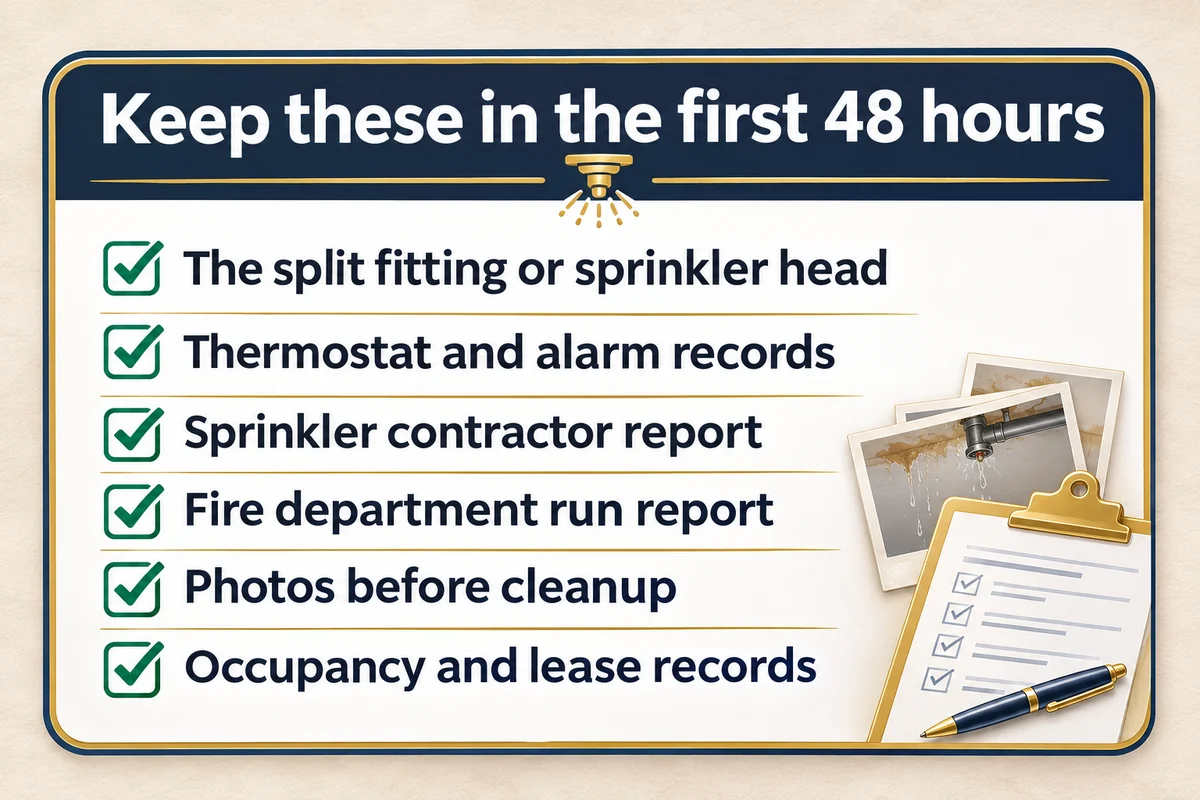
The first hours decide what evidence exists later. Most of these steps cost nothing and take minutes.
- Have the system shut down by the fire department or a licensed sprinkler contractor, and ask for a written report naming the failed part, its location and the temperature in that space.
- Keep the split pipe section, fitting or head. Bag it and label it with the date and where it came from. The carrier and any later subrogation case will want to examine it.
- Photograph the break, the ceiling space and every wet room before the water is extracted. Our list of what the carrier pays for emergency mitigation explains how to keep the drying bills claimable.
- Save the heating records: thermostat history, building automation logs, low-temperature alarm emails and the furnace service tickets. They answer the protected-against-freezing question if vacancy comes up.
- Pull the leases, move-in and move-out dates and the floor plan, so the 31% and 60-day questions can be answered with paper.
- Report the loss to the carrier in writing, and tell the tenants to report to their own carriers the same day.
- While the system is down, the building has no fire protection. Follow the fire department's instructions on a fire watch and on restoring the system, and keep that record too.
Where to go from here
If the carrier is reading the heat sentence against a sprinkler line, or counting your building as vacant, ask for the exact policy form and edition it is relying on, in writing. Our page on frozen pipe damage claims explains how we work these files for owners across Illinois, residential and commercial. We are licensed public adjusters, not lawyers, and we do not promise an outcome. We charge nothing upfront, and our fee is a percentage of the recovery set by contract and capped by Illinois law. If you want a second reading of your forms before you answer the carrier, send us the denial letter or the policy and we will review it free.
Questions we get about this
Does commercial insurance cover a frozen fire sprinkler pipe that burst?
Usually, on the widely used ISO special form CP 10 30, because its freezing exclusion lists fire protective systems as an exception. The water damage and the repair of the frozen parts are read as a sprinkler leakage loss. Your own policy form and endorsements govern, so check which edition you have.
Does the carrier need proof that I kept the building heated?
Not under the freezing exclusion of the special form, which does not apply to fire protective systems. Heat can still matter if the building was vacant for more than 60 consecutive days, because sprinkler leakage is then paid only if the system was protected against freezing.
When is a commercial building vacant for insurance purposes?
Under the ISO building form, an owner's building is vacant unless at least 31% of its total square footage is rented and used for customary operations or used by the owner for its own operations. A tenant's unit is vacant when it lacks enough business property to operate. Buildings under construction or renovation are not vacant.
Who pays for a tenant's inventory soaked by the landlord's sprinkler system?
The tenant claims its stock and equipment on its own business personal property coverage, and the landlord claims the building on its own policy. Sprinkler leakage cover does not require that the system belong to the tenant. The carriers can sort out fault between themselves later through subrogation.