Ice Dams in Illinois: What Insurance Covers and What It Calls Maintenance

In most Illinois homeowners policies the damage an ice dam causes — water forced under the shingles, soaked insulation, stained ceilings and walls — is claimable. The ice itself, the gutter cleaning and the attic work that would stop it happening again are treated as upkeep. The argument is almost never about the roof. It is about the date.
Ice dam damage insurance questions arrive in Illinois every February, and they mostly sound the same: there is a brown ring on a bedroom ceiling, somebody at the carrier has used the word maintenance, and nobody has explained where the line between damage and upkeep actually sits. It sits in a handful of policy clauses and in one fact about your loss — when the water got in. What follows is how those clauses usually work. Wording varies between carriers and between policy years, so read your own alongside this.
Are ice dams covered by homeowners insurance?
Usually the resulting damage is and the ice is not. Most homeowners policies cover the house itself against any cause of loss they do not specifically exclude, and ice damming is not on that exclusion list. What the policy does exclude is wear, deterioration and the upkeep that would have prevented the problem. So the water is claimable; melting the ice generally is not.
It helps to know what is physically happening, because every coverage argument in the file traces back to it. Heat leaking out of the living space warms the roof deck underneath the snowpack. The snow melts from below and the water runs down the slope. At the overhang it passes beyond the heated part of the building, meets deck that is sitting at outdoor temperature, and freezes. A ridge of ice builds at the eave, and behind that ridge a pond of standing water forms on the roof.
Asphalt shingles are lapped to shed water that is running downhill. They are not a membrane, and they do not hold back standing water. So the pond works back up under the laps and through the nail line into the sheathing, the top plate of the exterior wall, the insulation, and finally the ceiling below — which is where the homeowner first sees it, days or weeks after the water arrived. That gap between the entry and the evidence is the whole dispute.
What is covered, and what is called maintenance?
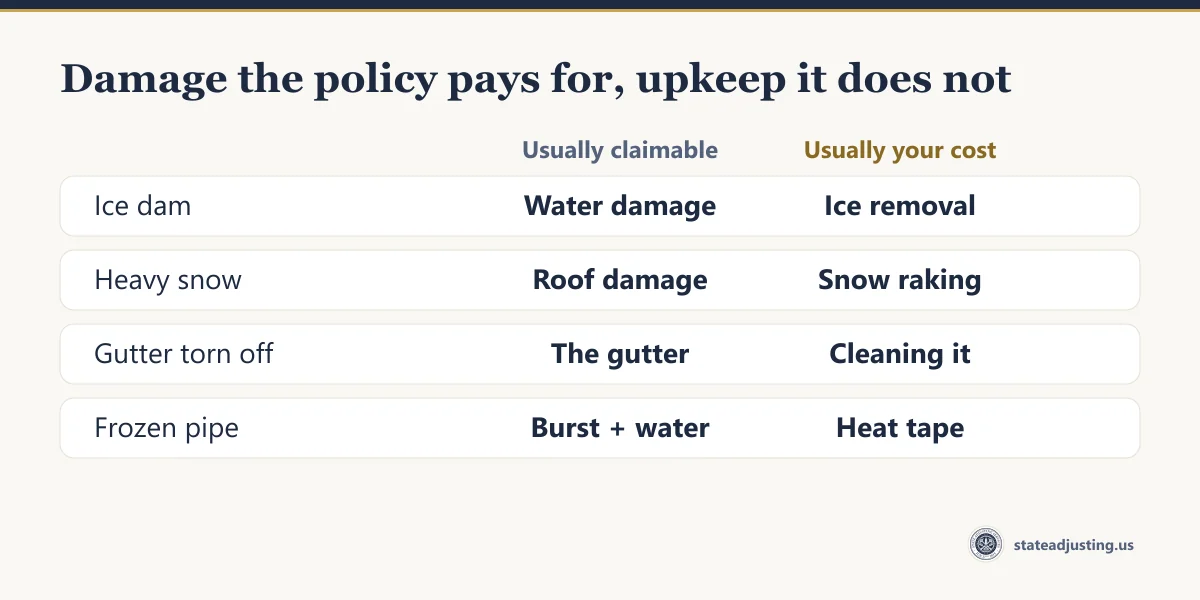
Damage caused by the ice is normally a claim. Work that removes the ice, or that stops the next one forming, is normally your own cost. The line is not about how expensive the item is or how obviously the winter caused it — it is about whether you are asking the policy to repair something that was harmed, or to improve something that was not.
| The item | Usual treatment | Why |
|---|---|---|
| Ceilings, walls, insulation and floors wet by the backed-up water | Usually claimable | Physical damage from a cause of loss the policy does not exclude |
| Shingles and underlayment lifted or perforated at the eave line | Usually claimable where the ice caused it | It is damage — it is simply damage nobody climbs up to look at in February |
| Gutters, fascia and soffit pulled down by the weight of the ice | Usually claimable | Direct physical damage; check whether your form carves specific property out of the weight-of-ice peril |
| Steaming or chipping the dam off the roof | Usually your cost | Removing ice is not repairing damage — though see the note on emergency measures below |
| Cleaning gutters, raking snow, adding attic insulation or ventilation | Usually your cost | Prevention. The policy insures against loss, it does not fund upkeep |
| Heat cable or an ice barrier membrane added so it does not happen again | Usually your cost | An improvement — unless a local code triggered by a covered repair requires it |
One row deserves an asterisk. Most policies ask you to take reasonable steps to protect the property from further damage once a loss is under way, and to reimburse the reasonable cost of doing it. Cutting a channel through a dam at midnight while water is running down a wall is a different act from having the roof cleared in December as a precaution, even though both are "ice removal". Keep the invoice, and have the contractor write down what the work was stopping.
Why do carriers reach for the word maintenance?
Because three standard exclusions can be pointed at a winter loss: wear and tear, neglect, and water that seeps or leaks constantly or repeatedly over an extended period. None of them describes a single January thaw. All of them describe something a homeowner did not do. That is why the date of loss ends up mattering more than the damage does.
Wear, tear and deterioration. This exclusion is aimed at a roof growing old, not at a discrete freeze-thaw event. It gets stronger the closer the shingles were to the end of their service life, which is a good reason to have the roof's condition on record before the winter — an inspection report, a real estate photograph, anything dated.
Neglect. Many homeowners forms define this narrowly: the insured's failure to use all reasonable means to save and protect the property at and after the time of a loss. Read that way it is about what you did once the water started running, not about insulation you never added three years ago. It is a much smaller exclusion than the word suggests.
Constant or repeated seepage or leakage. This is the one that decides most ice dam disputes. Some forms exclude water that seeps or leaks over a period of weeks, months or years; others name a specific number of days. Either way it is a question of fact, not of opinion: did water enter over one thaw, or all winter? Nobody wins that argument by asserting it. It is won with photographs, dates and a weather record.
None of this is legal advice — we are licensed public adjusters, not attorneys. It is a description of clauses that appear in most policies, and of which ones actually fit an ice dam.
Which winter claim are you actually filing?
Four different winter losses reach coverage by four different routes, and filing the wrong one invites the wrong denial. Water through the roof edge, structural deflection under snow, hardware torn off by ice weight and a pipe that froze in an exterior wall are separate claims with separate arguments attached to them.
| What happened | How it normally reaches coverage | What tends to get argued |
|---|---|---|
| Water backed up behind an ice dam and came inside | Resulting water damage to the dwelling and its contents | Long-term seepage; poor ventilation; the roof was old |
| Roof, ceiling or framing deflected under heavy snow | Weight of ice, snow or sleet — and, in some forms, collapse coverage | That it sagged rather than collapsed, so no coverage applies |
| Gutters, fascia or soffit torn down by ice | Direct physical damage from the weight of the ice | Pre-existing rot; that the gutters were undersized to begin with |
| A pipe froze and burst in an exterior wall or attic | Sudden and accidental discharge of water from a plumbing system | Vacancy — many forms exclude freezing while the home is unoccupied unless heat was maintained or the system was drained |
The second row is worth a sentence on its own, because "it did not collapse" is a common and often incomplete answer. A number of policy forms address structural impairment as well as total failure, and deflected framing is an engineering question rather than a visual one. If a ceiling or a rafter line moved under snow, the assessment that establishes whether it moved permanently belongs in the claim file. Our ice and snow damage claims page covers how we scope those.
What gets left out of an ice dam estimate?
Ice dam claims are underpaid far more often than they are denied. The stain is the exit wound, and the estimate is usually written to the stain. Between the roof edge and that spot on the ceiling there is a wet path through the assembly that nobody opened up, and it is normally the larger half of the loss.
- Blown-in insulation that got wet. It does not get its R-value back by drying. In most scopes it comes out and goes back in, and it is routinely missed because it is out of sight above the ceiling.
- The whole drywall plane, not the patch. Ceilings are painted plane to plane. A repaired square in the middle of a ceiling is visible from the doorway, which is exactly what the repair was supposed to fix.
- The wall cavity under the stain. Water that reaches the top plate runs down inside the wall. The ceiling shows it first; the wall holds it longest.
- Sheathing and framing at the eave. The part that was under the ice, which is the part nobody inspects while the ice is still on it.
- Floors that cupped later. Hardwood moves for weeks after the water is gone, often after the estimate is written.
- Mold remediation where wet insulation sat in a closed cavity for the rest of the winter.
- Code-required work on the rebuild. Where a local code requires an ice barrier at the eaves once the roof comes off, ordinance-or-law coverage — if you carry it — is the line that pays for the upgrade. It is a separate coverage with its own limit, not part of the repair estimate.
- Matching. If the replacement material cannot reasonably match what is left, that is its own argument — see when Illinois policies owe a uniform repair rather than a patch.
- The depreciation held back from the first cheque. On a replacement-cost policy part of the money is withheld until the work is done. Our guide to recoverable depreciation covers how to go back for it.
How do you prove when the water got in?
By dating things while they still exist. The ice melts, the stain dries to a pale outline, the insulation is bagged and gone, and by April there is nothing left to photograph. Almost every ice dam claim that goes badly went badly because the evidence was thrown away in the week the homeowner was busy dealing with the mess.
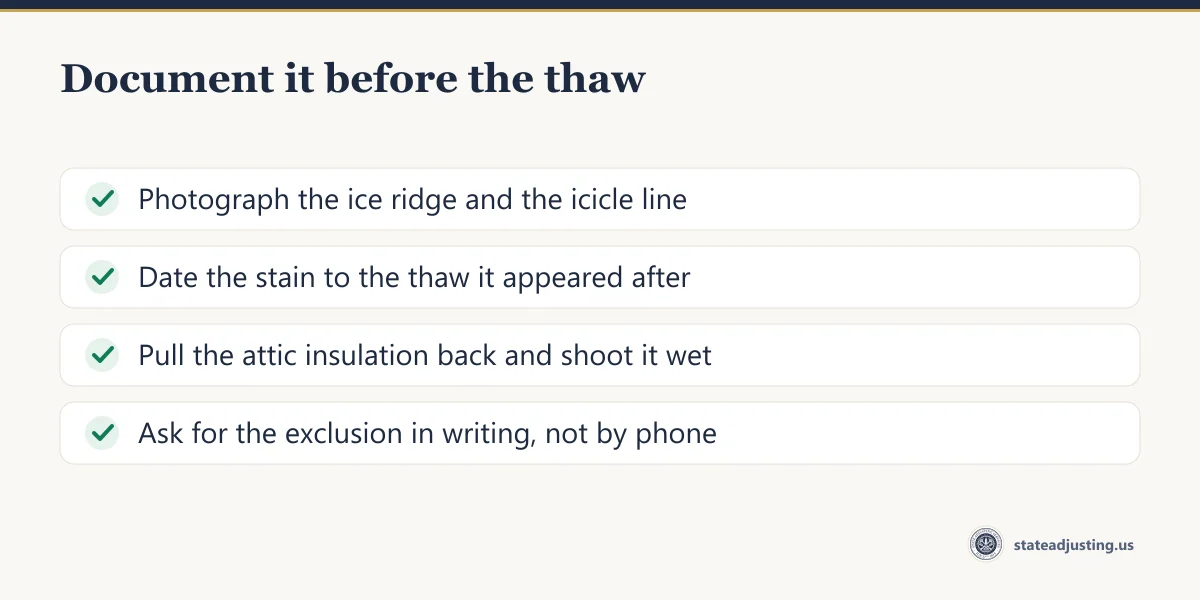
- Photograph the ice while it is on the roof. The ridge at the eave, the icicle line, the snow depth, and the same view from a distance so the whole roof plane is in one frame.
- Date the stain. Photograph it the day you notice it, and write down which thaw came before it. A stain that appears the day after a 45-degree afternoon is a very different piece of evidence from one nobody can place in time.
- Open the attic. Pull the insulation back above the stain and photograph it wet. Moisture readings, if you have someone who can take them, are worth more than the photograph.
- Pull the weather record for your date of loss. National Weather Service data is public and free, and a timeline that lines up with a thaw answers the seepage argument before it is made.
- Keep the first written observations from the roofer or the remediation crew. What they saw on day one, in writing, dated.
- Report promptly, and in writing. Policies require prompt notice. A phone call that is not in the file did not happen.
- Ask which exclusion, applied to what. If you are told the loss is maintenance, ask the carrier in writing to name the exclusion and identify which part of the damage it is being applied to. "Maintenance" on its own is not a coverage position.
Illinois has rules about how carriers answer. Under the state's improper-claims-practice regulation a company must affirm or deny liability within a reasonable time and offer payment within 30 days of affirming liability where the amount is not in dispute; and on a first-party claim that is denied, or settled for less than was claimed, it must give the insured a reasonable written explanation within 30 days after the investigation and determination of liability is complete (50 Ill. Adm. Code 919.50). If you cannot get that explanation, the Illinois Department of Insurance takes consumer complaints.
What to do next
Start with the declarations page: confirm what the dwelling coverage is written on, what your deductible is, and whether you carry ordinance-or-law. Our guide to the six lines that decide your claim shows which lines to read first. Then photograph everything — the ice if it is still there, the ceiling, the attic — before anyone dries or removes anything. Then report the loss in writing with the date you believe the water entered, and say what it is based on.
If the answer comes back as maintenance, that word is a starting position, not a decision. Ask for the exclusion in writing and for the inspection report behind it. Water that entered over one thaw and water that entered over a season are two different claims, and the file usually contains enough to tell them apart.
We handle winter losses across Illinois, residential and commercial. Our water damage claims page covers the sudden-versus-gradual side of the same question, the process page sets out how a claim runs with us in it, and past clients describe how it went on our reviews page. If you want somebody to read the policy before you talk to the adjuster again, our free claim review costs nothing. When we are engaged, our fee is a percentage of what we recover, agreed in writing and regulated by Illinois law, with $0 owed upfront. We answer the phone Monday to Friday, 8:00 AM to 5:00 PM, at (630) 297-8136.
Questions we get about this
Will my insurance pay to remove an ice dam?
Usually not as damage — removing ice is prevention, and prevention is the homeowner's cost. There is a separate route worth knowing about: most policies ask you to take reasonable steps to protect the property from further damage once a loss is under way, and to reimburse the reasonable cost of doing it. Cutting a channel through a dam while water is running into the house may fall there. Keep the invoice, have the contractor describe what the work stopped, and read your policy's duties-after-loss section.
Can the insurer deny my claim because my attic insulation is poor?
It can raise the point, and it is worth knowing how the clause is usually written. Many homeowners forms define neglect as the insured's failure to use all reasonable means to save and protect the property at and after the time of a loss — that is about what you did once water started, not about work you never did. Insulation and ventilation are still worth fixing. The exclusion is narrower than the argument that gets built on it.
The ice was in January and the ceiling stain appeared in March. Is it too late?
Not necessarily, but the timing is precisely what the claim turns on. Report it as soon as you see it, in writing, and state what you believe the date of loss was and why. Policies require prompt notice and many contain their own limitation period for bringing suit, so the deadlines are contractual and vary by policy. Read yours, and if a deadline is genuinely in play speak to an attorney — we are public adjusters, not lawyers.
Are gutters torn off by ice covered by homeowners insurance?
Often, as direct physical damage. The complication is that many forms carve specific property out of the weight-of-ice, snow or sleet peril — awnings, fences, decks, patios and pavement are commonly named — so the exact wording matters. A carrier may also argue the gutter was already rusted or the fascia already rotten. Photograph the fascia and soffit behind the gutter, not only the gutter lying on the ground.