Insurance Adjuster Inspection: How to Prepare for the Visit

The carrier's inspection is not a decision about your claim. It is a scope — measurements, photographs and notes that an estimate is built from days later. Damage the adjuster does not see, or sees but does not record, will not appear on that estimate. Your job on the day is to make sure everything gets looked at, and to keep your own record of what was.
An insurance adjuster inspection usually takes under an hour and decides more of a property claim than anything else that happens in it. Most homeowners treat it as a formality: let the adjuster in, point at the ceiling, wait for the letter. What is actually being produced that morning is a sketch, a photo set and a list of quantities, and every dollar of the settlement is generated from those three things.
We are licensed Illinois public adjusters, not attorneys. Policy wording varies between carriers and between editions of the same form, and your own policy governs. What follows is how these inspections are usually run and how to prepare for one — not legal advice.
What actually happens during an adjuster inspection?
The adjuster walks the property, measures the damaged areas, photographs them, and writes a scope of what needs repairing. Nothing is normally decided in front of you. Later, that scope is entered into estimating software, priced against a regional price list, and becomes the estimate and the first cheque.
Three documents come out of the visit, and only one of them is ever sent to you without asking:
- The sketch or diagram — the building drawn to the dimensions taken on site. Roof slopes, room sizes, elevations. Quantities on the estimate are calculated from this drawing, not typed in by hand.
- The photo report — usually captioned and organised by area. It is what a desk reviewer, a supervisor or a re-inspector will look at months later instead of your house.
- The field notes — cause, age, condition, what was tested, what was excluded and why.
You normally receive the estimate. You are usually entitled to ask for the photo report and the sketch as well, and it is worth doing: the estimate tells you the numbers, and the other two tell you where the numbers came from.
Who is coming, and what can they actually decide?
Not everyone who arrives with a ladder is an adjuster. After a widespread hail or wind event, carriers pull in contracted help, and the person on your roof is often not the person who will write your estimate. Ask, on the day, who they work for and whether they will be writing the file.
| Who arrives | Working for | What they can decide on site |
|---|---|---|
| Staff adjuster | Employee of the carrier | Scope and, within their authority, the estimate itself |
| Independent adjuster | An adjusting firm contracted by the carrier, common after storms | Scope; the carrier reviews and approves the estimate |
| Ladder assist or roof report vendor | A measurement service | Nothing — they photograph and measure, and never adjust |
This matters for a practical reason. Anything you say in the driveway to somebody who is not writing the file may never reach the file. Say it anyway, then put it in an email the same day.
What should be ready before the adjuster arrives?
Have a short, dated packet and clear physical access. Not a binder — one page of damage, your own photographs from before cleanup, the receipts for emergency work, and the failed part if you kept one. Preparation is not about arguing. It is about making it difficult for something to be missed.
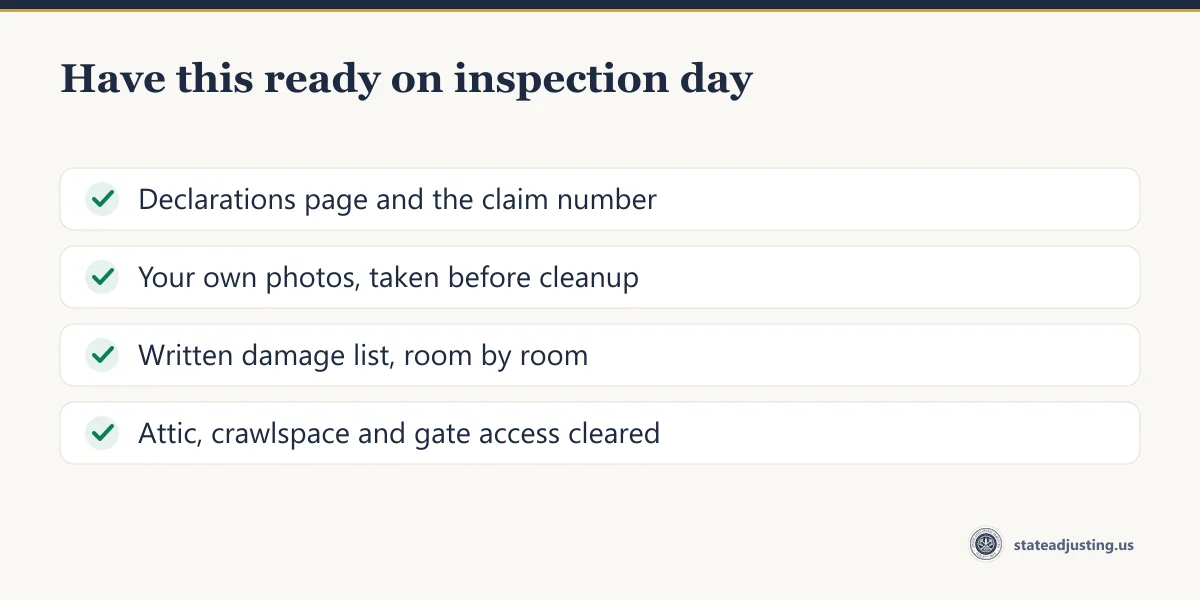
The paperwork:
- The declarations page and the claim number. If a percentage wind and hail deductible applies, you want to already know it.
- A one-page damage list, dated, organised room by room and elevation by elevation. Hand a copy over at the start and keep one.
- Your own photographs, taken before you tarped, dried or cleaned anything. If you have not taken them yet, take them before the adjuster arrives — see what to photograph after property damage.
- Receipts for emergency work: the tarp, the board-up, the water extraction, the hotel if you left.
- Anything you removed and kept — the burst supply line, a bagged shingle, the section of siding.
The access: a cleared attic hatch, an unlocked gate, a path to the crawlspace or the basement mechanicals, somewhere to set a ladder, dogs contained, and cars moved. An adjuster who cannot get into the attic writes an estimate without the attic in it, and rebooking that visit costs weeks.
If you already have a contractor's estimate, having it available is reasonable. Understand what it is: a proposal for a scope of work, not a demand. A padded one costs you credibility for the rest of the claim, and reading it against the carrier's version is a separate skill — see how to read the carrier's estimate.
Why the measurements decide more than the argument
Almost every disagreement that looks like a coverage fight is really a quantity problem. The estimate is generated from the sketch and the measured quantities, so a slope that was never measured and a room that was never drawn cannot produce a line item, however obvious the damage is to you.
| What gets measured | What it decides |
|---|---|
| Roof area in squares (1 square = 100 square feet) and the pitch | Tear-off, underlayment, shingles, steep-charge and waste |
| Ridge, hip, rake and eave in linear feet | Ridge caps, starter course, drip edge, ice barrier |
| How many elevations were actually walked | Whether the rear slope and the side siding exist on the estimate at all |
| Room dimensions in the sketch | Drywall, paint, flooring and trim quantities in every affected room |
| Fixtures, cabinets and openings noted | Whether items are detached and reset, or quietly painted around |
| Test squares cut per slope | The hit count that supports repair versus full replacement |
Test squares are usually a ten-foot by ten-foot area marked on a slope, with the impacts inside it counted. A count taken on one slope is a finding about one slope. If the storm-facing slopes were not opened up the same way, that is a fair thing to raise — the same point that decides many hail damage claims.
What to say, and what not to guess at
Answer what you are asked, from records rather than memory, and say "I don't know" when you do not. The inspection is not a recorded statement and does not need to become one. Volunteering a guess about how old the roof is, or how long a stain has been there, gives the file a fact you cannot support.
- Dates come from records. The storm date from an archived weather report; the discovery date from the photograph's timestamp or the plumber's invoice.
- Do not theorise about cause. "It might have been leaking a while" is a sentence that can end a water claim on its own.
- Do not agree to a figure in the driveway. Nothing is priced yet, including by them.
- Keep the two events separate. A formal recorded statement is a different exercise with different preparation — see the recorded statement.
- Point, do not argue. Coverage disputes are decided in writing later. Your only job on the roof is to make sure the damage is seen and recorded.
How to walk along without getting in the way
Most adjusters do not mind being accompanied. Follow the same order they do — exterior perimeter, roof, then the interior from the top down — and photograph the same things they photograph. You are not supervising. You are building a parallel record that exists if the file is later reviewed by somebody who never came.
- Note which slopes and elevations were physically walked, and which were viewed from the ground or from a drone or aerial report.
- Photograph the test square locations after they are marked.
- Work through your damage list out loud and tick items off as they are looked at. Circle anything that was not reached.
- Photograph any moisture-meter reading on the display, and note the room.
- Stay off the roof. You are not insured to be up there, and a fall changes the subject permanently.
A worked example: what a one-slope inspection costs
Illustrative figures for a two-storey house after a hail storm — not a client file. The first inspection was done from the front of the property. The front slope was walked, the rear and side slopes were viewed from the ground, and nobody went inside. The estimate came back at $9,400, which was a fair price for what had been scoped.
A re-inspection was requested in writing, with the contractor present, and the rest of the property was scoped:
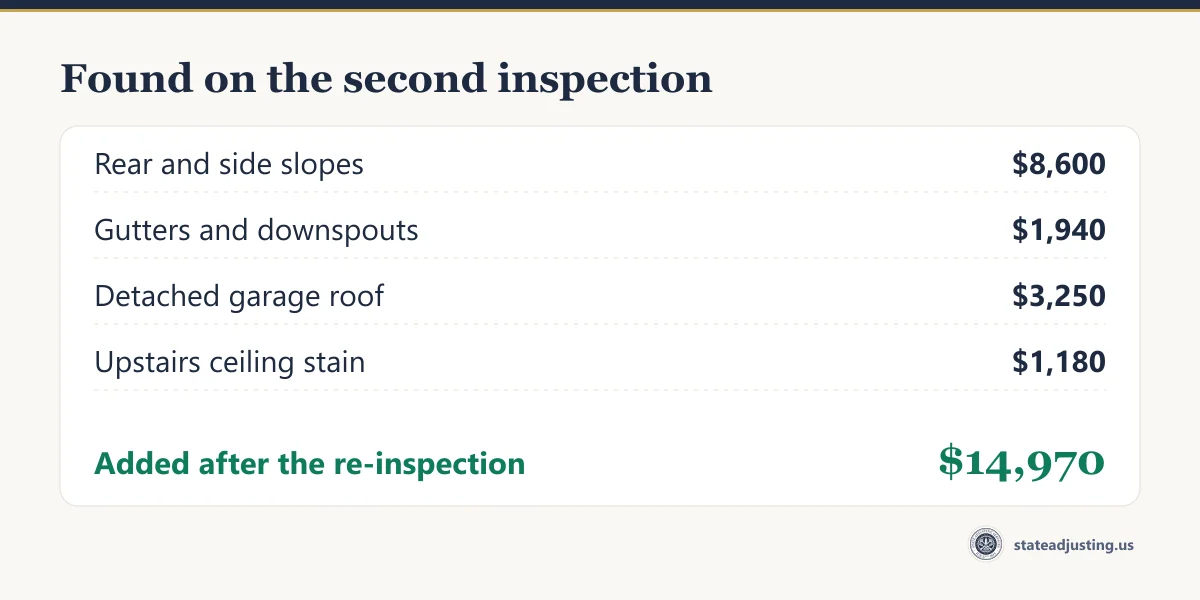
$8,600 + $1,940 + $3,250 + $1,180 = $14,970 added, taking the scope from $9,400 to $24,370. Two things are worth noticing. Nothing in that list was ever denied — it had simply never been looked at. And because it is one storm and one claim, one deductible applies to the whole of it, not one per visit.
What to send in the 48 hours after
Send one short email the same day or the next. It costs ten minutes and it converts a conversation nobody wrote down into a document in the claim file.
- List the areas that were inspected, and separately the areas that were not reached, with the reason if you know it.
- Ask for the estimate and the photo report and sketch.
- Ask, in one line, which elevations and slopes were physically inspected.
- Attach your own photographs of anything that was not reached.
- Ask for a date by which the estimate is expected. Illinois regulations set timeframes for a carrier to act on a claim once it has what it needs; if two or three weeks pass in silence, ask again in writing rather than by phone — see the deadlines that end claims in Illinois.
When the scope is wrong: re-inspections and engineers
A re-inspection is a normal, routine request, not an escalation. Ask for one in writing, say specifically what was not scoped, and ask that your contractor or public adjuster be present so the measurements are taken once with everybody watching rather than argued about afterwards.
Carriers sometimes send an engineer instead. An engineering report is an opinion about cause — whether the damage came from the storm or from age and wear — and it is not itself a coverage decision. You can ask for the full report and the photographs behind it, and read what it actually examined: how many slopes, whether the attic was entered, whether the report addresses the areas you claimed. A report that inspected one elevation is evidence about one elevation. Where the dispute is about cause rather than about price, the appraisal clause is the wrong tool, because appraisal decides amount.
What to do next
Before the visit: take your photographs, write the one-page list, find the declarations page, clear the attic hatch. During: walk along, photograph what they photograph, and note what was not reached. After: send the email, and ask for the photo report along with the estimate.
If the inspection has already happened and the estimate looks short of what you saw, the scope is usually the reason — not a denial. We review Illinois property claims at no cost and tell you plainly whether there is anything to pursue. There is no fee unless there is a recovery, and the fee is a percentage of that recovery, regulated by Illinois law and agreed in writing before we start. You can see how we work a claim, or send us the estimate and the photographs. We are open Monday to Friday, 8:00 AM to 5:00 PM.
Questions we get about this
Do I have to be present when the insurance adjuster inspects my property?
You are usually not required to be, but being there is worth the half hour. The inspection produces the measurements and photographs your estimate is generated from, and areas that are locked, blocked or simply not mentioned tend not to make it into the scope. If you genuinely cannot attend, leave a dated damage list and your own photographs with whoever does, and send the same material by email so it is in the claim file.
Should my contractor be at the adjuster inspection?
It often helps, particularly on a roof, where two people measuring the same slopes at the same time removes most later disagreements about quantities. Keep the roles straight: in Illinois a roofing licensee may build the repair and price the work, but may not represent or negotiate the claim. If the contractor cannot make the first visit, a re-inspection with them present is a normal request.
How long after the inspection should the estimate arrive?
On an uncomplicated residential claim it is commonly one to three weeks, and longer after a widespread storm when independent adjusters are handling volume. There is no single published deadline for the estimate itself, though Illinois regulations do set timeframes for a carrier to act on a claim once it holds what it needs. If two or three weeks pass with nothing, ask in writing for a status and an expected date.
What if the adjuster only inspected part of the roof?
Say so in writing, straight away, and ask for a re-inspection of the specific slopes and elevations that were not walked. A hit count taken on one slope is a finding about that slope, and damage that was never scoped is not the same thing as damage that was denied. Attach your own photographs of the areas that were missed, and ask that your contractor or public adjuster be present the second time.