Ordinance or Law Coverage: Who Pays for Code Upgrades After a Loss

Your policy pays to put the building back the way it was. It does not automatically pay the extra cost of meeting today's building code. Ordinance or law coverage is the limited give-back that does — commonly 10% of your Coverage A limit, one pot for the whole loss, and paid only on code costs you actually incur.
After a fire or a serious storm, two documents describe the same repair and they do not agree: the carrier's estimate, written to put back what was there, and the building department's correction list, written to the code in force today. Ordinance or law coverage is the part of a homeowners policy that pays the difference. In Illinois that gap opens on almost every roof that gets torn off and every fire that opens a wall.
We are licensed Illinois public adjusters, not attorneys or code officials. What a given municipality enforces on a given permit is the building department's call, and policy wording varies between carriers and forms — your own documents govern.
Why does a policy exclude code upgrades at all?
Because the policy insures the building you had, not a better one. The standard homeowners form excludes loss caused by the enforcement of any ordinance or law regulating the construction, repair or demolition of a building — and that exclusion applies whether or not the property was physically damaged. The additional coverage is a narrow give-back written back into the same form.
Three things follow, and all three matter when the money is argued over. It is not a peril and never pays on its own: there has to be a covered loss first, the ordinance has to be in force at the time of that loss, and it has to be enforced because of that loss. A violation the inspector happened to notice is not a claim. It pays the increase rather than the item, so anything you already had is ordinary repair money. And it is capped by a percentage of your dwelling limit, which has nothing to do with how long your code list is.
What counts as an increased cost of compliance?
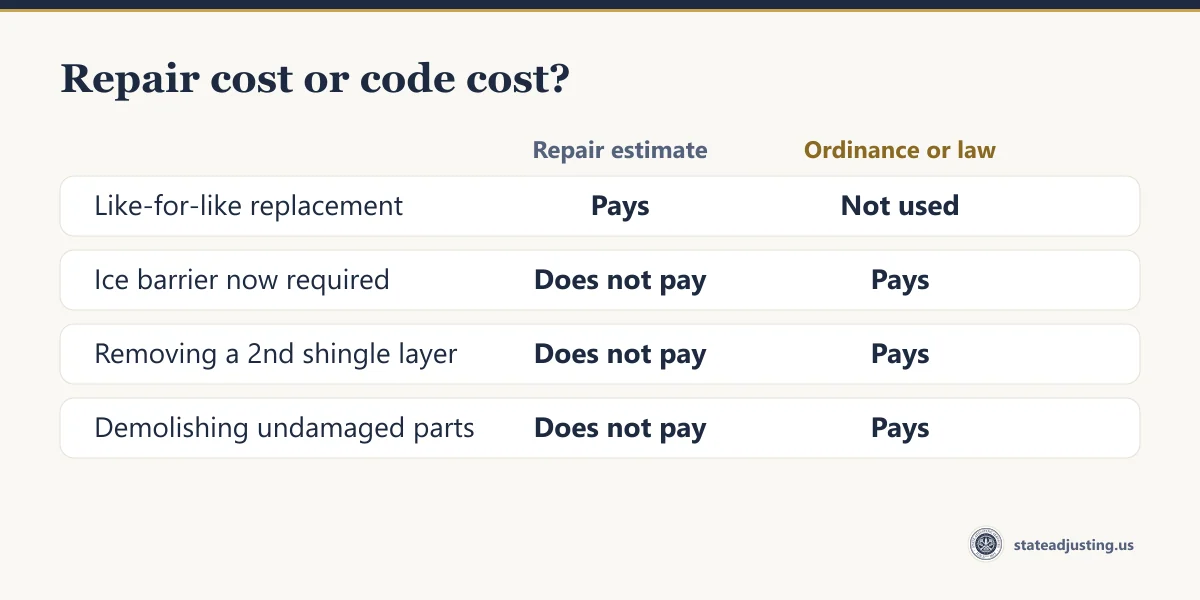
Only the cost above what a like-for-like repair would have cost anyway. Replacing a drip edge that was already on the roof is ordinary repair. Adding one where none existed, because the current code requires it, is an increased cost of compliance. Carriers pay the first as a matter of course and argue about the second, so it is worth keeping the two piles separate on paper.
| Cost | Main repair estimate | Ordinance or law |
|---|---|---|
| Replacing shingles, drywall or wiring with like kind and quality | Pays | Not used |
| Ice barrier at the eaves where none existed before | Does not pay | Pays |
| Removing a second shingle layer the code no longer allows to stay | Does not pay | Pays |
| Re-decking because spaced boards will not hold current fasteners | Does not pay | Pays |
| Hardwired, interconnected smoke and carbon monoxide alarms after a fire | Does not pay | Pays |
| Demolishing an undamaged portion the municipality condemns because of the damaged portion | Does not pay | Pays |
| Testing for or removing pollutants a law requires | Does not pay | Commonly excluded as well |
| The loss in market value caused by the ordinance itself | Does not pay | Commonly excluded as well |
The last two rows are where people lose time. This coverage is written for construction cost, not for consequences: if a new setback rule means the rebuilt house has to be smaller and is therefore worth less, that lost value is generally not what it pays for.
How much do you have, and how fast does it run out?
The widely used homeowners form lets you use up to 10% of the limit that applies to Coverage A for increased code costs, as an additional amount of insurance. It is one pot for the whole loss rather than a limit per item, and it is a percentage of your dwelling limit rather than of your damage. An endorsement raising it to 25% or 50% is commonly available.
| Coverage A limit | At 10% | At 25% | At 50% |
|---|---|---|---|
| $200,000 | $20,000 | $50,000 | $100,000 |
| $300,000 | $30,000 | $75,000 | $150,000 |
| $450,000 | $45,000 | $112,500 | $225,000 |
| $700,000 | $70,000 | $175,000 | $350,000 |
Read that table the unhelpful way round and the problem is obvious: the oldest houses have the longest code lists and the smallest dwelling limits. A 1958 ranch insured for $200,000 can easily carry $20,000 of rewiring, alarms, insulation and egress work on a fire that opens half of it — and $20,000 is the entire allowance.
One feature this shares with recoverable depreciation: the form pays increased costs you incur. Nobody sends a cheque for code work you decided not to do. Repair to the old standard and that portion is simply not paid.
Which code items actually show up on Illinois claims?
That depends on your municipality. Illinois has no single statewide building code governing repairs to existing houses — villages and cities adopt their own editions of the model codes, which is why two neighbouring towns can produce different lists on identical roofs. A few codes are statewide: the Illinois Plumbing Code and the Illinois Energy Conservation Code, adopted under the Energy Efficient Building Act (20 ILCS 3125), among them.
The items we see most often on Illinois residential claims:
- Ice barrier at the eaves. The model residential code requires an ice barrier where there is a history of ice forming along the eaves, running from the eave edge to a set distance inside the exterior wall line. All of Illinois qualifies, and older roofs frequently do not have one.
- Drip edge at eaves and rakes. Required for asphalt shingles from the 2012 edition of the model residential code onward. A roof installed before your village adopted that edition usually has none.
- Complete tear-off. Where more than one layer of covering is already on the deck, the code generally requires removing everything rather than adding another layer.
- Re-decking. Spaced board decking that will not hold current fasteners has to be sheathed, which is a code cost and not a damage cost.
- Smoke alarms. The Illinois Smoke Detector Act (425 ILCS 60) has required, since 1 January 2023, that dwellings have alarms with sealed ten-year batteries or a hardwired or low-voltage system.
- Carbon monoxide alarms. The Carbon Monoxide Alarm Detector Act (430 ILCS 135) requires an alarm within 15 feet of every sleeping room.
- Electrical. Arc-fault and ground-fault protection where circuits are replaced, and a panel that will accept them.
- Egress. A basement sleeping room rebuilt after a fire or a water loss generally needs a compliant emergency escape opening.
- Insulation and air sealing. Opened walls and accessible attics fall under the Illinois Energy Conservation Code when they are put back.
The single most useful thing a homeowner can do here costs nothing: ask the building department for the permit conditions or plan review correction list in writing, with the code sections cited. An adjuster in another state, working from estimating software, is guessing at your village's adopted edition. A letter from your own building official turns an argument into a document, and documents are what get paid.
What does this look like in money?
A worked example — not a client file. A 1968 ranch in Illinois, Coverage A $340,000, kitchen fire that opens the wiring, the wall cavities and one basement bedroom. The like-for-like repair estimate comes to $186,000. The village issues the permit with four conditions attached.
| Code condition on the permit | Cost above like-for-like |
|---|---|
| Wiring and panel brought to current code | $9,400 |
| Hardwired smoke and carbon monoxide alarms | $2,150 |
| Insulation and air sealing to the Illinois energy code | $4,800 |
| Egress window in the rebuilt basement bedroom | $3,600 |
| Increased cost of compliance | $19,950 |
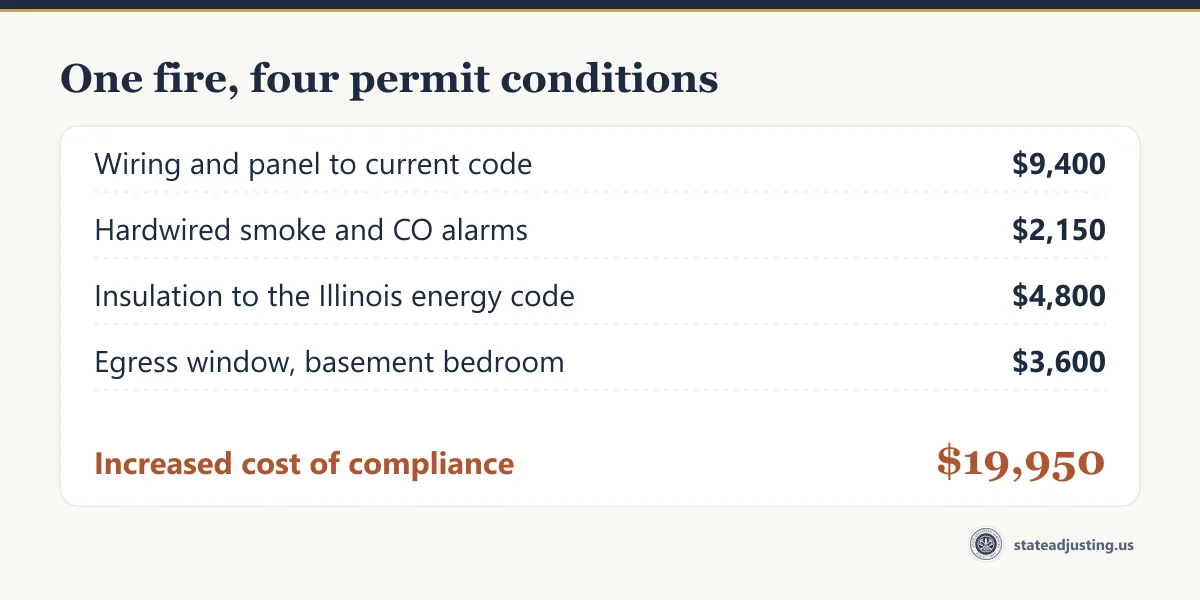
None of those four lines belongs in the $186,000. They are not repairs to damaged property; they are the price of the permit. At 10% of $340,000 there is $34,000 available, so the $19,950 fits and the homeowner pays none of it — provided the work is actually done and invoiced.
Change one fact and it stops fitting. Take a fire heavy enough that the municipality requires the whole structure brought to code, plus demolition of an undamaged rear addition that can no longer stand alone. The code total lands at $47,300 against $34,000 of coverage, and $13,300 comes out of the homeowner's pocket on a claim where nothing was denied. The same policy with the 25% endorsement would have carried $85,000 — a renewal decision, not a claim decision.
What is different on a commercial building?
Commercial policies usually handle this through a separate endorsement splitting the exposure into three named coverages. It is more generous and more exacting at once: if the limits were never scheduled, the coverage is not there.
| Coverage | What it pays | Where the limit comes from |
|---|---|---|
| A — undamaged portion | The value of the undamaged part of the building that must come down because of the law | Usually within the building limit |
| B — demolition cost | Demolishing that undamaged part and clearing the site | A separate scheduled limit |
| C — increased cost of construction | The extra cost of repairing or rebuilding to current code | A separate scheduled limit |
Two conditions catch people out. Coverages B and C commonly pay only when the work is performed, so an owner who takes the money and does not rebuild collects the damage but not the code costs. And if you rebuild elsewhere, the form typically pays what the code work would have cost at the original site.
Does flood work the same way?
No — flood has its own mechanism, and it is the one place a partial loss can be forced into a full rebuild. A community in the National Flood Insurance Program has to enforce a substantial damage rule: when repair costs reach roughly half the building's pre-damage market value, the whole structure must be brought into compliance, which in a floodplain usually means elevating it.
The NFIP policy answers that with Increased Cost of Compliance coverage — up to $30,000 toward elevating, relocating, demolishing or floodproofing, once the community issues a substantial damage or repetitive loss determination. It is not free money on top: the ICC payment and the building payment together cannot exceed the policy's maximum building limit. If your loss involved rising water, start from flood claims.
What to do next
Four steps, in this order, and none of them requires an argument with anyone.
- Find the line on your declarations page. It reads "Ordinance or Law" with a percentage beside it. If it says 10%, multiply your Coverage A limit by 0.1 and you know your ceiling.
- Get the permit conditions in writing before the estimate is agreed, not after. Code sections cited, from your own building department.
- Keep the two piles separate. Damage repairs in the main estimate, code items in an ordinance or law schedule with the permit letter attached to it. Mixing them is how legitimate code money gets denied as duplication — reading the carrier's estimate shows where each belongs on the summary page.
- Invoice the code work as it is completed. This coverage pays costs incurred. If the items surface only after the walls are open, that is a supplement, and it is a normal one.
We review property claims across Illinois at no cost, and we say plainly when there is nothing worth pursuing. If there is, our fee is a percentage of what is recovered, set by written contract and capped by Illinois law: nothing upfront, no fee if there is no recovery. Read how we work a file, or start from the damage — fire and smoke and hail are where code lists get expensive fastest.
Call (630) 297-8136 Monday to Friday, 8:00 AM to 5:00 PM, or send us the estimate and your declarations page and we will tell you what the code allowance should be doing on your file. If the repair itself still needs doing, our construction partner is one option among many and never a condition of us working your claim.
Questions we get about this
What is ordinance or law coverage on a homeowners policy?
It is a limited give-back to an exclusion. The policy excludes the cost of complying with any ordinance or law regulating construction, repair or demolition, then gives back a capped amount for exactly that purpose — commonly up to 10% of your Coverage A limit, as an additional amount of insurance. It pays the increase over a like-for-like repair, not the repair itself, and only where a covered loss triggered enforcement of a code that was already in force.
Does insurance pay to bring my house up to code after a fire?
It pays the part your ordinance or law allowance covers, and no more. The repair estimate puts back what was there; the code upgrades the building department requires on the permit come out of the allowance, commonly 10% of the dwelling limit for the whole loss. Where the code list is longer than the allowance, the difference is the homeowner's. The money is also paid on costs you actually incur, so code work you skip is not reimbursed.
How do I prove a code upgrade is required?
Ask the building department for the permit conditions or plan review correction list in writing, with the code sections cited. That single document does more than any argument, because it comes from the authority that enforces the code rather than from your contractor or from estimating software. Get it before the estimate is agreed, and attach it to the ordinance or law portion of the claim rather than burying the items in the main repair scope.
Can I increase my ordinance or law coverage?
Generally yes, at renewal, through an endorsement that raises the allowance from the standard 10% to 25% or 50% of Coverage A. Whether it is worth it depends on the house: the older the structure and the more the local code has changed since it was built, the faster 10% disappears. Your agent can quote it. It is a decision to make on a quiet day, because it cannot be added to a claim that has already happened.