Tornado Damage Claims: Wind, Debris Impact and the Parts People Forget

A homeowners policy has no tornado peril. A tornado is paid as windstorm — direct wind, debris impact, and rain entering through the opening the wind made — all under one deductible. Tornado claims are rarely denied outright. They are under-scoped: the framing, the interior, the detached structures and the land are the lines first estimates leave out.
A tornado damage claim usually goes wrong quietly. The roof and the storm-facing wall are visible from the driveway, get measured on the first visit, and become the estimate. The damage that decides whether the house is genuinely rebuilt — framing that moved out of square, water that arrived after the roof left, the garage at the back of the lot — needs a second look that nobody schedules. Nothing is denied. The claim simply closes small.
We are licensed Illinois public adjusters, not attorneys. Nothing here is legal advice, and your own policy and declarations page govern what is covered. What follows is how the widely used homeowners form treats a tornado, and where policyholders lose money on claims that were never actually contested.
Does homeowners insurance cover tornado damage?
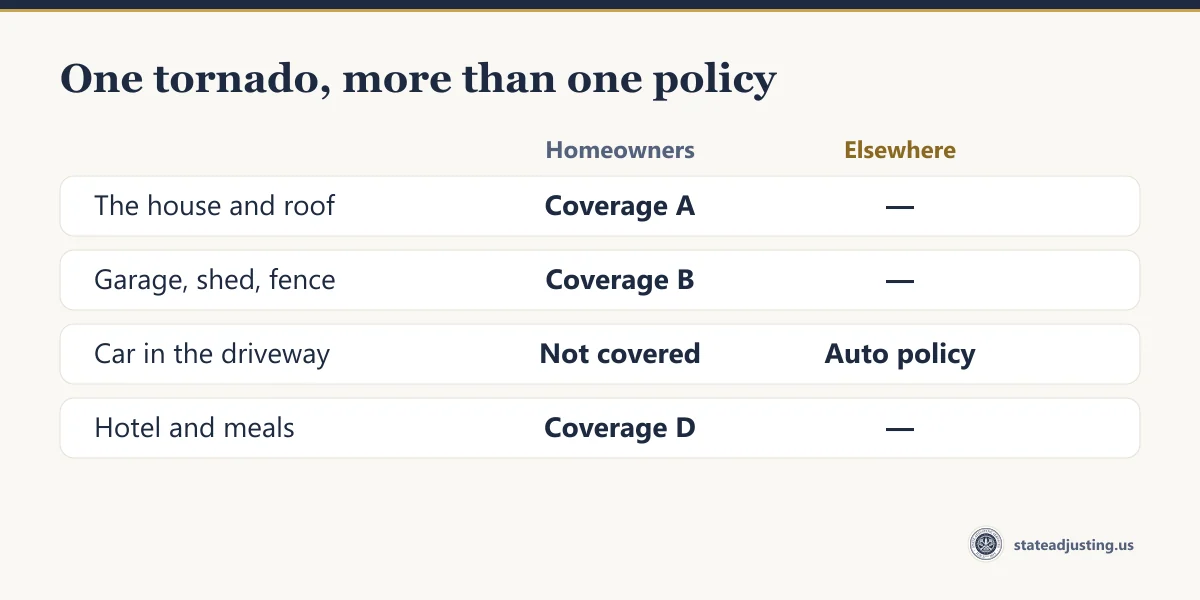
Yes — but not under that name. No standard homeowners policy contains a tornado peril. The dwelling and other structures are insured against direct physical loss with listed exclusions, and windstorm sits inside that. Personal property is insured against named perils, one of which is windstorm or hail. A tornado is a windstorm.
That matters because the wording is not identical on both sides of the policy. On the dwelling side, rain reaching the interior is paid when a covered peril first damaged the building and created an opening. On the contents side, the same rain is handled inside the windstorm-or-hail peril itself, which asks that the direct force of wind or hail made the opening. The ceiling and the mattress underneath it can be governed by two different sentences — we wrote about that split in detail in our guide to the opening created by wind test.
Two things sit outside the policy entirely. Flooding that follows the storm is excluded and belongs to an NFIP flood policy. Vehicles are excluded from personal property, so the car crushed in the driveway is an auto comprehensive claim with its own deductible — a separate claim most households forget to open in the first week.
Is there a separate tornado deductible in Illinois?
There is no tornado deductible. There may be a percentage wind and hail deductible, which amounts to the same thing, because a tornado is wind. On a $340,000 dwelling limit, a 1% wind and hail deductible is $3,400 — not the flat $1,000 most people remember. Named-storm deductibles are coastal and do not apply in Illinois.
The offsetting point is that one tornado is one occurrence. One deductible is taken across the whole Section I loss, however many coverages it touches: the roof, the interior, the detached garage, the fence and the contents are not five deductibles. The place this gets expensive is a multi-day outbreak, where damage on two dates can be argued as two occurrences and two deductibles. Date of loss is worth getting right the first time, against archived weather records rather than memory. Our guide to percentage wind and hail deductibles works through how the number is actually calculated.
What does a tornado damage that a plain windstorm does not?
Three things. Debris travelling at speed, which punctures and breaks rather than lifts. Pressure and racking, which move framing out of square without removing the roof. And a debris field across the whole lot — so the physical evidence of the first two is cleared away by neighbours and volunteers within days, before anyone has photographed it.
| What happened | What it looks like | What proves it |
|---|---|---|
| Direct wind uplift | Missing shingles, lifted decking, creasing at rakes and ridges on the storm-facing slopes | Slope-by-slope photographs; National Weather Service observations for the date |
| Debris impact | Punctures, broken glazing, hard dents concentrated on one elevation | The object itself, kept; close shots with a tape measure in frame |
| Rain through the opening | Ceilings, insulation and flooring directly beneath the breach | Attic photographs under the breach; a room-by-room moisture map |
| Racking and structural movement | Doors that no longer latch, cracks at door and window corners, walls out of plumb | A structural engineer's report; level and plumb readings |
| Debris across the lot | Fence runs down, shed flattened, trees on the drive | Photographs taken before the cleanup crews arrive |
The racking line is the one that is genuinely hard. A roofer cannot scope it and a general adjuster will not guess at it. If doors and windows in an undamaged-looking room stopped closing on the day of the storm, that is a structural question and it needs a structural engineer — retained early, because the repairs that follow are framed around the report. An engineer's report is an opinion about what was examined, so what the engineer was asked to look at matters as much as the conclusion.
What do people forget on a tornado claim?
The forgotten items are consistent, and almost none of them are contested when they are finally presented. They are missing because nobody walked to them, not because a carrier decided against them.
- The framing. Out-of-plumb walls, sheared sill-plate anchorage and truss uplift do not appear on a roof estimate.
- The interior. If the roof opened, water went somewhere. Insulation, ceilings, and the floor two rooms away are part of the same occurrence.
- Detached structures. The garage, shed and fence are Coverage B, commonly 10% of the dwelling limit as a ceiling for all of them combined — see our guide to what Coverage B actually pays for.
- Fences measured properly. Fences are settled by the linear foot of the run, not by counting the panels that visibly fell.
- Debris removal. The widely used form pays debris removal as part of the loss, and adds a further 5% of the applicable limit when the loss plus removal would exceed that limit.
- The vehicle. Not on this claim at all. Auto comprehensive, separate deductible, and the sooner it is reported the better.
- Loss of use. Coverage D starts the day the house becomes unfit to live in, and after a tornado local rentals get scarce and expensive fast. Keep receipts from day one.
- Code upgrades. Where the municipality requires current code on the rebuild, that increased cost has its own capped allowance, which we covered in ordinance or law coverage.
- Contents that left the property. Items blown into a field or never found are still lost property, and still belong on the inventory.
One thing genuinely is not covered, and it is worth knowing before it becomes an argument: most forms exclude loss caused by a power failure that occurs away from the residence premises. Four days without electricity after a tornado usually does not produce a spoilage payment unless the outage started at your own property.
What does the difference actually add up to?
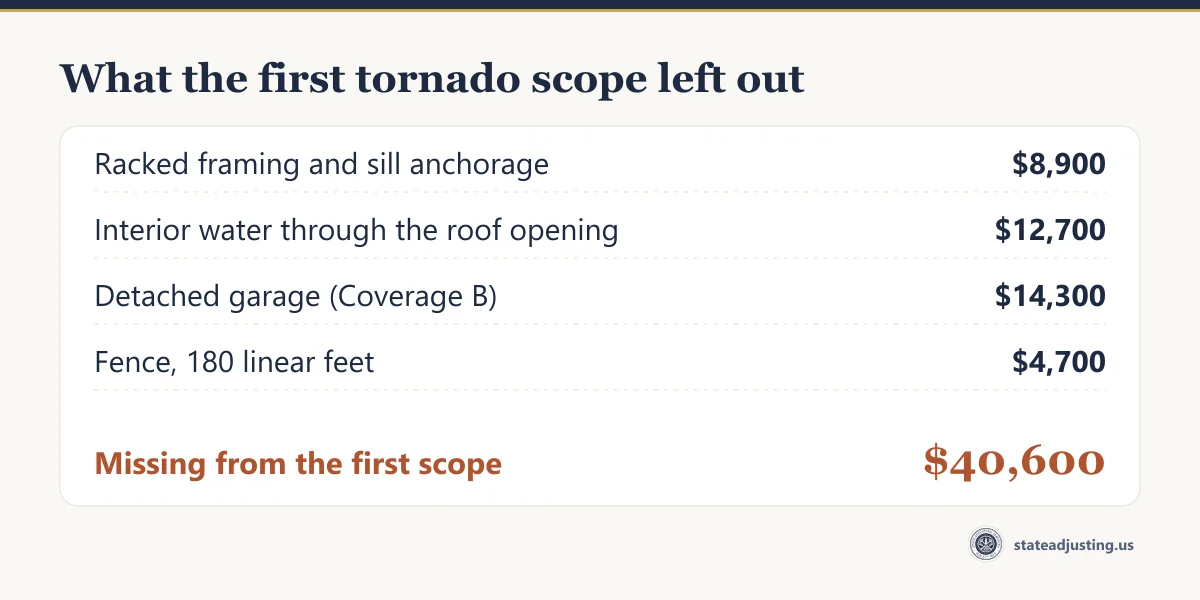
Here is the arithmetic on an illustrative Illinois tornado loss — a worked example, not a client file. Dwelling limit $340,000, 1% wind and hail deductible, so $3,400. The first scope was written from the driveway and the front slope.
| Scope | Line items | Amount |
|---|---|---|
| First estimate | Roof 32 squares, siding on two elevations, six impact-broken windows, debris removal | $43,650 |
| Added on re-inspection | Racked framing and sill anchorage $8,900; interior water $12,700; detached garage $14,300; fence $4,700 | $40,600 |
| Structure and other structures | Corrected scope | $84,250 |
| Personal property | Coverage C, inventoried | $9,200 |
| Section I property total | Replacement cost value | $93,450 |
| Less depreciation withheld | Recoverable once the work is done | −$16,750 |
| Actual cash value | $76,700 | |
| Less one deductible | 1% of $340,000, taken once for the occurrence | −$3,400 |
| First cheque | $73,300 |
Had the file closed on the first estimate, the same household would have received roughly $31,150 — $43,650 less about $9,100 of depreciation and the same $3,400 deductible. The difference in the first payment is about $42,150, and the $16,750 of withheld depreciation returns on completion on top of it. Coverage D for the hotel and meals runs alongside all of this and is paid as it is incurred. Nothing in that gap was ever denied. It was simply never written down.
What about the trees, the landscaping and the land?
This is the answer people least expect. In the widely used form, trees, shrubs and other plants are covered for a short list of named perils — fire, lightning, explosion, riot, aircraft, vehicles not owned by a resident, vandalism and theft. Windstorm is not on that list. A tornado can take every tree on the lot and the trees themselves are not a covered item.
Removal is treated separately and narrowly. The form pays up to $1,000 in total, and no more than $500 for any one tree, to remove trees felled by windstorm — and only where the tree damaged a covered structure or blocked the driveway or a ramp built for accessibility. A tree lying across the lawn, damaging nothing, is usually the homeowner's expense. Six trees down after a tornado is a $1,000 line, not a $9,000 one, and finding that out in month two is a bad way to find out.
What does move money is the damage those trees did on the way down, and the debris removal attached to covered property. Photograph the tree on the structure before it is cut, not after.
What to do in the first week
The order matters here more than on any other claim type, because the site is being cleared while you are deciding what to do.
- Report the loss and get the claim number, then confirm the date of loss in writing against the National Weather Service record for that day rather than from memory.
- Photograph the whole property before anything is cleared — the debris field is the evidence for every impact line on the estimate. Our guide to what to photograph before you touch anything covers the four-pass sequence.
- Keep the objects that hit the house. A branch through the soffit or a piece of a neighbour's roof in the wall is a scope argument you cannot rebuild later.
- Tarp, board up and keep the invoices. The duty to prevent further damage is real, and emergency work is part of the claim.
- Test every interior door and window and write down which ones stopped closing. That list is what justifies a structural engineer.
- Start a Coverage D file on day one — hotel, meals above normal, pet boarding, extra mileage.
- Walk the back of the lot with the adjuster, not just the front elevation, and ask in writing which elevations and structures were actually inspected.
If the estimate you have been sent covers the roof and stops there, that is the moment to get another set of eyes on it — not after the cheque is cashed and the site is clear. We handle tornado damage claims and wind damage claims across Illinois, and you can see how a file is documented and negotiated on our claims process page.
We will review a tornado file at no cost and no obligation: send the declarations page, the carrier's estimate and your photographs, and we will tell you plainly whether the scope matches the damage. If we take the claim on, our fee is a percentage of the recovery, agreed in writing, capped by Illinois law and paid out of the settlement — nothing upfront, and no recovery, no fee. Reach us Monday through Friday, 7:00 AM to 7:00 PM, and Saturday and Sunday, 9:00 AM to 5:00 PM, at (630) 297-8136 or through our contact page.
Questions we get about this
Is tornado damage covered by homeowners insurance in Illinois?
Generally yes, but not under a tornado peril — no standard homeowners policy has one. A tornado is treated as windstorm, which covers the dwelling and other structures against direct physical loss and personal property under the named windstorm or hail peril. Flooding that follows the storm is excluded and belongs to a flood policy, and vehicles go on the auto policy. Your own policy governs.
Does a tornado claim have its own deductible?
No. There is no tornado deductible, but many Illinois policies carry a percentage wind and hail deductible that applies because a tornado is wind. On a $340,000 dwelling limit, 1% is $3,400 rather than a flat $1,000. One tornado is one occurrence, so a single deductible is taken across the roof, interior, detached structures and contents together.
Are my trees and landscaping covered after a tornado?
Usually not the trees themselves. In the widely used form, trees, shrubs and plants are covered only for a short list of named perils that does not include windstorm. Removal is separate and capped: commonly up to $1,000 in total and $500 for any one tree, and only where the tree damaged a covered structure or blocked a driveway or accessibility ramp.
Can I reopen a tornado claim after the first cheque?
Often, yes. A closed file is an inactivity flag rather than a decision about your policy rights, and a supplement for damage that was never scoped rides on the original claim number and date of loss, so no second deductible applies. What matters is the evidence — which is why photographing the property before debris is cleared is the single most valuable thing to do in the first days.