Wind-Driven Rain and the Opening Created by Wind Test

Rain that gets inside during a storm is paid only if a covered peril first made an opening in a roof or wall and the water came in through it. Wind pushing rain past a worn seal, a tired flashing or a gap that was already there usually fails the test — even when the storm was real and the roof damage is accepted.
Wind-driven rain is the one claim where the storm can be undisputed and the interior still gets denied. The roof is paid; the soaked ceiling underneath it is not. That split comes from a single provision in the policy, and it turns on one question: was there an opening, and did the water come through it?
We are licensed Illinois public adjusters, not attorneys. Wording varies between carriers and forms, and your own policy governs. What follows is how widely used homeowners forms handle interior rain, not a rule of law.
Why does rain inside the house need its own test?
Because the policy treats interior water from rain separately from the storm damage that let it in. The dwelling is insured against risk of direct physical loss, but rain reaching the interior is carved out — and handed back only when a covered peril has first breached the building envelope.
The limitation appears in two places, worded differently — a difference worth carrying into a call with the carrier.
| Coverage | The usual shape of the wording | What that means in practice |
|---|---|---|
| A — dwelling, B — other structures | Rain to the interior is excluded unless a covered peril first damages the building causing an opening in a roof or wall, and the water enters through that opening | The give-back is open to any covered peril that made the breach — wind, hail, a falling limb, an impact |
| C — personal property | The same limitation usually sits inside the windstorm or hail peril, and asks for the direct force of wind or hail to cause the opening | Narrower. When something other than wind or hail made the hole, contents and dwelling can land in different places |
| D — loss of use | Follows the covered loss; no rain wording of its own | Payable when a covered loss leaves the house unfit to live in, for the reasonable time to repair |
The sentence governing your ruined ceiling and the one governing the mattress underneath it may not be the same sentence, and the second is usually the tighter. Read both off your own form.
What actually counts as "an opening"?
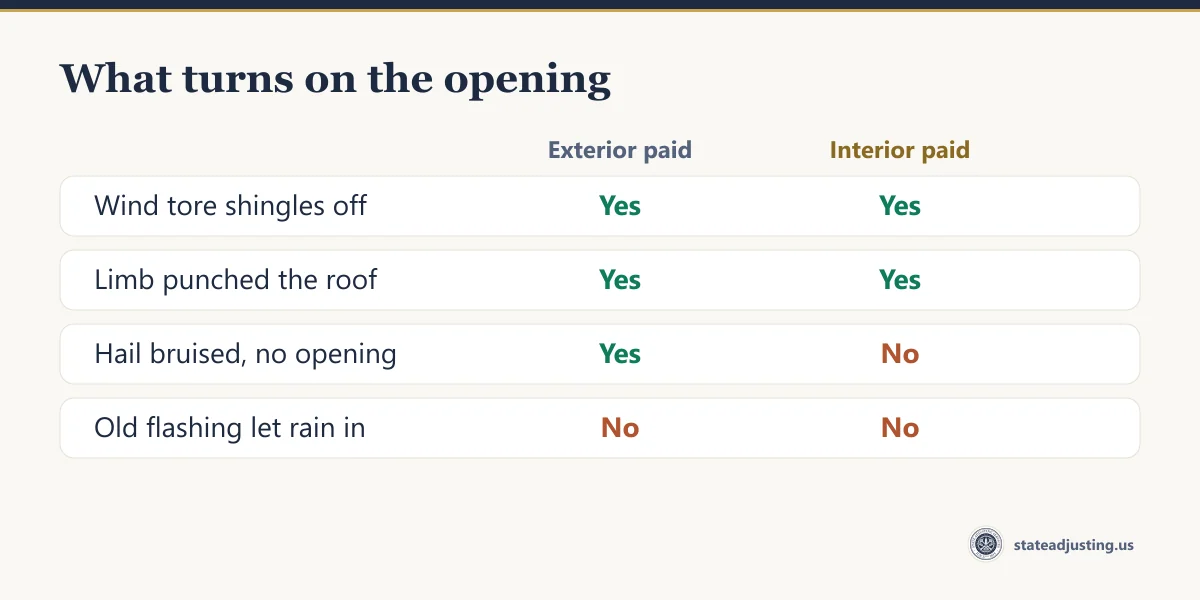
Nothing in the form defines it. In practice it means a breach the water can physically pass through: shingles torn off, roof deck left bare, flashing or ridge cap blown away, a broken window, siding peeled back, a limb driven through the sheathing. A gap that was already there is not an opening the storm created.
The clear cases at both ends are rarely the ones in dispute:
- Usually accepted as an opening: missing shingles with exposed deck or underlayment, torn or displaced flashing and drip edge, a lifted section of roof covering, blown-off ridge or hip caps, broken or blown-in glazing, a door blown open, siding removed by wind, impact punctures from debris.
- Usually not: rain forced through a failed sealant joint, a worn glazing bead, deteriorated mortar or a rotted sill; water tracking behind siding laps or through weep holes; a chimney crown cracked for years; shingles at the end of their service life that were curling before the storm.
The real argument sits between those lists. Creased shingles that lifted under wind pressure and dropped back, torn underlayment beneath an intact-looking field, a ridge cap displaced and re-seated — all pass water while the roof looks fine from the driveway. That case is made with photographs, the attic and the material that came off the building. And "the roof was old" is a different finding from "there was no opening": that one is about deterioration, covered in our guide to roof age and cosmetic damage endorsements.
It is also why a hail claim can pay the roof in full and nothing inside. Bruised shingles are covered damage; they are not necessarily an opening.
Which of the three things is the denial letter actually saying?
Interior rain denials usually blend three separate findings into one paragraph, and each needs different evidence. Separating them is the first useful thing to do with the letter, because answering the wrong one wastes the response.
- "No opening was created." A question about the exterior, answered with photographs of the breach taken before any tarp went on, the removed material, and a roofer's report describing the breach rather than saying "storm damage".
- "There was an opening, but the water did not come through it." A question about the interior, answered with the shape of the wet area — where it sits relative to the breach, how it follows the framing, whether the attic is wet above it.
- "The opening pre-dated the storm." A question about dating, answered with the character of the break, any pre-storm imagery of the roof, and archived weather for the date of loss.
A letter making all three findings at once is not three times as strong. More often it means the file holds one exterior inspection and nothing from inside — which is worth checking before you answer it.
How is the water's path proved?
By capturing the route from outside to inside while it still exists. The breach is tarped within a day and the ceiling comes out within a week; after that there is nothing left for anyone to inspect. This is what we ask for on these files.
| What to capture | What it settles |
|---|---|
| Wide photograph of the damaged slope or wall, before any tarp | Places every close-up on your building and shows the breach in context |
| Close photograph of the breach, tape measure in frame | The size and character of the opening, not just that something was wrong |
| The removed material, kept in a bag | A creased shingle or torn flashing is an exhibit; a description is not |
| Attic photographs directly beneath the breach | Wet sheathing, insulation wet in a plume, daylight through the deck |
| Moisture readings mapped room by room | A plume from one point reads differently from an even stripe down a wall |
| Dated tarp or board-up invoice | When the opening was closed — separating the first night's water from later rain |
| Archived weather for the date of loss | National Weather Service observations and the NOAA Storm Events Database are public. They establish the wind that day, not your damage |
The interior map matters more than people expect. Water entering through a roof breach lands somewhere specific and then travels along rafters, top plates and duct runs, so the wet area is usually a plume with a source. Water wicking down inside a wall from a worn window head tends to produce a narrow, even stripe with nothing above it. Our post on what to photograph before you touch anything sets out the four-pass sequence.
What is riding on the test, in money?
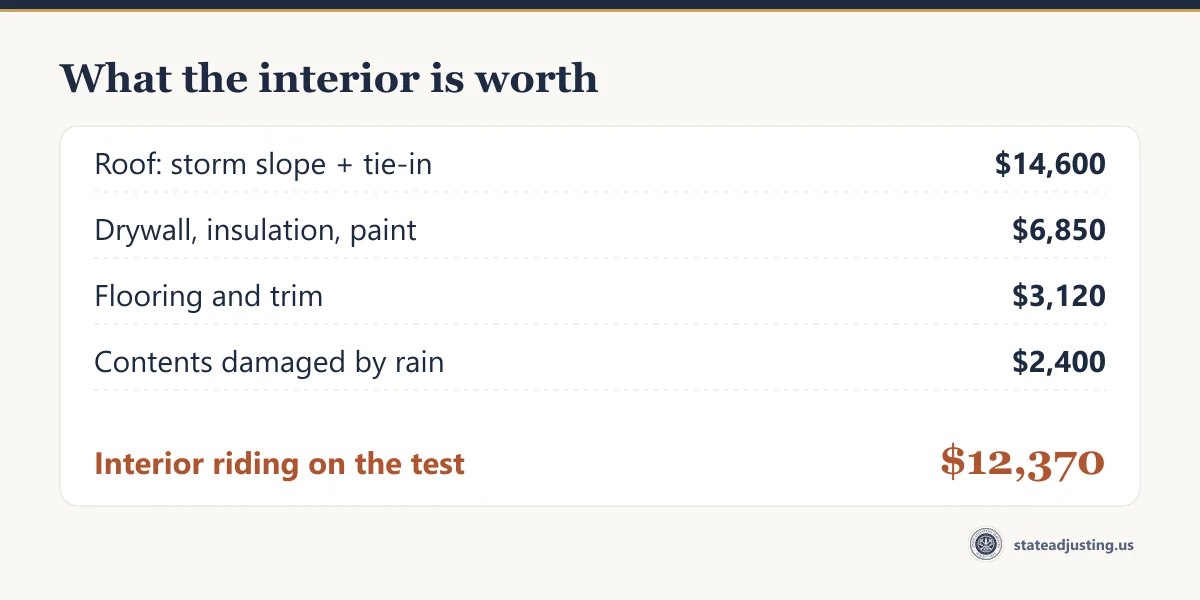
On an ordinary storm file, close to half of it. The exterior repair is paid on the storm damage. Everything the water touched inside — ceilings, floors, contents — sits on the far side of the opening test. The figures below illustrate that split. They are not a past result of ours, and not a quote.
A June line of storms strips the shingles from the south slope of a two-storey house, leaving roughly forty square feet of deck bare. It rains another six hours overnight. By morning two bedroom ceilings are down, the hall carpet is soaked and a mattress is finished.
| Line | Replacement cost |
|---|---|
| Roof — storm slope, tear-off, deck repair and tie-in | $14,600 |
| Drywall, insulation and paint — two bedrooms and the hall | $6,850 |
| Flooring and trim | $3,120 |
| Contents — mattress, bedding, boxed items | $2,400 |
| Total | $26,970 |
| Less the deductible | $2,500 |
| Paid if the interior is accepted | $24,470 |
| Paid if only the roof is accepted | $12,100 |
The roof is not in dispute in either column. $12,370 — about 46% of the claim — turns entirely on whether the bare deck counts as an opening created by wind, and whether the water is shown to have come through it.
One point on the arithmetic: a single storm is one occurrence, so one deductible covers roof, interior and contents together — you are not charged again for the ceiling. But if your policy carries a separate percentage wind and hail deductible, that one figure can be several times the flat amount people remember. We show how it is calculated in our guide to percentage wind and hail deductibles.
You have to destroy the evidence to meet your own duty
The policy requires you to protect the property from further damage. That means tarping the breach quickly — which removes the exact thing the claim will later be argued about. Both obligations are real, and the order solves it.
- Photograph before the tarp, not after. Two minutes from the ground with a phone is enough. Nobody should climb a storm-damaged roof for a picture.
- Keep emergency repair receipts, and stop there. Reasonable tarping and board-up are normally payable. Do not complete the permanent repair before the carrier inspects unless the property cannot be secured any other way.
- Keep what comes off: the torn shingles, the flashing, the wet sheathing. Ask the roofer not to clear the site before you have them.
- Log later rain. If the tarp fails or a second storm arrives, note the date. Damage from the second event is a separate allocation question, and answering it beats having it assumed.
Waiting carries its own risk: standing water becomes a different argument once mould appears, and drying delay is where a carrier starts asking about neglect — see sudden versus gradual water damage.
Is it different on a commercial policy?
The structure is familiar: many commercial forms carry a comparable interior-rain limitation with the same opening give-back, and some add endorsements narrowing it further. What changes is the roof. On a low-slope membrane the question is usually whether wind tore the membrane open or a seam or termination bar failed — answered on the roof by someone who can read a lifted lap, not in correspondence. Parapets, scuppers and blocked drains add a possibility that is not wind at all.
What to do this week
If rain got inside during an Illinois storm and the interior is being questioned, work in this order.
- Pull the two paragraphs — the interior-rain wording under the dwelling perils, and the windstorm or hail peril under personal property. Note where they differ.
- Sort the denial into the three findings above and decide which one the carrier is really making. Answer that one.
- Assemble the exterior set — pre-tarp photographs, the removed material, the roofer's written description of the breach, the dated tarp invoice.
- Assemble the interior set — attic photographs beneath the breach, the room-by-room moisture map, the wet area before demolition.
- Ask for the complete claim file in writing, including the inspection report and the adjuster's photographs. You cannot answer a finding you have not seen.
- Ask for a decision that names the provision relied on. "Wind-driven rain" is a phrase, not a provision. The paragraph tells you which argument you are in.
If the disagreement is about the amount of an accepted loss, appraisal may be available. If it is about whether the interior is covered at all, appraisal is generally the wrong lever — that is a coverage question, and a point to take to an attorney rather than assume.
What we can do
We read the policy, the estimate and the photographs together, because on an interior-rain file those three documents only mean something side by side. If a wind damage claim paid the roof and stopped at the ceiling, the next step is establishing the path the water took — a documentation problem before it is an argument. Our claim process page sets out how a file is handled.
The review is free and there is no obligation. We are paid a percentage of the recovery, regulated by Illinois law and agreed in writing before we start: no fee upfront, no recovery, no fee. If you have an open water damage claim and cannot follow the reasoning in the letter, send us the paperwork — contact us or call (630) 297-8136, Monday to Friday, 8:00 AM to 5:00 PM.
Questions we get about this
Does homeowners insurance cover rain that comes in during a storm?
Only through a specific give-back. Widely used homeowners forms exclude rain, snow, sleet, sand or dust reaching the interior of a building unless a covered peril first damages the building and creates an opening in a roof or wall, and the water enters through that opening. Storm damage to the roof being accepted does not settle the interior on its own — the opening and the path the water took are separate questions, and your own policy wording governs.
What counts as an opening created by wind?
The form does not define it, so it is read practically: a breach that water can physically pass through. Shingles torn off with the deck exposed, blown-off flashing or ridge caps, a lifted section of roof covering, broken glazing, siding removed by wind, or a puncture from flying debris. Water forced through a worn sealant joint, deteriorated mortar, an old chimney crown or a gap that already existed is generally not treated as an opening the storm created.
Why did my insurer pay the roof but deny the ceiling underneath it?
Because two different provisions are being applied. The roof damage is judged against the covered peril. The interior water is judged against the interior-rain limitation, which asks whether an opening was created and whether the rain entered through it. A denial of that second question usually rests on one of three findings — no opening, an opening the water did not come through, or an opening that pre-dated the storm — and each is answered with different evidence.
What should I photograph before tarping a storm-damaged roof?
Take a wide shot of the whole damaged slope or wall from the ground, then a closer shot of the breach with a tape measure in frame for scale, before any tarp goes on. Then photograph the attic directly beneath the breach and every wet area inside before demolition begins, and keep the material that comes off the building. Do not climb a storm-damaged roof for a photograph, and keep the dated tarp or board-up invoice.