Public Adjuster Contracts in Illinois: What to Check Before You Sign

In Illinois a public adjuster contract is a regulated form, not a private agreement. It has to sit on a form filed with and approved by the Department of Insurance, carry the adjuster's license number, state the fee in figures against a statutory cap, and reach your insurer within five business days. Your right to cancel starts when the insurer receives it — not when you sign.
A public adjuster contract is one of the few documents in a property claim whose contents the state writes out line by line. Article XLV of the Illinois Insurance Code sets what the contract must contain, five things it is forbidden to contain, how the fee is capped, and how you get out of it. Almost none of that comes up at the kitchen table, because almost everybody signs the form they are handed.
We are licensed Illinois public adjusters, not attorneys. Nothing here is legal advice, and your own contract governs. What follows is what the statute requires of any public adjuster contract in this state — ours included — and what each requirement is actually protecting.
What must an Illinois public adjuster contract contain?
Section 1575 lists it: the adjuster's full name as recorded by the Department, permanent business address, email and phone; the license number; the title of the document; your name, address, insurer and policy number; a description of the loss and where it happened; the services to be rendered; the compensation in full; an attestation of bonding; and both signatures with the date and time of signing.
That list looks like paperwork. Each line is doing a specific job:
| Required on the contract | What it is actually for |
|---|---|
| Full name as it appears in Department records | So the licence can be looked up. A trading name on the contract and a different name on the licence record is something to resolve before signing, not after. |
| License number | An Illinois public adjuster licence is issued by the Department of Insurance. A roofing licence is not a substitute — Illinois keeps those two roles separate. |
| The title "Public Adjuster Contract" | It distinguishes the document from an authorization, a work order or a contingency roofing agreement offered off the same clipboard. |
| Insurer name and policy number | The statute allows these once known, so a gap on day one is normal. A gap a month later is not. |
| Description of the loss and its location | It fixes what is being adjusted. One contract does not quietly absorb a second storm three months later. |
| The services to be rendered | What you are buying, in writing, rather than "handling the claim". |
| Compensation in full, including any applicable cap | The fee, in figures. See the next section. |
| Attestation that the adjuster is fully bonded | The bond runs in favour of the State. It is the Director's route to recover for people harmed by a licensee — not an insurance policy on your claim. |
| Signatures with date and time | The time is there for a reason. Solicitation between 7:00 p.m. and 8:00 a.m. is prohibited, and the timestamp is the record of it. |
How much can a public adjuster charge in Illinois?
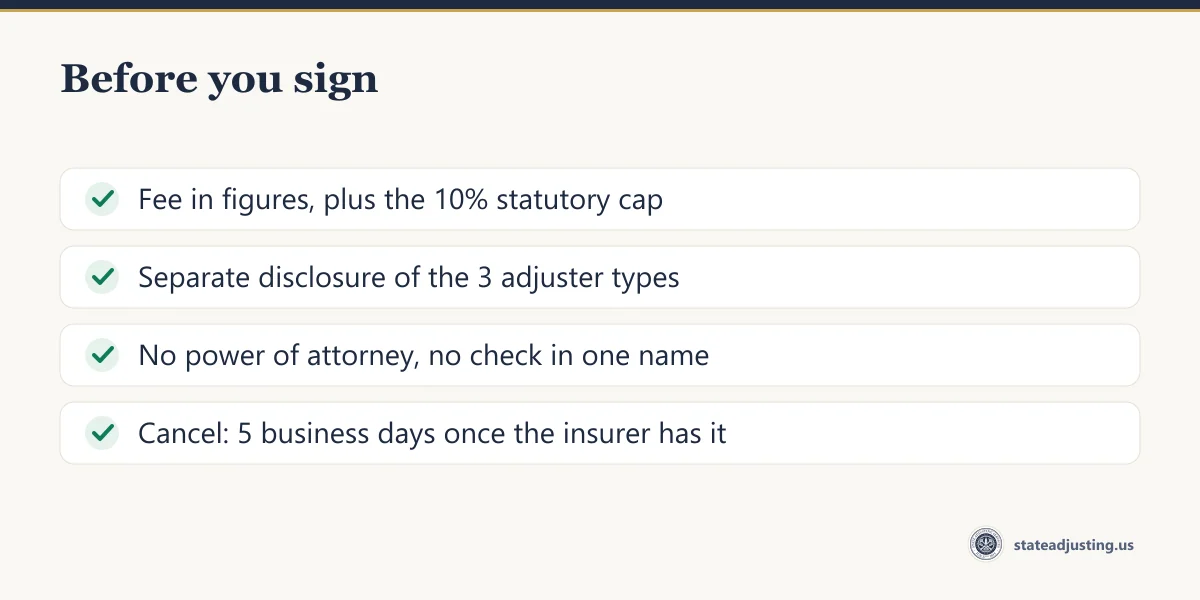
Illinois caps public adjuster compensation at 10% of the amount of the insurance settlement claim paid by the insurer (215 ILCS 5/1570). The contract must state the actual percentage — not a range, not "customary" — together with any applicable cap. A fee can instead be hourly or expense-based, itemised with dollar estimates, with further expenses approved in advance.
Three things about that cap are worth separating.
It is a ceiling, not a rate. The number that applies to you is the one written into your own contract in figures before you sign. We do not publish ours on a web page for exactly that reason: a fee that is not in your signed contract is not your fee.
For a personal residence there is no exception. The statute allows an adjuster to exceed the cap only for non-residential property damaged in a catastrophic event, and only with the Director's written approval. A catastrophic event is defined as widespread or severe damage producing an overwhelming demand on state and local response resources — not a bad hailstorm on your street.
The base is what the insurer pays. Not what was estimated, not what was claimed, not what a letter approved. A contract may not contain a term letting the fee be collected on money that is due from an insurance company but has not been paid.
Here is what that means arithmetically. Take a hail claim written at $26,400 replacement cost, with $5,200 of recoverable depreciation withheld and a $2,500 deductible. The first check is $18,700. The depreciation is released after the work is completed and documented: $5,200. A supplement for code items found during tear-off adds $3,400. The insurer has paid $27,300, and that is the figure a percentage fee is calculated on.
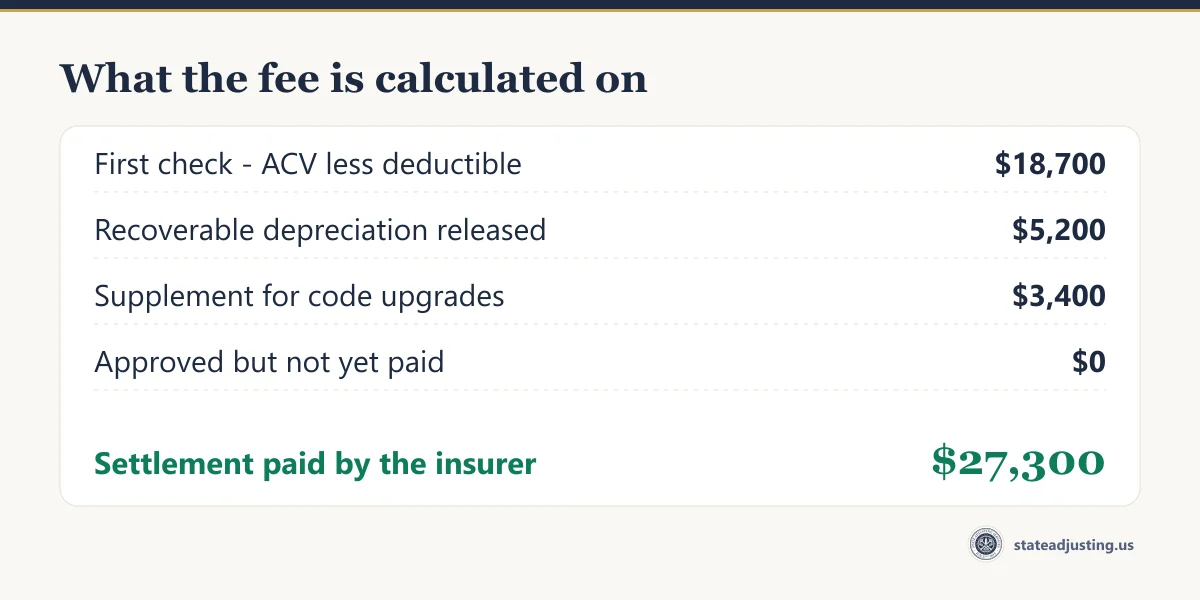
Two figures deliberately sit outside that total. The $2,500 deductible is never paid by the insurer, so it never enters the fee base. And if a further line — say $1,900 for gutters — is approved in writing but the check has not been issued, it carries no fee until it arrives. Figures here are an illustration of the arithmetic, not a result we are claiming.
What is a contract not allowed to say?
Section 1575 lists five terms an Illinois public adjuster contract may not contain. They are not technicalities. Each one is a specific way the relationship can be turned against the policyholder, and each is worth reading the contract for by name.
| Prohibited term | What it would have meant for you |
|---|---|
| A fee collectible when money is due from the insurer but not paid | You would owe a percentage of a check that never came. |
| Requiring you to authorise the insurer to issue a check only in the adjuster's name | Your settlement would be payable to your representative alone. Who legitimately appears on a claim check is already a crowded question. |
| Precluding either party from pursuing civil remedies | You would sign away your right to take the adjuster to court. |
| A hold-harmless indemnifying the adjuster for their own negligence | You would carry the cost of their mistake. |
| A power of attorney to act in your place | Somebody else could sign in your stead. You sign the sworn proof of loss, and you accept the settlement. |
The standards of conduct in Section 1590 close the same loop from the other side: a public adjuster may not settle a claim without the insured's knowledge and consent. Being represented is not the same as being replaced.
How do you cancel a public adjuster contract?
You may void the contract for five business days after the insurer receives it. Notice can be given by registered or certified mail with return receipt requested, by personally serving the notice, or by email to the address shown on the contract. Anything of value you handed over is returned within fifteen business days of that notice.
The clock is the part people misread. It does not run from your signature. The adjuster must give the insurer an exact copy of the contract no later than five business days after it is executed — so the cancellation window can open days after the conversation at your table, and it can be pinned to a date you were never told.
- Ask in writing for the date the copy went to the carrier, and keep the reply. That date, not your signature date, is what the five days count from.
- Send the cancellation by a method the statute names. A phone call is not one of them.
- Check that the contract is on a filed form. Contracts must be on a form filed with and approved by the Director. A form nobody filed is a question for the Department of Insurance, not a doorstep argument.
- Look for the separate disclosure document. Before signing, you must be given a separate signed and dated disclosure explaining the three kinds of adjuster — company, independent and public. If it was never produced, ask why.
What the rules say about how you may be approached
Section 1590 governs conduct, and most of it exists because of what happens in the days after a storm or a fire. A public adjuster may not solicit while the loss-producing occurrence is still going on, nor while the fire department or its representatives are engaged at the damaged premises, nor between 7:00 p.m. and 8:00 a.m.
The rest of the section sets the duties that follow from being hired:
- Serve the client with objectivity and complete loyalty to that client's interests alone.
- Disclose any direct or indirect financial interest with any other party involved in the claim, beyond the compensation in the contract.
- Do not steer the client to a provider from whom compensation may flow back, disclosed or otherwise.
- Do not acquire an interest in salvage without the client's written permission, obtained after the claim is settled.
- Do not practise law or give legal advice.
- Provide the client with documentation of the damage on request.
That disclosure duty is why we name our construction partner in the open rather than routing work quietly. Illinois separates the roles — contractors build, licensed public adjusters negotiate the claim — and using them is always the client's choice, never a condition of us handling the file. The doorstep version of the same problem is covered in our guide to telling a contractor from a claim scheme.
What to do before you sign anything
Whoever you hire, and whether or not that is us, five minutes with the document is worth more than an afternoon of regret:
- Find the licence number on the contract and confirm it is a public adjuster licence issued by the Illinois Department of Insurance.
- Find the fee, in figures, and the cap stated next to it. If either is missing, stop there.
- Read for the five prohibited terms by name — particularly the power of attorney and the check payable in one name.
- Ask for the separate three-adjuster-types disclosure, and ask when the insurer will receive its copy.
- Confirm the loss described on the contract is the loss you mean, dated correctly.
If you are still deciding whether a public adjuster is worth it at all, our guide on what the job actually involves — and when it is not worth hiring one is the honest version, and our process page sets out what happens week by week. You can read what clients have said and the questions we get asked most.
We review a claim before any contract is signed, at no cost and with no obligation, and we will say plainly when a claim does not need us. Call (630) 297-8136 Monday to Friday, 8:00 a.m. to 5:00 p.m., or send us the details.
Questions we get about this
Does an Illinois public adjuster contract have to be approved by the state?
The form does. Under 215 ILCS 5/1575 a public adjuster contract must be on a form filed with and approved by the Director of the Illinois Department of Insurance. That is approval of the form's wording, not of any individual claim or fee. If you are handed something that does not identify itself as a public adjuster contract and does not carry a licence number, that is worth raising with the Department before you sign.
How much can a public adjuster charge in Illinois?
Compensation is capped at 10% of the amount of the insurance settlement claim paid by the insurer (215 ILCS 5/1570). For a personal residence there is no exception to that cap. For non-residential property damaged in a catastrophic event, an adjuster may exceed it only with the Director's written approval. The cap is a ceiling — the rate that applies to you is the figure written into your own contract, and it should be there in numbers before you sign.
Can I cancel after I have signed with a public adjuster?
You may void the contract for five business days after your insurer receives it, and notice must be given by registered or certified mail with return receipt requested, by personally serving the notice, or by email to the address shown on the contract. The adjuster has to send the insurer an exact copy within five business days of signing, so the window can open later than you expect. Ask in writing for the date the copy was sent.
Does signing mean the adjuster can settle the claim for me?
No. A public adjuster contract may not include a power of attorney allowing the adjuster to act in your place, and the standards of conduct in 215 ILCS 5/1590 bar settling a claim without the insured's knowledge and consent. A public adjuster documents, estimates and negotiates on your behalf. The decision to accept a settlement stays yours, and so does signing the sworn proof of loss.