A tree fell on the house: whose insurance pays and what it pays for

When a tree falls on your house, the insurance claim for the damage goes to your own homeowners policy, even when the tree grew in your neighbor's yard. Your policy pays to repair the roof, walls and anything else the tree broke, less your deductible. Getting the tree itself off the property is paid from a separate, much smaller pot, and replanting is usually not paid at all after wind. Most of the money argued over on a fallen-tree claim sits in the gap between those three.
We are licensed Illinois public adjusters, not attorneys. The wording quoted below is from the widely used homeowners form, HO 00 03 05 11, in the copy the Maine Bureau of Insurance publishes. Many carriers write their own version. Your policy and its endorsements govern.
Whose policy pays when a tree comes down
Where the tree landed decides who pays for what. Damage to your house, garage or fence is claimed on your policy no matter whose tree it was. The neighbor's policy pays for the neighbor's property. Removal of the tree is paid only in the situations the policy lists, and a tree lying in an empty yard is not one of them.
| Where it landed | Repairs are claimed on | Is hauling the tree away paid? |
|---|---|---|
| Your house, from the neighbor's yard | Your policy, the dwelling coverage | Yes, within the tree limit, if a peril your contents coverage names brought it down (wind, ice, lightning and others) |
| Your house, from your own yard | Your policy, the dwelling coverage | Yes, within the tree limit, only if wind, hail or the weight of ice, snow or sleet brought it down |
| Your detached garage, shed or fence | Your policy, other structures coverage | Yes, on the same terms as the house: a fence counts as a covered structure |
| Across your driveway, nothing broken | Nothing to repair | Yes, if it stops a registered car from getting in or out; the same for a ramp built for a disabled person |
| In the yard, hitting and blocking nothing | Nothing to repair | No: the cleanup is yours |
| Your tree onto the neighbor's house | The neighbor's policy, for their house | Under their policy. Yours steps in through liability only if you are found legally responsible |
A tree on a parked car is a different policy altogether. The homeowners form does not cover motor vehicles as contents, so the car goes to the comprehensive coverage of your auto policy, if you carry it. Things inside the house are covered when a falling object breaks the roof or an outside wall first; a branch through an open window does not meet that test on the widely used form.
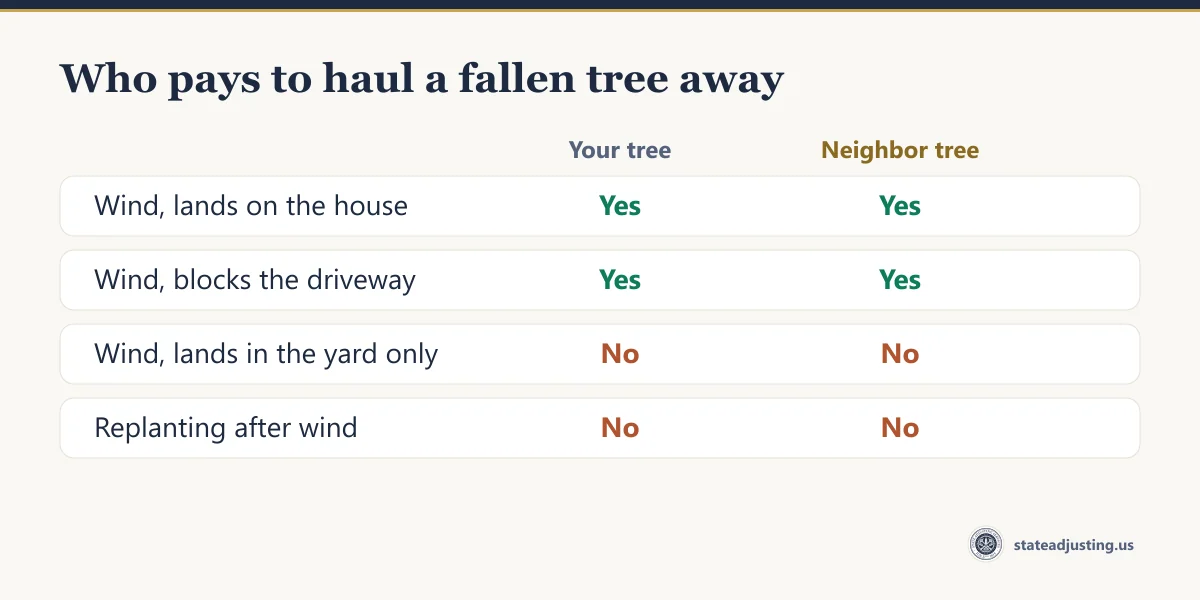
Your tree or the neighbor's: the clause reads them differently
The tree removal clause names two kinds of tree and gives them different triggers. Your own trees are covered for removal only when wind, hail or the weight of ice, snow or sleet felled them. A neighbor's tree is covered when any peril listed for your personal property felled it, which is a longer list. Here is the clause, line by line, from Section I, Additional Coverages, Debris Removal.
"We will also pay your reasonable expense, up to $1,000, for the removal from the 'residence premises' of:"A separate amount on top of the dwelling limit. It is a ceiling for the whole loss, not a per-tree allowance.
"(1) Your trees felled by the peril of Windstorm or Hail or Weight of Ice, Snow or Sleet; or"Your own tree knocked down by lightning, a car or a vandal is not on this line, although the house damage it caused is still claimed.
"(2) A neighbor's trees felled by a Peril Insured Against under Coverage C;"Coverage C is your personal property. Its named perils include windstorm, lightning, falling objects, weight of ice and snow, vehicles and vandalism.
"provided the trees: (3) Damage a covered structure; or (4) Do not damage a covered structure, but: (a) Block a driveway..."This is the condition. A covered structure includes the garage, shed and fence, not only the house. The driveway must be blocked for a vehicle registered for road use, and a ramp for a disabled person counts the same way.
"No more than $500 of this limit will be paid for the removal of any one tree."Two trees can use the full $1,000. One very large oak cannot.
When the neighbor's insurer gets involved
Mostly it does not. You claim on your own policy, and your carrier may later ask the neighbor's carrier to repay it, which is called subrogation. That usually goes somewhere only if the neighbor knew or should have known the tree was dead or failing. If your carrier recovers, part or all of your deductible may come back to you. Whether a neighbor is legally responsible is a question of Illinois law, and that one belongs with an attorney, not with us.
Three bills, three limits: a worked storm
A fallen tree produces separate bills, and each one is paid from a different place in the policy. The large one is lifting the tree off the roof. Whether that line counts as part of repairing the house or as tree removal under the $1,000 cap is the argument that moves the most money. The example below is invented to show the arithmetic. It is not a quote and not a client's claim.
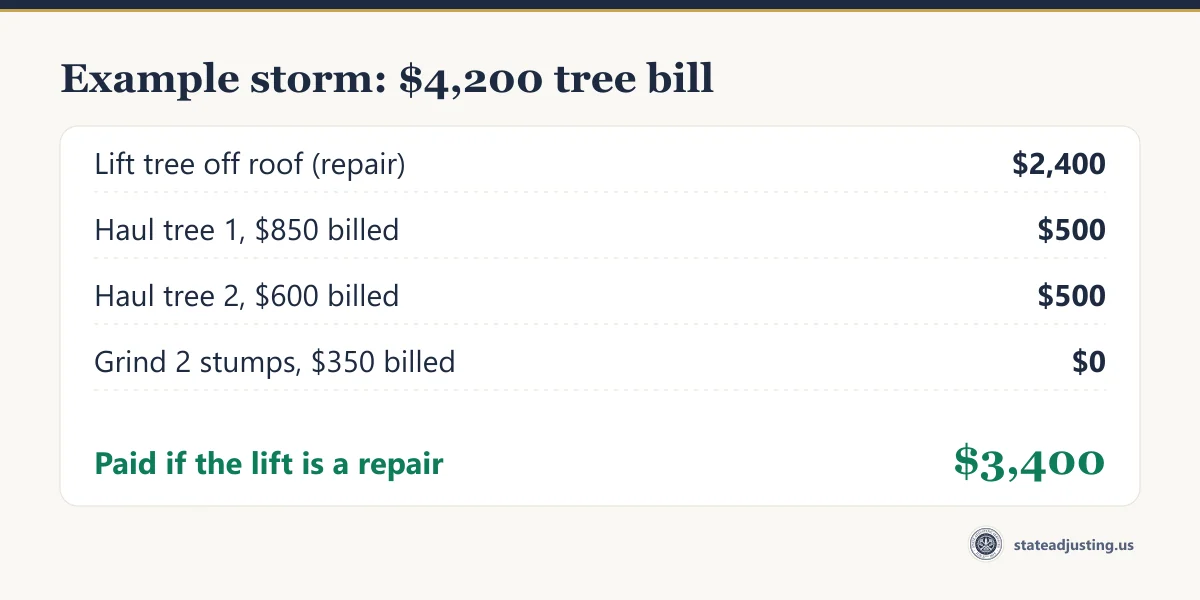
Wind brings down two of your own trees. One lands on the roof, the other across the driveway. The tree service bills $4,200.
- Line on the invoiceBilledPaid fromPaid
- Crane and crew lift tree 1 off the roof$2,400Repair of the house, if it is treated as part of the repair$2,400
- Cut up and haul tree 1 from the yard$850Tree removal, $500 cap per tree$500
- Cut up and haul tree 2 off the driveway$600Tree removal, $500 cap per tree$500
- Grind both stumps$350A stump is not a felled tree; expect this to be yours$0
$3,400paid of the $4,200 when the lift is treated as part of repairing the roof, before the deductible.
$1,000paid for all tree work when the carrier puts the crane bill inside the tree removal cap, before the deductible.
The $2,400 difference is the lift. The insurance agents' trade magazine IA put exactly this question to its faculty in 2024 ("Tree Damage to Roof: When Does Debris Removal Sublimit Apply?") and printed three answers. Two treated taking the tree off the house as part of the repair; one read the wording as putting it under the cap. Carriers are split the same way, which is why the next section starts with the invoice.
Replanting is the third pot. The widely used form pays for trees and shrubs up to 5% of the dwelling limit and $500 a tree, but only for fire or lightning, explosion, riot, aircraft, a vehicle not driven by someone who lives there, vandalism and theft. Wind and ice are not on that list. Some articles quote that 5% as the removal budget; on this form it is not.
What to do before the tree service cuts anything
Photograph the tree where it lies, then let the tree service work from an itemised quote. The photographs settle why the tree fell. The invoice decides which part of the policy pays for each hour of crane time.
- Photograph the break and the roots before a single cut: the snapped trunk or the lifted root plate, the point where the tree hit, and the whole scene from the street. A clean break in sound wood shows wind. A hollow, rotten trunk is what a carrier asks about, and it is what decides any later recovery from a neighbor. We wrote out the shot list in what to photograph before you touch anything.
- Report the claim and ask, in writing, whether the carrier wants to see the tree before it is moved. If rain is coming through the roof, say that you are having it lifted and tarped to protect the house, and keep the message.
- Ask the tree service to split its invoice by tree and by job: lifting off the structure, cutting and hauling from the ground, stumps. One lump-sum line hands the carrier the choice of where to put it.
- Tarp the opening and keep every receipt. The policy pays the reasonable cost of protecting the house from further damage under Reasonable Repairs, as we explain in emergency mitigation and board-up bills.
- Once the tree is off, have the roof, rafters, gutters, siding and any fence or shed documented. A detached garage or fence is claimed under other structures, which has its own limit and rules.
- If it was the neighbor's tree, tell them in writing, keep a copy, and do not wait for their insurer to decide anything before you file on yours.
Check one number before you add the bills up: many Illinois policies carry a percentage wind and hail deductible, which on a wind-felled tree can be several thousand dollars rather than a flat $1,000.
Where we come in
A tree claim looks simple until the estimate puts the crane bill in the wrong line, or leaves out the rafters the tree cracked under the decking. We read the policy and the estimate against each other and document the damage the first inspection missed. Our wind damage claims page explains how we work on storm losses. The first review is free, and our fee is a percentage of the recovery, agreed in writing and regulated by Illinois law, so nothing is paid upfront. Call (630) 297-8136 or send us the details; we answer seven days a week.
Questions we get about this
A tree fell on my car in the driveway. Does my homeowners policy pay?
Not for the car. The widely used homeowners form does not cover motor vehicles as personal property, so the car is claimed under the comprehensive coverage of your auto policy, if you carry it. Removing the tree can still fall under the homeowners tree removal coverage if it also damaged a covered structure or blocks the driveway. Your own policies govern.
Will I get my deductible back if it was the neighbor's tree?
Only if your carrier recovers its payment from the neighbor or the neighbor's insurer through subrogation, which usually depends on showing the neighbor knew or should have known the tree was dead or failing. If the recovery succeeds, part or all of the deductible may be returned. It is not automatic.
The tree that fell on the house was dead. Will the claim be denied?
Not necessarily. The damage to the house is claimed under the dwelling coverage, and a carrier may still raise the condition of the tree. The condition matters most for whether the neighbor can be held responsible and for removal of your own tree, which is covered only when wind, hail or the weight of ice, snow or sleet felled it. Photograph the trunk and roots before anything is cut.
Can I claim just to remove a tree that fell in the yard?
Only if it blocks a driveway for a road-registered vehicle or a ramp built for a disabled person. A tree that hits no covered structure and blocks nothing is not covered for removal on the widely used form, and with removal capped at $500 a tree, the deductible often makes such a claim pointless anyway.