Underinsured: What Happens When Your Coverage A Limit Falls Short

Coverage A is the cost to rebuild your house, not what it would sell for. If the limit is less than 80% of that rebuild cost, most homeowners policies stop paying full replacement cost on every loss, including small ones. The penalty is a ratio, and it bites long before the limit itself is ever reached.
Almost every conversation about being underinsured starts in the wrong place — with a total loss. That is not where the Coverage A limit usually hurts. It hurts on a $60,000 roof and siding claim on a house insured for $300,000, where the limit was never remotely in play and the cheque still came up short by five figures. The mechanism is a condition in the loss settlement section, and most homeowners meet it for the first time in a letter.
We are licensed Illinois public adjusters, not attorneys or insurance agents. Loss settlement wording varies between carriers and forms, and your own policy governs.
What is Coverage A actually insuring?
The cost to rebuild your house at this address, at today's labour and material prices, with the same kind and quality of construction. Not the market price, not the mortgage, not the assessed value. Land is not part of it, because land does not burn. That is the whole definition, and four other numbers get mistaken for it constantly.
| Figure | What it actually measures | Why it is not Coverage A |
|---|---|---|
| Market value | House plus land, at this year's prices | Includes the lot; sits far above or below construction cost |
| Mortgage balance | What you owe the lender | A finance number, unrelated to what a builder charges |
| County assessed value | The output of a tax formula | Set for assessment, not by anyone who prices construction |
| Purchase price | What one buyer paid on one day | Says nothing about prices since |
| Replacement cost | Same house, same site, current prices | The one Coverage A is meant to match |
An older house in a soft market is the classic trap: it may sell for less than it costs to rebuild, so a limit set from the sale price is short from the day the policy is written.
How does a limit quietly fall behind?
Rarely by one big event. It drifts. The limit is set once, usually at purchase, then nudged each renewal by an inflation guard percentage that is a general index, not a measurement of your house. Meanwhile the house changes and the local cost of building changes, and neither of those is reported to anybody. The usual contributors, in the order we see them:
- Renovations that were never reported. A finished basement, an addition, a kitchen taken to a higher grade of finish. The policy still describes the house that was bought.
- Inflation guard drift. A fixed annual percentage keeps the limit moving, but it has no idea what happened to framing labour or shingle prices in your county.
- Code changes since the house was built. Rebuilding to current code costs more than the original construction did. That is a separate coverage — see our guide to ordinance or law coverage — but it is part of why the true number keeps moving.
- Demand surge after a wide storm. When one hailstorm damages a whole county, labour is bid up for months — and replacement cost is measured at the time of loss.
- A limit chosen to hit a premium. Occasionally a limit is lowered to bring a quote down. The saving is small; the exposure is not.
What is the 80% replacement cost condition?
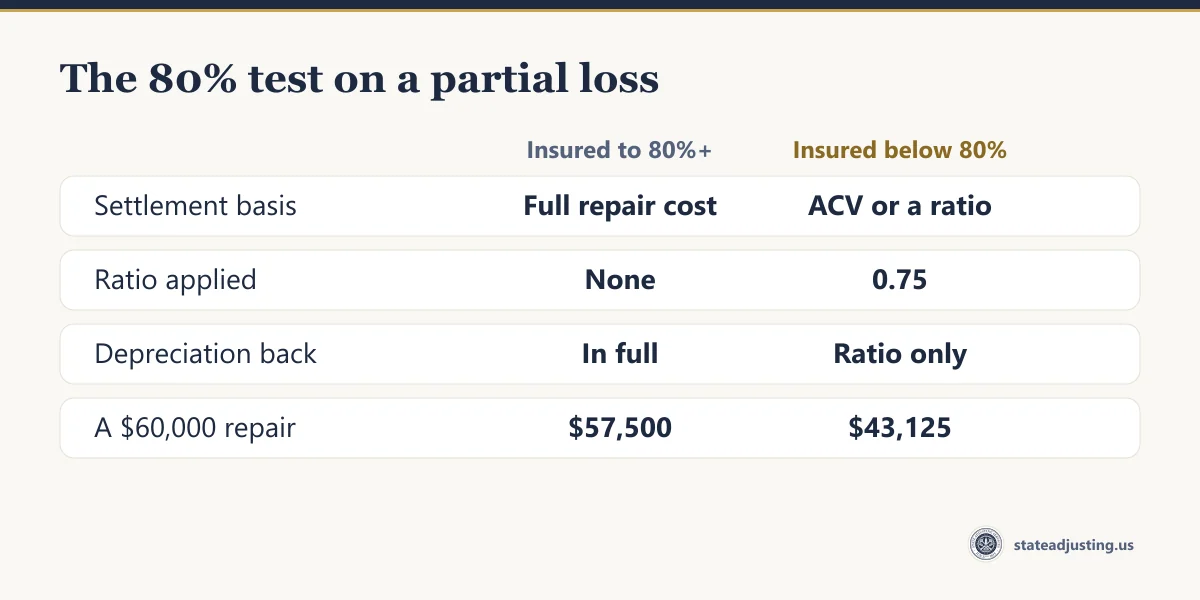
It is the test that decides whether you get replacement cost at all. Widely used homeowners forms say: if the amount of insurance on the damaged building is 80% or more of its full replacement cost immediately before the loss, we pay the cost to repair. If it is less, we pay the greater of actual cash value or a proportion of the repair cost.
That proportion is the part worth memorising: the insurance you carried, divided by 80% of the building's full replacement cost, applied to the cost to repair after the deductible. Two things follow. The divisor is 80% rather than 100%, so the policy builds in a cushion and penalises only the shortfall below it. And — this is the one that costs money — the test applies to every partial loss. Nothing waits until the claim gets large.
What does that cost on a real partial loss?
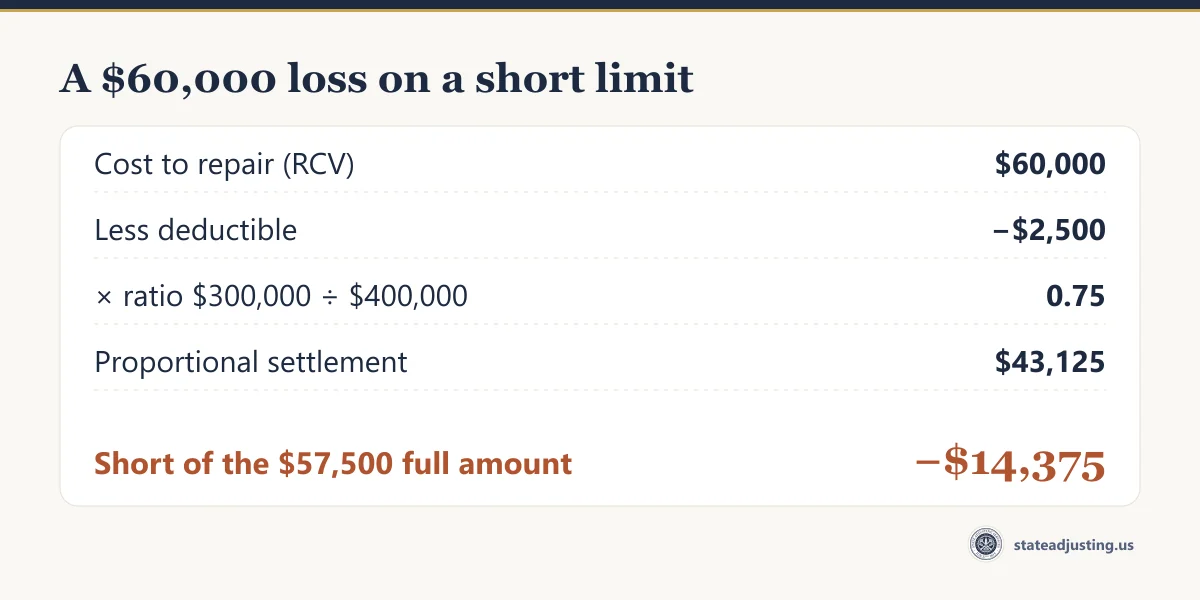
Take a house carrying $300,000 of Coverage A, which the carrier's estimator puts at $500,000 to rebuild at the time of loss. A wind and hail storm damages the roof, gutters and two elevations of siding. The repair estimate is $60,000 replacement cost, with $21,000 of depreciation and a $2,500 deductible.
| Step | Figure |
|---|---|
| Full replacement cost of the dwelling at the time of loss | $500,000 |
| 80% of that — the test | $400,000 |
| Coverage A actually carried | $300,000 |
| The ratio: $300,000 ÷ $400,000 | 0.75 |
| Cost to repair, less the deductible: $60,000 − $2,500 | $57,500 |
| Proportional settlement: $57,500 × 0.75 | $43,125 |
| The other route — actual cash value: $60,000 − $21,000 − $2,500 | $36,500 |
| The policy pays the greater of the two | $43,125 |
| Same loss, insured to 80% or more | $57,500 |
The short limit cost $14,375 on a $60,000 claim, on a house where the $300,000 limit was never approached — which is why "my limit is much bigger than my damage" is not the reassurance it sounds like. The money is not withheld as recoverable depreciation either: the first cheque is still actual cash value, but the top-up after the work is finished stops at the proportional figure rather than at full replacement cost. Our walkthrough of ACV versus replacement cost covers how those two cheques work when the limit is adequate.
There is a second number in that arithmetic, and it is the one worth arguing about. The $500,000 is not a fact — it is the output of the carrier's replacement cost estimator, driven by inputs somebody typed. If the defensible rebuild figure is $420,000, the test becomes $336,000, the ratio becomes 0.893, and the same claim settles at $51,339 instead of $43,125. The inputs moved $8,214.
Does extended replacement cost fix it?
It fixes a different problem. Extended replacement cost is an endorsement that will pay a stated amount above your Coverage A limit — commonly 25% or 50% — when the rebuild costs more than the limit. It exists for the case where you insured the house properly and construction still came in higher. It is not a cure for a limit that was set too low to begin with.
The attached condition is the part people miss. These endorsements generally require that the dwelling be insured to the full replacement cost the carrier estimated, and that additions and alterations were reported — so if the limit is short because a renovation was never declared, that is the first thing examined. Two further limits: the extra amount usually applies to the dwelling only, and payment is often conditioned on rebuilding at the same location.
Guaranteed replacement cost — no ceiling at all — still exists but is far less common and carries stricter conditions on age, updates and inspection. Whether either is on your policy is a line on the declarations page, not something to assume.
What happens on a total loss when the limit is short?
You are paid the limit, plus any extended replacement cost amount, plus the coverages the form provides as additional amounts of insurance — commonly ordinance or law and debris removal, which sit outside Coverage A rather than inside it. Beyond that the shortfall is the homeowner's.
What compounds it is that the rest of the policy is priced off Coverage A. The percentages vary by form, so read your own declarations page, but the shape is consistent:
| Coverage | Typical basis | At $300,000 | At $500,000 |
|---|---|---|---|
| B — other structures | 10% of A | $30,000 | $50,000 |
| C — personal property | 50% of A | $150,000 | $250,000 |
| D — loss of use | 20–30% of A | $90,000 | $150,000 |
| Ordinance or law | 10% of A | $30,000 | $50,000 |
A dwelling limit $200,000 short is also roughly $20,000 short on the detached garage, $100,000 short on contents and $60,000 short on the hotel and rent during the rebuild. On a fire claim those are the coverages families feel first, because they pay while there is nowhere to live.
How do I check whether I am underinsured?
This takes an afternoon and can only be done between claims. Work down the list in order:
- Read the Coverage A figure off the declarations page and write it next to your mortgage balance and the market price, purely to confirm they are three different numbers.
- Get a rebuild figure from someone who builds. A local contractor's per-square-foot number for new construction of the same grade, times your finished square footage, plus foundation, site work and anything custom.
- List every change since the policy was written — additions, finished basement, upgraded kitchen or bathrooms, a higher grade of roof — and send the list to your agent in writing.
- Ask your agent to run the carrier's own replacement cost estimator and send you the output. This is the highest-value item on the list. That printout, with its inputs visible, is the document the 80% test will later be measured against.
- Check the inflation guard line and what percentage it applies at each renewal.
- Check whether extended or guaranteed replacement cost is on the policy, and what condition it attaches.
- Check Coverage B, C and D against reality, not against the percentage — a detached garage worth more than 10% of the dwelling limit is its own conversation with your agent.
If any of that reads like unfamiliar territory, our guide to the six lines that decide your claim covers where these figures live on the declarations page.
What to do if you are already in a claim
The limit cannot be raised after a loss, and nobody should suggest otherwise. What is still open is how the ratio was calculated and what sits outside it.
- Ask for the replacement cost calculation in writing, with the inputs, not just the conclusion. A carrier applying the condition is relying on that figure.
- Check the inputs against the house. Square footage, storeys, foundation type, finish grade and roof geometry move the number most, and are frequently wrong on older files.
- Confirm which building was damaged. The test applies to the damaged building — a detached garage is settled under Coverage B with its own limit, not under the dwelling ratio.
- Confirm the limit in force on the date of loss. Inflation guard adjusts at renewal, and the declarations page in your drawer may be a year old.
- Identify the additional amounts of insurance — ordinance or law, debris removal — paid on top of Coverage A rather than out of it.
- Watch the settlement sequence. Actual cash value first, then the top-up on completion, capped at the proportional figure. Make sure it is actually requested.
One honest caution: when the disagreement is about the cost to rebuild the whole house rather than the cost to repair the damage, appraisal is not an obvious fit. Whether a panel may reach that question depends on the wording, and it is worth advice rather than assumption.
What we can do
We review the estimate, the declarations page and the replacement cost calculation together, because on an underinsured file those three documents only make sense side by side. If the ratio is being applied to a rebuild figure that does not describe your house, that is measurable. Our claim process page sets out how a file is handled.
The review is free and there is no obligation. We are paid a percentage of the recovery, regulated by Illinois law and agreed in writing before we start — no fee upfront, no recovery, no fee. If a storm claim settled lower than the estimate and you cannot see why, send us the paperwork. Contact us or call (630) 297-8136, Monday to Friday, 8:00 AM to 5:00 PM.
Questions we get about this
What is Coverage A on a homeowners policy?
Coverage A is the dwelling limit — the most the policy will pay to repair or rebuild the house itself. It is meant to equal the cost of rebuilding the same structure at the same address at current labour and material prices. It is not the market value, the mortgage balance or the county's assessed value, and it does not include the land, because land is not destroyed by a covered loss.
What is the 80% rule in homeowners insurance?
Widely used homeowners forms pay replacement cost on a building only if the amount of insurance is at least 80% of the building's full replacement cost immediately before the loss. Below that, the policy pays the greater of actual cash value or a proportion of the repair cost — the insurance carried divided by 80% of the rebuild cost. The test applies to every partial loss, not only to a total loss, so a shortfall reduces ordinary claims as well.
Does extended replacement cost coverage fix an underinsured home?
Not by itself. Extended replacement cost pays a stated amount above the Coverage A limit, commonly 25% or 50%, for the case where you insured the house properly and the rebuild still cost more. It generally requires that the dwelling be insured to the carrier's own full replacement cost estimate and that additions and alterations were reported. If the limit is short because a renovation was never reported, that condition is usually the first thing examined.
Can I increase my Coverage A limit after a loss?
No. The limit and the conditions attached to it are fixed as of the date of loss, and no endorsement can be added afterwards to cover damage that has already happened. What can still be examined on an open claim is the replacement cost figure the carrier used, whether its inputs describe your house accurately, which building the damage belongs to, and which additional amounts of insurance are payable on top of Coverage A rather than out of it.