Woodpecker damage and home insurance: what a claim can still pay
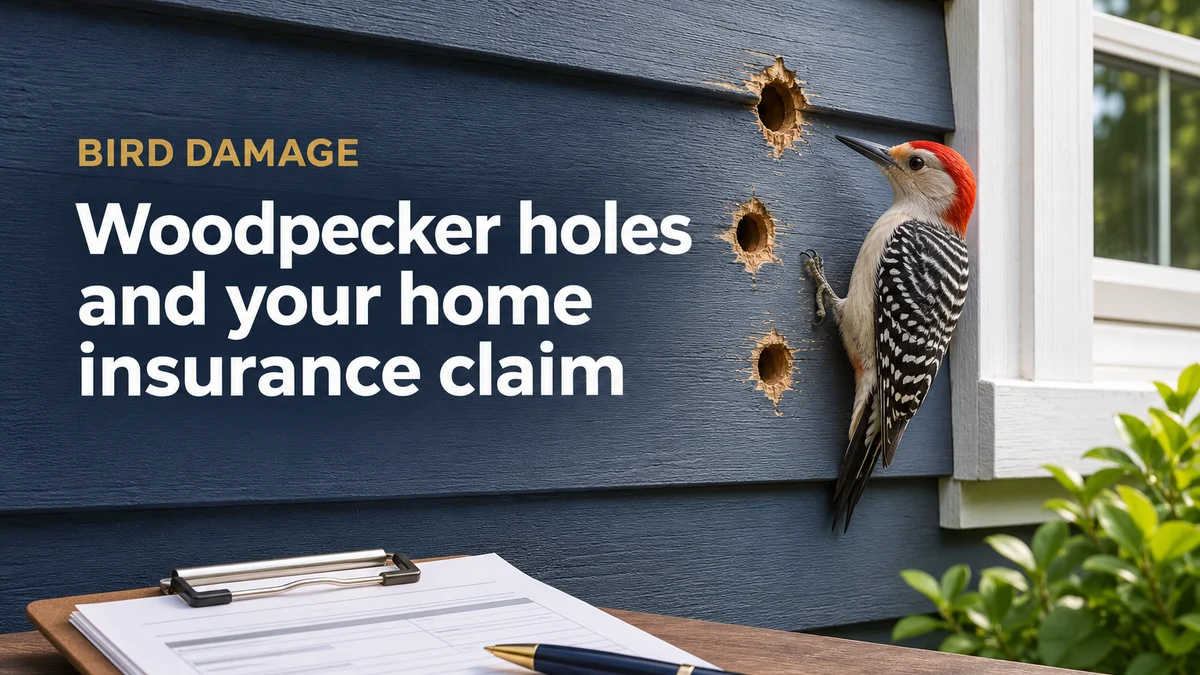
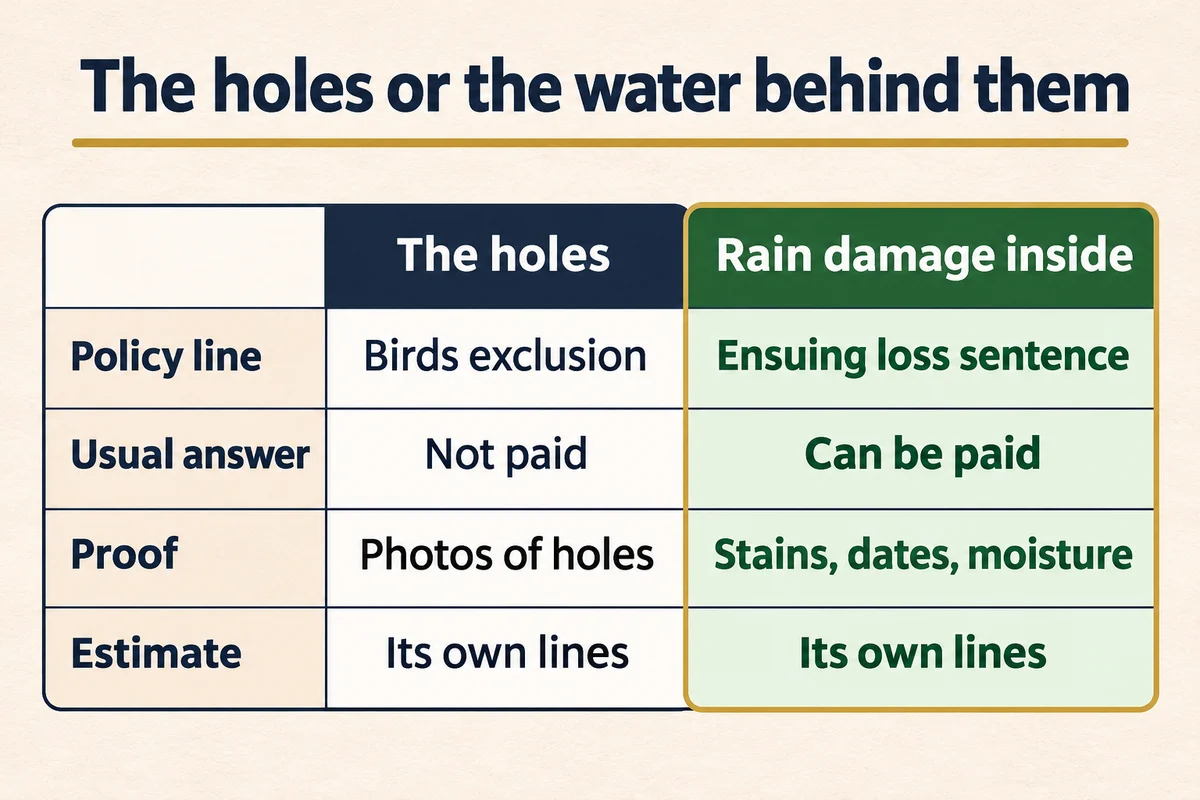
Woodpecker damage to siding, trim and fascia is usually not covered by homeowners insurance, because the standard policy form lists birds among the causes it does not insure. That is often not the end of the claim. When rain gets in through the holes and stains a ceiling or soaks the drywall, the water damage inside the house can be a separate loss, and the same form treats it differently. Your own policy's wording decides it, and the split between the two is where these claims are usually won or lost.
Below: how to read the holes on your wall, the three lines of the standard form that decide the claim, how an adjuster splits one wall into three zones, why your belongings are a harder case, what federal law lets you do about the bird, and the order to build the file in.
Read the holes before you call anyone
The pattern on the wall tells you why the bird is there, and that tells you how the claim will be argued. The U.S. Fish and Wildlife Service explains the reasons woodpeckers work on houses on its page about woodpeckers and your home: food, a place to nest or roost, a place to store food, and drumming to communicate.
A tight row of shallow marks and loud tapping
The bird is drumming to claim territory or to call a mate. The Service says this mostly happens in early spring, at the start of the breeding season.
For the claim: often more noise than opening. Shine a light on the spot and check whether the siding is broken through at all.
Scattered small holes, often in a soft patch
The bird is hunting insects in the wood. The Service names carpenter bees, leafcutter bees and grass bagworms among them.
For the claim: the insects fall under the same exclusion as the bird, and the carrier will ask how long they have been there. Date your first photos.
One large round hole, often high under the eaves
The bird is digging a nest or roost cavity. That drilling usually happens in early spring, with some in the fall, and rotting wood draws cavity nesters in.
For the claim: this is the hole that lets rain into the wall. Photograph it, then the ceiling and walls below it inside the house.
The three lines in your policy that decide it
Most homeowners policies are built on forms written by the Insurance Services Office (ISO). In the 1991 edition of its Homeowners 3 form, the list of causes the house is not insured against names birds, names rot, and is followed by a sentence that gives coverage back for an ensuing loss. Your company may word these lines differently, so find the matching ones in your own policy.
Birds, vermin, rodents, or insects
Section I, perils insured against, Coverages A and B, item 2.e(7)The holes the bird makes, and the insect damage that drew it, are not insured. This is the line the carrier will quote first.Smog, rust or other corrosion, mold, wet or dry rot
Same list, item 2.e(3)Rot in the trim or the sheathing behind the holes is excluded on its own terms, whatever let the water in. Some policies add back a limited amount for mold after a covered water loss; our article on mold after water damage explains those sublimits.Under items 1. and 2., any ensuing loss to property described in Coverages A and B not excluded or excepted in this policy is covered.
Directly after the listWhen an excluded cause leads to a different kind of damage that is not excluded, that damage can be paid. Wet drywall, a stained ceiling and soaked insulation are the usual candidates.
The wording above comes from the HO 00 03 04 91 form in a copy filed with the Nevada Division of Insurance. One more line sits further on, among the Section I exclusions: neglect, meaning neglect of the insured "to use all reasonable means to save and preserve property at and after the time of a loss." A hole you photographed in May and left open until November hands the carrier that argument for every stain the rain made in between.
One wall, three zones: how the damage gets split
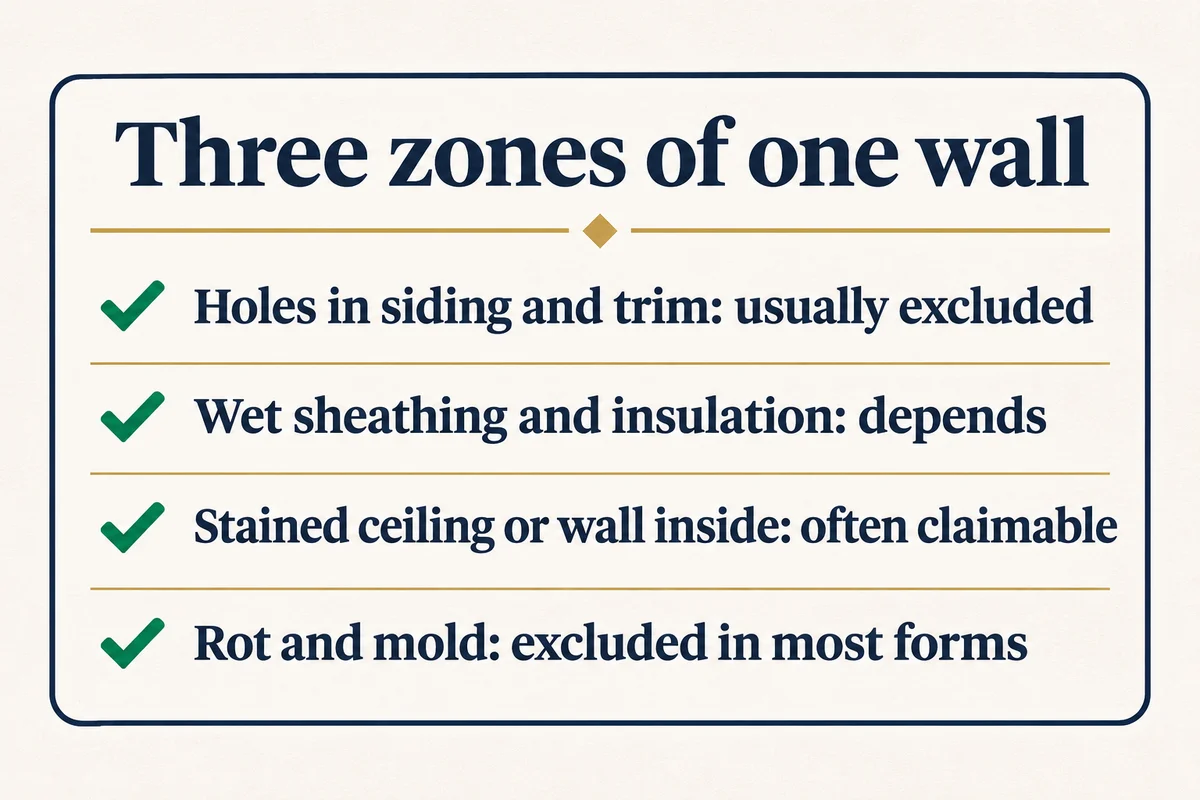
An adjuster reads a woodpecker loss from the outside in. Each zone has its own answer, and the claim only works when the estimate keeps them apart.
The outside face
Siding, trim, fascia and soffit with holes in them.
Usually excluded
Patching or replacing the boards is bird damage, and that is normally your cost.
Inside the wall
Wet sheathing, wet insulation, sometimes a nest.
Depends
Water from a recent rain can be argued as an ensuing loss. Rot, mold and insects fall under their own exclusions. Moisture readings and dates decide which story fits.
Inside the room
A stained ceiling, bubbled paint, wet drywall.
Often claimable
The strongest part of the claim, if the damage is new and you acted when you found it.
An estimate that puts all three zones on one line makes it easy to deny all three under the bird exclusion. Ask your contractor to price the outside repair, the work inside the wall and the room repair on separate lines. The room repair alone may be below your deductible, so compare the two before you file; our guide on filing a claim or paying out of pocket walks through that sum.
Belongings wet by the same rain are a harder case
Rugs, furniture and other belongings sit under Coverage C, which in the standard form is a list of named perils, not open perils. Rain reaches it only through the windstorm peril, and that peril carries a condition:
This peril does not include loss to the property contained in a building caused by rain, snow, sleet, sand or dust unless the direct force of wind or hail damages the building causing an opening in a roof or wall and the rain, snow, sleet, sand or dust enters through this opening.
Homeowners 3 form HO 00 03 04 91, Coverage C, peril 2, windstorm or hail
A woodpecker hole is an opening, but the wind did not make it. Under this wording, a rug ruined by rain through that hole is not paid, while the ceiling above it may be. The same test decides many roof leaks, and our article on wind-driven rain and the opening test shows how it is applied.
What federal law lets you do about the bird
Woodpeckers are protected by the Migratory Bird Treaty Act, so you can keep them off the house but not simply get rid of them. The Fish and Wildlife Service says a depredation permit is a last resort for some species and is issued only after non-lethal methods have been tried and failed. It also says homeowners are liable for the illegal removal of protected species. If a nest is active, control measures wait until the young leave it.
The Service lists what tends to work:
- Bird netting hung from the outer eaves down the side of the building, kept taut and repaired when it tears. It calls this typically effective at excluding most woodpeckers.
- Owl and hawk models, spinners and windsocks, which it says have inconsistent success.
- Recorded woodpecker distress calls followed by raptor calls, as a sound deterrent.
- No gels or sticky substances, because they can harm the bird's flight and its ability to stay warm.
These steps also answer the neglect line. Keep the receipt for the netting and a dated photo of it in place, and close any hole that is open to the weather as soon as the law allows.
Building the claim file, in order
- Photograph the outside first: a wide shot of the wall, then each hole with a coin or a tape measure next to it. Your phone records the date.
- Go inside the same wall. Check the ceiling, the top of the walls, closet corners and the attic above the eaves, and photograph every stain. Write down the day you first noticed each one.
- Close the holes or have them closed, and put up a deterrent. Keep the receipts. Water that keeps coming in after you knew about the holes is the weakest part of any claim.
- If insects were in the wood, ask the pest professional to write down what they found. The insects are excluded, but the note helps fix the timeline.
- Report the inside damage to the carrier as water damage that came in through the holes, with the date you found it. Describe what you saw; do not guess at what happened behind the wall.
- Get the contractor's estimate with the three zones on separate lines.
- If opening the wall shows more wet material than anyone expected, report it with photos. That is a normal supplement, not a new claim.
When to bring us in
Most woodpecker losses are small, and the board repair is yours to pay. A second look is worth it when rain has damaged finished rooms, when the carrier denies the whole loss under the bird exclusion without looking at the inside, or when the opened wall shows more than the first estimate. If squirrels, raccoons or bats are the problem instead, our article on animals in the attic covers those exclusions.
Send us the photos of the wall and the room, the date you found the stains and, if you have it, the denial letter. As licensed Illinois public adjusters we take on water losses like this one and second looks at refused claims, and the first review of your policy costs you nothing. If we take the claim, our share comes out of what the carrier pays, at a percentage Illinois law regulates; when nothing is recovered, you owe us nothing. The contact page reaches us, and the office answers seven days a week.
Questions we get about this
Does homeowners insurance cover woodpecker damage?
Usually not for the holes themselves. The standard homeowners form excludes damage caused by birds, vermin, rodents or insects. Water damage inside the house that follows from rain entering through the holes can be a separate ensuing loss, which the same form may cover. Your own policy's wording governs.
Is rot behind woodpecker holes covered?
Usually not. The standard form lists mold, wet or dry rot in the same group of exclusions as birds, so rot is excluded on its own terms. Some policies add back a limited amount for mold after a covered water loss. Wet drywall or a stained ceiling inside is the stronger part of such a claim.
Will insurance pay for furniture damaged by rain through a woodpecker hole?
Under the standard form, belongings are covered for rain only when wind or hail made the opening the rain came through. A woodpecker hole was not made by wind, so the belongings are usually not paid, even when the ceiling above them may be. Check the wording of your own policy.
Can I remove a woodpecker that is damaging my house?
Woodpeckers are protected by the Migratory Bird Treaty Act. The U.S. Fish and Wildlife Service says a depredation permit is a last resort, issued only after non-lethal methods have failed, and that control waits until the young leave an active nest. Bird netting from the eaves is the method it describes as typically effective.