Business theft insurance claim: who took it decides which policy pays
A business theft insurance claim turns on one question before any number is discussed: who took the property. If an outsider broke in and carried it away, the commercial property policy is usually the one that answers, on the special causes of loss form, subject to a few caps. If an employee took it, if someone talked you into handing it over, or if it simply turned up missing on a count, the same form says no, and the loss belongs to a crime policy or to nobody. Owners often learn this sorting from the denial letter. It costs far less to learn it on the first day.
We are licensed Illinois public adjusters, not attorneys. The provisions quoted below come from the widely used ISO causes of loss special form, edition CP 10 30 09 17, which New York's Office of General Services publishes as a sample copy. Many Illinois business policies use it or a carrier's own version of it. Your policy, its edition and its endorsements govern your claim.
Four ways property leaves a business, and where each one lands
The special form insures theft as a cause of loss, then removes particular kinds of it. Place your loss in one of these four lanes before you call anyone. The lane decides which policy you report it under and which documents the carrier will want.
Someone from outside broke in or walked in
A burglar forces the rear door overnight, or a shoplifter leaves with a case of goods during open hours. The special form does not require visible forced entry. This is the situation the property policy is written for.
Property policy, subject to the theft caps and your deductibleAn employee, partner or someone you entrusted took it
Exclusion B.2.h removes dishonest or criminal acts by you, partners, officers, managers, employees (temporary and leased workers included), directors and authorized representatives, plus theft by anyone you entrust property to, such as a courier. It applies during business hours and after them.
A crime policy or employee dishonesty coverage, if the business bought oneSomeone tricked you into handing it over
Exclusion B.2.i removes voluntary parting with property induced by a fraudulent scheme, trick, device or false pretense: goods released to a fake pickup driver, or shipped to a buyer whose payment later bounces. Limitation C.1.f does the same for property moved off the premises on unauthorized instructions.
Crime or social engineering coverage, not the property formNobody knows what happened
Limitation C.1.e: the form does not pay for property that is missing where the only evidence is a shortage found on taking inventory, or where nothing physical shows what happened to it. A low count on its own is not a theft claim. A low count plus a cut lock, footage or a police report can be.
Nothing, until you have physical evidence of an event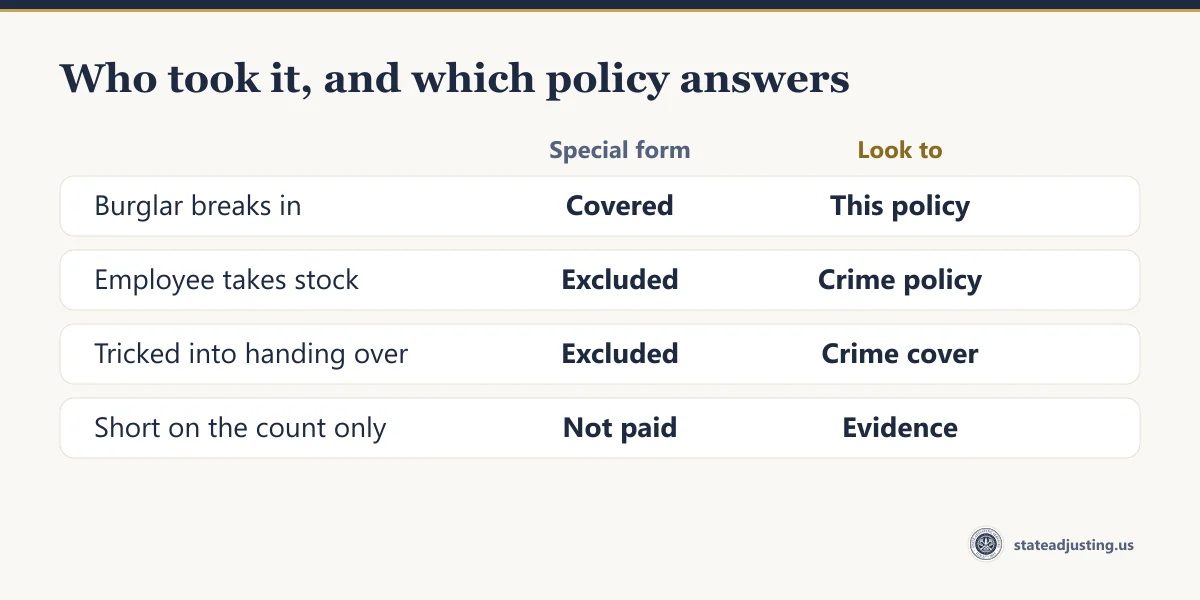
Six provisions in the special form that decide a theft claim
Most theft disputes come back to a short list of provisions. Find these in your own form, because a carrier's version may number or word them differently.
| Where in CP 10 30 | What it says, briefly | What it means on the day |
|---|---|---|
| B.2.h | Excludes dishonest or criminal acts, theft included, by you, your people and anyone you entrust property to | The carrier will ask who had keys and alarm codes. Write that list before the adjuster asks for it. |
| B.2.h(2) | Acts of destruction by employees stay covered; theft by employees does not | A worker who smashes equipment on the way out is a property claim. The same worker leaving with laptops is not. |
| B.2.i | Excludes voluntary parting induced by a trick or false pretense | Fraud losses get reported to the crime carrier rather than argued under the property form. |
| C.1.d | Limits theft of building materials and supplies not yet attached to the building | Lumber and fixtures waiting for a remodel are not paid if stolen, unless you hold them for sale. |
| C.1.e | No payment for property missing where an inventory shortage is the only evidence | Keep the physical record: the damaged entry, footage with time stamps, the police report. |
| C.3 | Special theft limits per occurrence for certain kinds of property | Furs, jewelry and precious metals, patterns and dies, and stamps and tickets each carry a cap unless your declarations show a higher one. |
The broken door is a separate part of the claim
The damage done getting in and out is not theft. A pried door frame, a shattered storefront, a torn-off alarm panel and the plywood over the opening are physical damage to the building or to your fixtures, and the special form handles them that way. This part is usually the easiest to prove because it is still there. Photograph it before the locksmith and the glazier arrive, and keep their invoices.
A few details matter here. The form includes an extension for glass that pays for temporary plates or board-up when the glass repair is delayed. Because the employee exclusion carves out destruction, damage an employee causes is still covered even though theft by that employee is not. And if you lease the space, read your lease for who insures the doors, glass and storefront: the building owner's policy may be the one that pays for them. Our article on emergency board-up bills explains how those invoices get questioned.
The theft caps: $2,500 and $250 per occurrence
Section C.3 sets special limits that apply to any one occurrence of theft, however many articles are taken. Each is the total for its whole category, and each sits inside your overall limit rather than on top of it. A higher figure printed in your declarations replaces it.
- $2,500
- Furs, fur garments and garments trimmed with fur. A tailor, a cleaner holding customers' coats or a consignment boutique can reach it with a handful of pieces.
- $2,500
- Jewelry, watches, precious and semiprecious stones, bullion, gold, silver, platinum and other precious metals. Jewelry and watches worth $100 or less per item fall outside the cap. One display case in a gift shop can exceed it in a single night.
- $2,500
- Patterns, dies, molds and forms. Machine shops and small manufacturers keep tooling that costs far more than this to remake.
- $250
- Stamps, tickets including lottery tickets held for sale, and letters of credit. A convenience store's lottery stock is the usual example.
The caps are written for theft. The same jewelry destroyed in a fire is valued under the form's ordinary rules. If your stock falls in one of these categories, the moment to raise the limit is at renewal, with your agent, before anything happens.
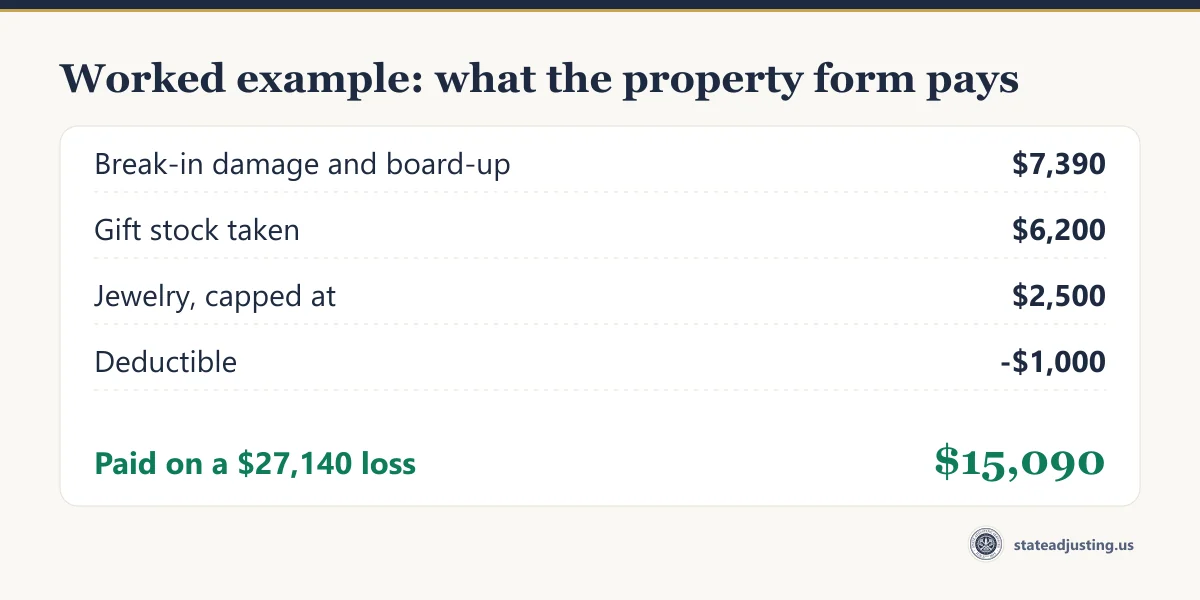
One break-in at a gift and jewelry shop, line by line
This is an illustration built to show the arithmetic, not a client file. A shop insured on the special form with a $1,000 deductible is broken into overnight through the rear door. Cash goes from the register. Every piece in the jewelry case was worth more than $100. A week later the owner's full count finds a further shortfall that nobody can tie to the night.
| Item | Loss | Property form pays | Why |
|---|---|---|---|
| Rear door and frame | $3,450 | $3,450 | Physical damage from the break-in |
| Storefront glass | $2,180 | $2,180 | Physical damage from the break-in |
| Board-up the first night | $640 | $640 | Temporary protection while new glass was on order |
| Alarm keypad and panel | $1,120 | $1,120 | Torn off the wall on the way in |
| Gift stock taken | $6,200 | $6,200 | Theft by an outsider, proved by supplier invoices and the point of sale record |
| Jewelry from the case | $9,400 | $2,500 | C.3 jewelry cap for one occurrence of theft |
| Cash from the register | $1,850 | $0 | Money is commonly listed as property not covered on the building and personal property form |
| Shortfall found on the later count | $2,300 | $0 | C.1.e, only an inventory shortage shows it |
| Deductible | -$1,000 | One occurrence, one deductible | |
| Total | $27,140 | $15,090 |
Of the $12,050 the form does not pay, $6,900 is jewelry above the cap, $1,850 is cash, $2,300 is the unexplained shortfall and $1,000 is the deductible. No line was refused for late notice or a missing document. The gap comes from limits the owner could have read the year before: a higher jewelry figure in the declarations and a crime policy for money would have closed most of it. The shortfall line can still move if the owner finds footage or a delivery record placing those items in the shop before the break-in and gone after it, because that turns a count into evidence of the same event.
If the shop stayed closed while the door and glass were replaced, the lost days are a separate question for business income coverage, which this table leaves out.
What the carrier will ask for, and the record that answers it
A theft file is proved on paper because the property is gone. Gather these in the first days, while the records still exist.
- The police report number and the responding officer's name. Commercial property forms commonly list notifying the police among your duties after a loss.
- Alarm and camera logs with their time stamps, exported now. Recorders overwrite old footage on a cycle, and the event you need is the oldest thing on the drive.
- Supplier invoices, statements and the point of sale history for every item you claim. They show the stock existed and what you paid for it.
- Your last dated physical count before the break-in. It is the baseline the missing quantities are measured against.
- Photographs of the point of entry and the empty shelves or cases, taken before anything is repaired or restocked.
- A written list of everyone with keys, codes or after-hours access, with where each person was that night. Exclusion B.2.h makes this question certain.
- Board-up, locksmith and glazier invoices, and your lease if you rent.
Our page on commercial theft and burglary claims covers how a stock list gets rebuilt when the records are incomplete.
When the carrier pushes back
Theft claims usually stall on one of three arguments. The first is that the loss is only an inventory shortage. The reply is physical evidence that something happened: the damaged entry, footage, the police report, serial numbers of stolen goods that surface for resale. A shortfall that matches what the camera shows leaving the building is a different thing from the bare count C.1.e describes.
The second is the employee exclusion. If the carrier suspects someone inside, ask in writing which facts support it. The access list and each person's whereabouts are the record that answers it. When a carrier raises fraud or wants an examination under oath, that is the point to speak with an attorney.
The third is the amount: catalog prices in place of your invoices, or quantities that do not match your count. That is a disagreement about numbers, the kind a documented supplement or the appraisal clause exists to settle.
Whatever the argument, Illinois rules require the carrier to put a denial or a reduced payment in writing. Under 50 Ill. Adm. Code 919.50 that explanation must give the reason and refer to the policy provision relied on. If the letters stop coming, our guide to filing a complaint with the Illinois Department of Insurance explains when that route helps and when it does not.
What to do this week
- Report the break-in to police and write down the report number.
- Photograph the entry and the empty cases, then secure the premises and keep every invoice for doing so.
- Export the camera and alarm logs before they are overwritten.
- Report the loss to the property carrier. If you carry a crime policy, report it there as well; each policy has its own notice condition.
- Pull the declarations page and find the theft limits, any higher figures printed for them, and the deductible.
- Build the list of stolen items from invoices and the point of sale record rather than from memory.
- Track every day the business is closed or limited, with the sales you would normally have made.
If you would like a second set of eyes on the file, we review commercial theft claims anywhere in Illinois without charge. There is $0 upfront: our fee is a percentage of the recovery, regulated by Illinois law and agreed in writing, and no recovery means no fee. Contact us or read how our claim process works. For a home rather than a business, our residential theft and vandalism guide covers the homeowners policy, and a building left empty has its own rules, set out in our article on vacant and unoccupied property.
Questions we get about this
Does commercial property insurance cover employee theft?
Not on the widely used ISO special causes of loss form. Exclusion B.2.h removes dishonest or criminal acts, theft included, by you, partners, officers, managers, employees (temporary and leased workers included), directors and authorized representatives. Damage an employee deliberately causes is still covered, but theft by an employee is not. Employee theft is usually handled by a separate crime policy or employee dishonesty coverage, if the business bought one.
Do I need signs of forced entry for a business theft claim?
The special form does not require visible forced entry. What it refuses is property that is missing where the only evidence is a shortage found on taking inventory, or where nothing physical shows what happened. Footage, a police report or a damaged entry is the kind of evidence that moves a loss out of that limitation. Check your own policy, because a carrier's form or an endorsement can add conditions.
Is cash stolen from the register covered by my property policy?
Usually not. Money and securities are commonly listed as property not covered on the building and personal property form, so cash taken from a register or safe is normally a question for a commercial crime policy. Read the property not covered section of your own form and check whether your business carries crime coverage.
How much does a commercial property policy pay for stolen jewelry?
On the ISO special form, theft of jewelry, watches, precious stones and precious metals is capped at $2,500 for any one occurrence of theft, for the whole category, unless your declarations show a higher limit. Jewelry and watches worth $100 or less per item fall outside that cap. The cap applies to theft; the same jewelry lost in a fire is valued under the form's ordinary rules.