Hail dents on a commercial metal roof: when the cosmetic exclusion applies
A hail-dented commercial metal roof that does not leak is not automatically outside your coverage. Whether a cosmetic damage exclusion takes the dents away depends on the exact words of the endorsement on your policy and on what the evidence shows about the roof's strength. On July 27, 2026, a federal appeals court reading a common version of this exclusion held that a metal roof which still keeps water out can fall outside it, if the hail left the roof measurably weaker against wind and snow.
That decision came from the Eighth Circuit and applied Minnesota law, so it binds no Illinois court. It is still the most detailed reading of this wording so far, and it changes what a building owner should measure before accepting a cosmetic denial. We are licensed Illinois public adjusters, not attorneys, and a lawsuit over the wording is a question for a lawyer. Your own policy governs.
What the appeals court changed in July 2026
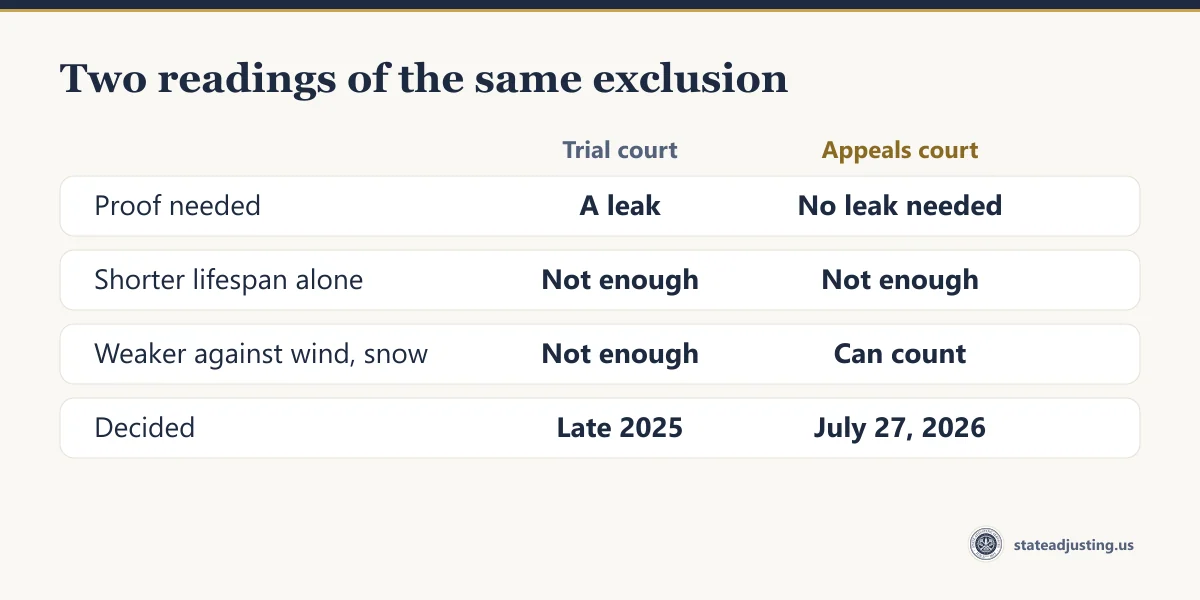
It changed the test from has the roof leaked? to does the roof still resist the weather to the same degree? The case involved two school buildings whose metal roofs were dented by hail in April 2022. Nothing was punctured, and neither roof leaked afterwards. The carrier denied the roofs under an exclusion for hail damage that changes how roof surfacing looks without stopping the roof from keeping out the elements to the same extent as it did before.
The trial court sided with the carrier in late 2025 because nothing had leaked. The Eighth Circuit's opinion in No. 25-3315 vacated that judgment and sent the case back. Here are the two readings next to each other.
The owner's engineer had testified that the dented roofs would no longer resist the wind and snow loads that are normal for that part of Minnesota. The carrier's engineer testified that the dents had not reduced either. The appeals court did not decide who was right. It held that a jury could believe either engineer and that the policy words allow the owner's reading, which under Minnesota law settles an unclear exclusion in favor of coverage. One of the three judges dissented and would have kept the carrier's win, pointing to other courts that read similar wording the way the trial court did.
Three wordings, three different things to prove
Start with the endorsement itself, because the court said plainly that different words lead to different results. It compared policies from other cases that were written more tightly, and said a carrier that wants to pay only once the weather has already got in must say so in unambiguous language. On commercial forms the endorsement usually carries a title about roof surfacing. Find it in the list of forms on the declarations page, then read its definition paragraph word by word.
If no cosmetic endorsement is attached at all, the carrier needs some other part of the policy to refuse the dents, and the argument usually moves to how the repair is priced. Older roofs may also carry a separate schedule that pays roof surfacing at actual cash value. Our guide to roof age and cosmetic damage endorsements shows how that schedule cuts the payment even when the damage itself is covered.
What the exclusion still removes after the ruling
The decision narrows the exclusion. It does not remove it. Under the same wording, the court said these can still be excluded:
- Dents whose only effect is that the roof will wear out sooner. The court rejected the lifespan argument outright.
- Damage to parts that do no structural work. The court's own examples were decorative elements and gutters.
- Weakening that is insubstantial, unmeasurable or inconsequential, the kind that does not change how the roof works as a practical barrier.
- A dispute the owner loses on the evidence. A jury may believe the carrier's engineer. In a Tennessee case under similar wording, cited in the opinion, the owner lost because no expert in metal roofing systems was disclosed to answer the carrier's.
The last point is the practical one. Under this wording a claim on a dented metal roof is decided by engineering evidence, so that evidence has to exist before the argument starts.
What a metal roof evidence record has to measure
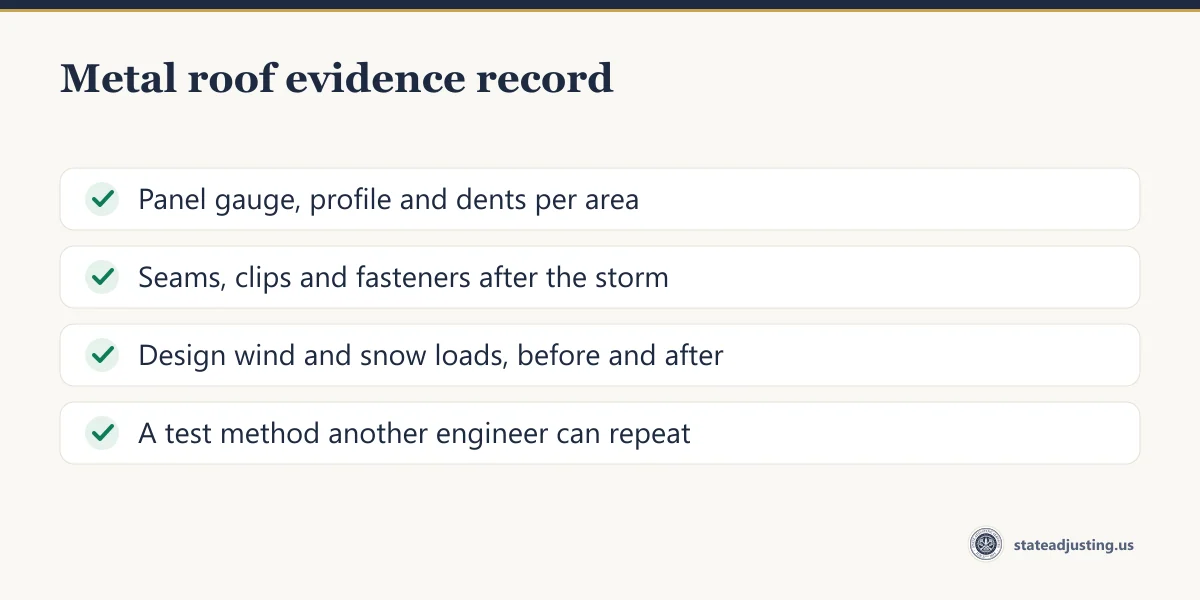
It has to measure strength, not appearance. Photos of dents prove the hail hit. They do not prove the roof is a lesser barrier. A record that can answer a same-extent exclusion ties each finding to a load the roof was built to carry. Our post on engineering reports in insurance claims covers how a causation opinion is written and how to answer one. The table below is the roof-specific part.
What the decision means for a building in Illinois
For an Illinois owner it is persuasive reasoning, not binding law. The opinion predicts how Minnesota's highest court would read the words. An Illinois court looking at the same words would apply Illinois law and may or may not reach the same result, and the dissent shows that judges already disagree. Nobody can promise how a court will read your endorsement.
What Illinois does settle is the paperwork. Under 50 Ill. Adm. Code 919.50(a)(1), a carrier that denies a first-party claim, or pays less than was claimed, owes a reasonable written explanation naming the exclusion, limitation, condition or definition it relied on. Ask for that letter before you answer. A letter that only says cosmetic without quoting the endorsement leaves you nothing to measure against.
First steps after a cosmetic denial on a commercial roof
- Get the denial in writing with the endorsement named, and pull the full form from your policy. A summary from the agent is not the form.
- Match its definition to one of the three wordings above and write down what it asks you to show.
- Before anyone repairs or replaces panels, have the roof documented: the dent map, the seams and fasteners, close photos with a scale, and drawings or a sample that show what the panels are. Once the panels are gone, so is the proof.
- Bring in an engineer who works with metal roofing systems. Ask for an opinion on load capacity before and after the storm, with the method written out.
- Check your time limits. The policy sets a deadline for bringing suit, and Illinois law affects how it is counted. Our list of Illinois claim deadlines shows where to look.
- Price the whole loss, not only the panels. Flashings, trim, rooftop units and interior damage are separate lines, and our commercial hail claims page lists what we record on a commercial roof zone by zone. A percentage hail deductible is figured on the insured limit, so work it out first with our guide to percentage wind and hail deductibles.
We review commercial hail claims across Illinois with nothing paid upfront. We read the endorsement with you and say plainly whether the claim is worth pursuing. Our fee is a percentage of the recovery, agreed in writing, and if nothing is recovered there is no fee. Send us the denial letter and the policy. We answer Monday through Friday 7:00 AM to 7:00 PM, and Saturday and Sunday 9:00 AM to 5:00 PM.
Questions we get about this
Does a hail dent on a metal roof have to leak to be covered?
Not under every wording. Under the same-extent wording the Eighth Circuit read in July 2026, proven loss of strength against wind or snow can be enough without a leak. Other forms make a leak the test. The endorsement on your own policy decides.
Is the July 2026 decision the law in Illinois?
No. It is a federal appeals decision applying Minnesota law, and it does not bind Illinois courts. It is one detailed reading of a common wording, and one of the three judges dissented.
Can appraisal settle a cosmetic damage denial?
Appraisal decides the amount of a loss, not whether an exclusion applies. When the dispute is about coverage itself, the routes are a complaint to the Illinois Department of Insurance or an attorney.
What should we do before the roof is replaced?
Document it first: a dent map on a roof plan, the seams and fasteners, close photos with a scale, drawings or a panel sample, and an engineer's load opinion with the method written out. Once the panels are removed, that evidence is gone.