Hiring a public adjuster after the insurer's offer: what is still open

Yes, in most cases you can hire a public adjuster after the insurance offer arrives, and even after the first check has cleared. An offer is the insurer's number, not an agreement, and a payment on account does not close a claim by itself. What does close it is narrower: a signed release, an appraisal award on the amount it decides, or a deadline in the policy that runs out. Before you sign anything mid-claim, the question that matters is which of those you are near.
Late fall is when many Illinois homeowners are holding a first check from a summer hail or wind claim and wondering whether it is the last one. This guide places your claim on the map, lists the papers that end a claim and the ones that only look like they do, and works through the fee on money that was paid before anyone was hired. We are licensed Illinois public adjusters, not attorneys. Your own policy wording governs, and nothing here is legal advice.
Where is your claim right now?
Find the row that matches your last letter from the insurer. The middle column is what can usually still be worked on at that stage; the right column is what to look at before you sign or start anything else.
| Your stage | What is usually still open | What to look at first |
|---|---|---|
| Offer in writing, nothing paid yet Open | The whole claim: the scope of damage, the prices, the items left off. A carrier can revise an offer it has not paid. | Any form sent with the offer that asks for your signature to accept it. Read it before you return it. |
| First check paid and deposited Open | Damage that was missed or found later, line items that were priced low, and the recoverable depreciation held back from the first check. | The letter that came with the check and the memo line on the check itself. Most first payments are partial and say nothing about finality. |
| Denial letter, in full or in part Open, with a clock | An answer to the reason the letter gives, backed by evidence. A partial denial leaves the rest of the claim open. | The suit deadline in your policy. Illinois pauses it while the claim is pending and lets it run again from the denial. |
| Repairs already finished Open if documented | The claim, as far as what was there before can still be shown. | Photos from before the work, the contractor's tear-off notes and invoices. Once the old roof is in a dumpster, those are the evidence. |
| Appraisal demanded or under way Narrowing | How the loss is measured and presented, until the award is signed. | Who your appraiser is and what they have been given. An award signed by two of the three normally sets the amount. |
| Release signed Usually closed | Little, for whatever the release covers. Damage outside its wording may be a separate question. | The exact wording of what you released. Whether a release can be undone is a question for an attorney. |
Most of the people who call us in the middle of a claim are in the second row. They have a check, the contractor's estimate is higher, and they are not sure whether cashing it was a mistake. In the ordinary case it was not. The gap between the two estimates is worked through a supplement to the claim, and the depreciation comes back once the repair is done and documented within the time your policy sets.
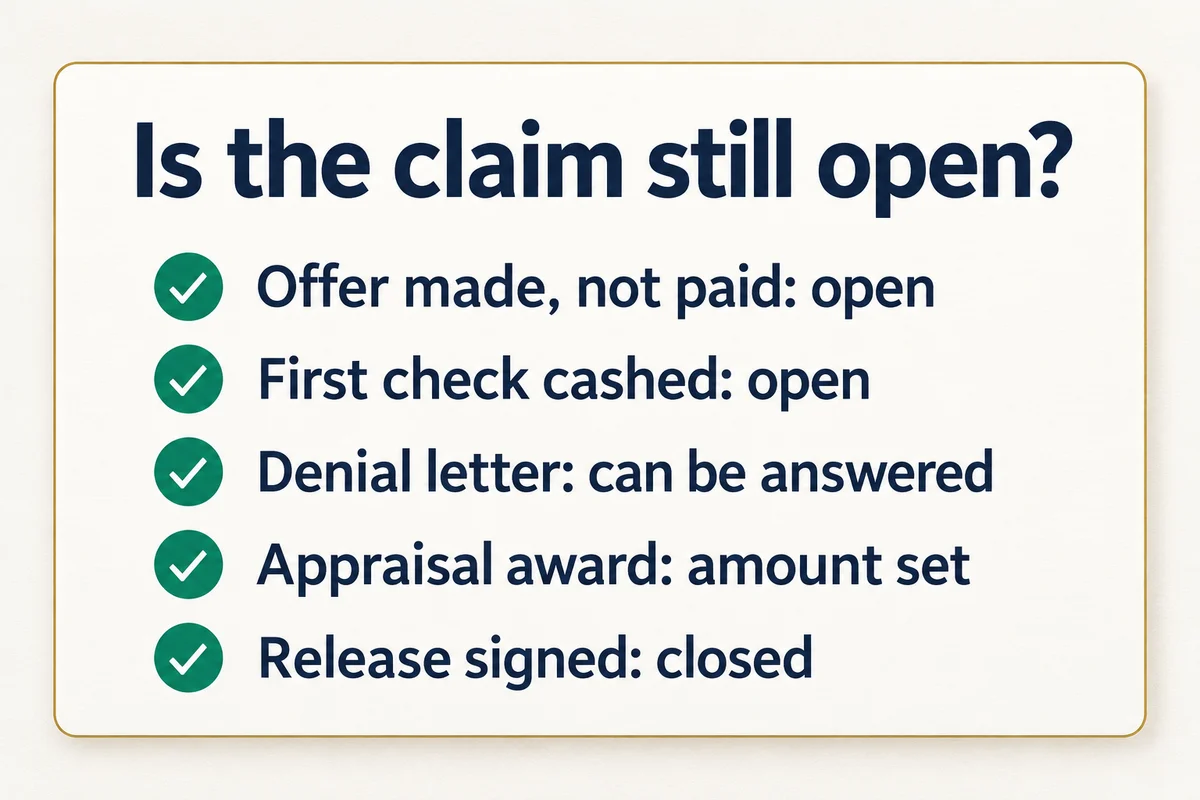
Which papers actually end a claim, and which only look final
A claim ends when you agree it is over, when a neutral process fixes the number, or when time runs out. Letters from the insurer that use the word closed do none of those on their own. The two columns below separate them.
Can end or limit the claim
- A release you sign that discharges the insurer for this loss. It usually says the payment is in full and final settlement.
- An appraisal award signed by two of the three people on the panel, for the amount it decides.
- The suit limitation period in the policy, once it has run out after the pause Illinois allows.
- A check or cover letter that says acceptance settles the whole claim. That is the moment to stop and ask before you sign the back.
Does not end it by itself
- A written offer, however firm it sounds.
- A first payment, including one you have deposited.
- A letter saying the file has been closed. Files are closed for administration and reopened when new information arrives.
- A denial letter. It starts the suit clock running again, and it can be answered.
- Your own decision to start repairs.
The suit deadline deserves its own sentence because it is the one people miss. Most Illinois homeowners policies require any lawsuit within a stated period after the loss. Section 143.1 of the Illinois Insurance Code pauses that period from the day proof of loss is filed until the day the claim is denied in whole or in part (215 ILCS 5/143.1). After a denial, the remaining time runs again. Our guide to the deadlines that end claims in Illinois walks through how that count is done.
What happens to the fee on money the insurer already paid?
Illinois caps what a public adjuster may charge on a personal residence at 10% of what the insurer pays on the claim. The Department of Insurance's consumer rights notice, which every Illinois public adjuster must give you before you sign, describes the cap as 10% of the total payments made on your insurance claim (IDOI Consumer Rights Notice, rev. 12/2023; 215 ILCS 5/1570).
That sentence sets a ceiling. It does not, in the text we have read, say in so many words how a check paid before the contract was signed is treated. So when you hire anyone mid-claim, the contract should answer it in writing, in figures: is the payment you already received inside the fee base or outside it? A contract that leaves it to be worked out later is one to send back before signing. On a claim that has already paid out, the difference can be large.
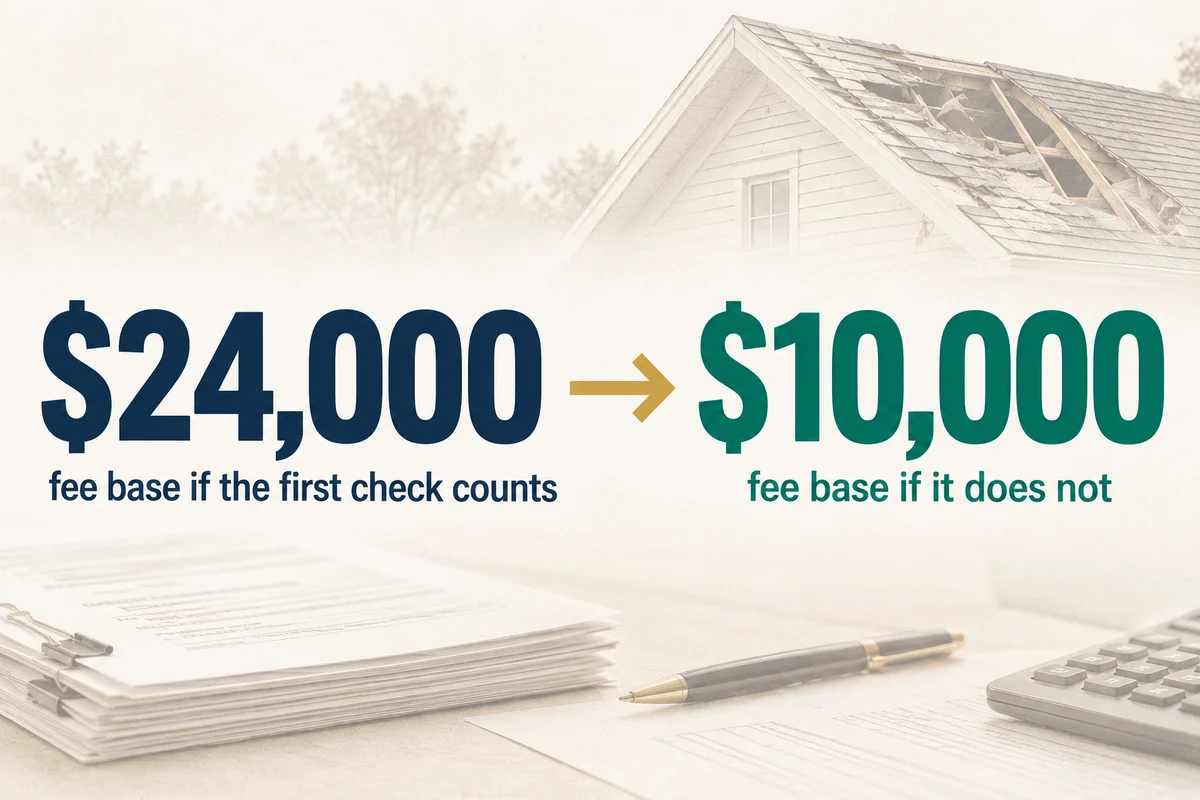
Say a hail claim has already paid a first check of $14,000 when the homeowner signs with a public adjuster. After signing, a supplement for missed items adds $6,500, and $3,500 of withheld depreciation is released once the roof is replaced.
Counted from the first dollar, the insurer has paid $24,000 on the claim. Counted from the signature, it has paid $10,000. At the 10% ceiling, that is the difference between a fee of up to $2,400 and a fee of up to $1,000 on the same file.
These figures illustrate the arithmetic. They are not a result we are claiming, and the percentage that applies to you is the one written into your own contract.
Two more contract points carry extra weight mid-claim. You can cancel for five business days after the insurer receives a copy of the contract, not five days after you sign it, and the adjuster has up to five business days to send that copy (215 ILCS 5/1575). And a public adjuster may not settle your claim without your knowledge and consent (215 ILCS 5/1590). Hiring help does not hand anyone your signature. Our longer guide to what an Illinois public adjuster contract must say goes through the rest of the form line by line.
What to bring to the first call
A useful review of a claim already in progress takes the paper trail, not a summary of it. Gather these before you talk to anyone, us included:
- The declarations page and the full policy, with every endorsement. The declarations page alone does not show the exclusions.
- The claim number and every letter and email from the insurer, in date order.
- The insurer's estimate, including the summary page that shows replacement cost, depreciation and deductible.
- Each payment: the amount, the date and the letter that came with it.
- Your own photos and videos, especially anything taken before repairs started.
- Contractor estimates and invoices, if you have them.
- Any document the insurer has asked you to sign and you have not signed yet. Bring it unsigned.
With those on the table, the stage of the claim is usually clear within one conversation, and so is whether there is anything left to work on. Sometimes the honest answer is that the offer is fair and the claim is nearly done. That is worth knowing too, before you pay anyone a percentage of it.
When an attorney is already on the file
If you have hired an attorney or a lawsuit has been filed, the attorney runs the claim and decides who else works on it. Illinois public adjusters may not practise law or give legal advice, and once a dispute is in court it is a legal matter. Before that point, the two roles divide the work in a predictable way, which our guide to who handles which part of an Illinois property claim sets out.
Getting a second look at the offer you are holding
If you have an offer or a first check and you are not sure what is left, send us the insurer's estimate and the letters. We review the file at no charge and tell you which row of the table above your claim sits in, what still looks open, and whether representation would make sense. Our process page shows what happens after that, and you can reach us through the contact page. Nothing is owed unless you sign a contract, and the fee is paid only out of what the insurer pays.
Questions we get about this
Is it too late to hire a public adjuster after I cashed the insurance check?
Usually not. A first payment is normally partial and does not close the claim by itself. Missed damage, low line items and withheld depreciation can still be worked on. Check the letter and the check for wording that says the payment is in full and final settlement before assuming anything.
Can a public adjuster charge a fee on money my insurer paid before I hired them?
Illinois caps the fee on a personal residence at 10% of what the insurer pays on the claim. The contract you sign should state in figures whether money already paid is inside or outside the fee base. If it does not say, ask for it in writing before signing.
Does a closing letter from the insurer mean my claim is over?
Not by itself. Insurers close files for administrative reasons and reopen them when new information arrives. What ends a claim is a release you sign, an appraisal award on the amount it decides, or a policy deadline that has run out.
What if my claim was denied months ago?
A denial can still be answered, but in Illinois the suit limitation period in your policy, paused while the claim was pending, starts running again from the date of the denial. Find the denial date and the deadline in your policy first, and speak to an attorney if the time is short.