Reopening a Settled Insurance Claim: What "Closed" Really Means

"Closed" is the carrier's file status, not a decision about your rights. A closed claim can usually be reopened by sending new evidence under the same claim number, with no second deductible. What actually ends a claim is different: a signed release, the policy's suit limitation period, or a replacement cost deadline you let pass.
Reopening a settled insurance claim is far more ordinary than most homeowners believe, and the word that stops them is closed. A letter arrives saying the file has been closed, and it reads like a verdict. It is not one. Closing a file is housekeeping: carriers close files that have gone quiet so an adjuster's open list stays workable. Nothing in a homeowners policy says a closed file cannot be reopened, and nothing about closure cancels money the carrier has already agreed to owe.
What can end a claim is a separate list, and the word closed is not on it. We are licensed Illinois public adjusters, not attorneys, and none of this is legal advice — releases and limitation periods in particular are questions for a lawyer. Policy wording varies between carriers and forms; your own policy governs.
Does a closed claim mean the claim is over?
No. Closed is an administrative status inside the carrier's system meaning nobody is actively working the file. It does not cancel policy rights, does not waive money already agreed in the estimate, and in most files it is undone by one email with documentation attached. Reopening a file is routine adjusting work.
The confusion is that a closure letter arrives in the same flat tone as a denial, and the two are opposite things. A denial is a coverage decision, with a stated reason you can answer. A closure is usually silence made official. Files close automatically after a set stretch of inactivity — and that stretch often starts exactly when the homeowner is doing the right thing: collecting bids, waiting on a contractor's schedule, saving up the deductible. The file closes while the withheld depreciation is still sitting there unpaid.
That last point matters more than any other in this article. On a replacement cost policy the first payment is deliberately short, and the rest is released after the work is done. If nobody explains that, the homeowner reads the first cheque as the settlement, stops, and the file closes around money that was never in dispute. We cover the mechanics of that second cheque in recoverable depreciation.
What actually ends a claim?
Four things, roughly in the order we encounter them: a signed full-and-final release, the policy's suit limitation period running out, a replacement cost notice or completion deadline passing, and the evidence disappearing. Only the first is something you do; the rest are clocks. A closed file is on none of these lists.
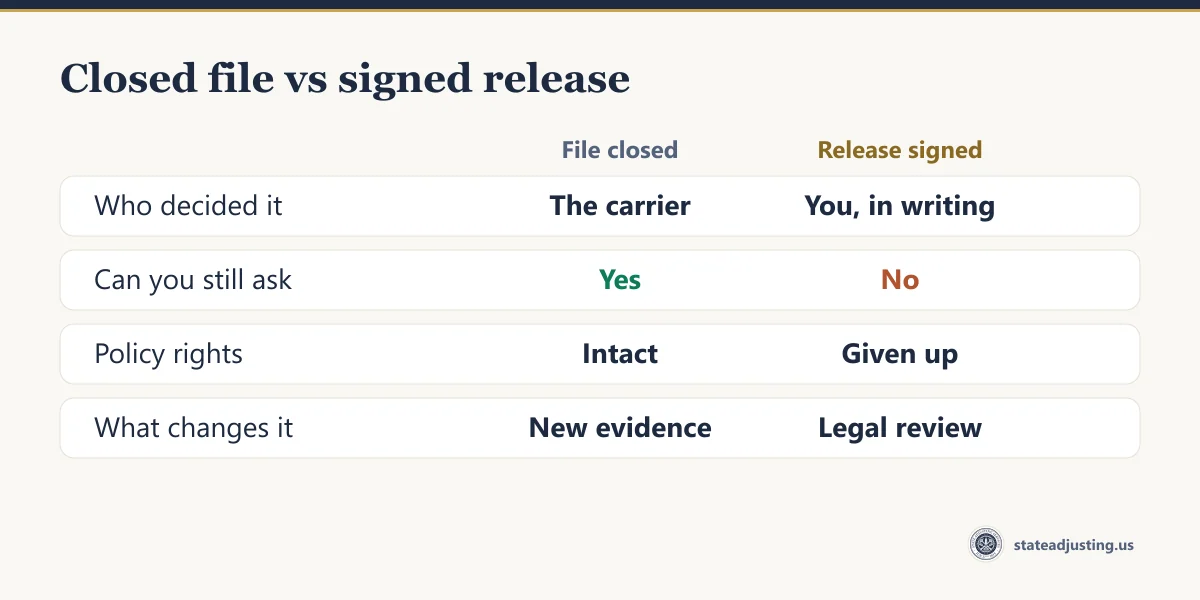
| Status | What it actually is | Who decided it | Can more be paid |
|---|---|---|---|
| File closed | An inactivity flag in the carrier's system | The carrier, often automatically | Yes — send documentation and ask |
| Claim settled | Payment issued for an agreed scope of damage | Both sides, in practice | Yes — for scope that agreement never covered |
| Release signed | A contract giving up further claim on that loss | You, in writing | Generally no — an attorney question |
| Time-barred | The policy's suit limitation period has run | The calendar | The ability to enforce it may be gone |
Most property claims settle without any release at all — the carrier simply issues payment for the agreed scope, which is why a later supplement is normal rather than exotic. If you are asked to sign a release, that is the moment to slow down and read which loss, which date and which coverages it names, and whether it is limited to one disputed item or covers everything arising from the loss. Separately, settlement wording printed on or near a cheque endorsement line raises accord and satisfaction, which is a legal question and not an adjusting one. Do not decide it on your own, and do not deposit the cheque assuming the words are decorative.
What supports reopening a settled claim, and what does not?
A reopening needs something new in the file. Damage that was concealed until tear-off, scope that was omitted from the estimate, an arithmetic error, or money already agreed and never sent. Wanting a larger number for the same documented scope is not a ground. Damage from a later storm is not a reopening at all — it is a new claim.
| What you found | Reopen the old claim | Why |
|---|---|---|
| Damage hidden behind finishes until repairs began | Yes | Same loss, same date, newly visible |
| A code-required item missing from the estimate | Yes | Scope omission, not a price dispute |
| Recoverable depreciation never requested | Yes | Money already agreed in the carrier's own estimate |
| The deductible or a prior payment taken twice | Yes | Arithmetic on the summary page |
| The completed repair invoice exceeds the estimate | Yes, with the invoice attached | Pricing evidence the estimate did not have |
| Damage from a storm after the settlement | No — file it as a new claim | New date of loss, new deductible |
| The same scope, but the number felt low | No | Nothing in the file has changed |
The difference between the last two rows is worth real money, in both directions. A reopening rides on the original claim number, the original date of loss and the original deductible — which you already paid out of the first cheque. Additional money on that file is not reduced by a second deductible. A new claim number means a second date of loss and a second deductible, and where the policy carries a percentage wind and hail deductible that difference alone can run into thousands.
Which is exactly why the date of loss has to be honest. If the damage genuinely came from last month's storm, attaching it to a two-year-old claim is not a shortcut — it misstates the loss, and carriers routinely check reported dates against archived weather data for the address. Where the storms are genuinely hard to separate, say so plainly in the request and let the carrier's own records do the allocating.
What does reopening actually put back?
Two different kinds of money, and they are proved in completely different ways. Money already agreed but never sent — usually withheld depreciation — needs only a completion document. Money never agreed — scope left out of the estimate — is a fresh argument that needs evidence for every line. They travel in one request but they are not one request.
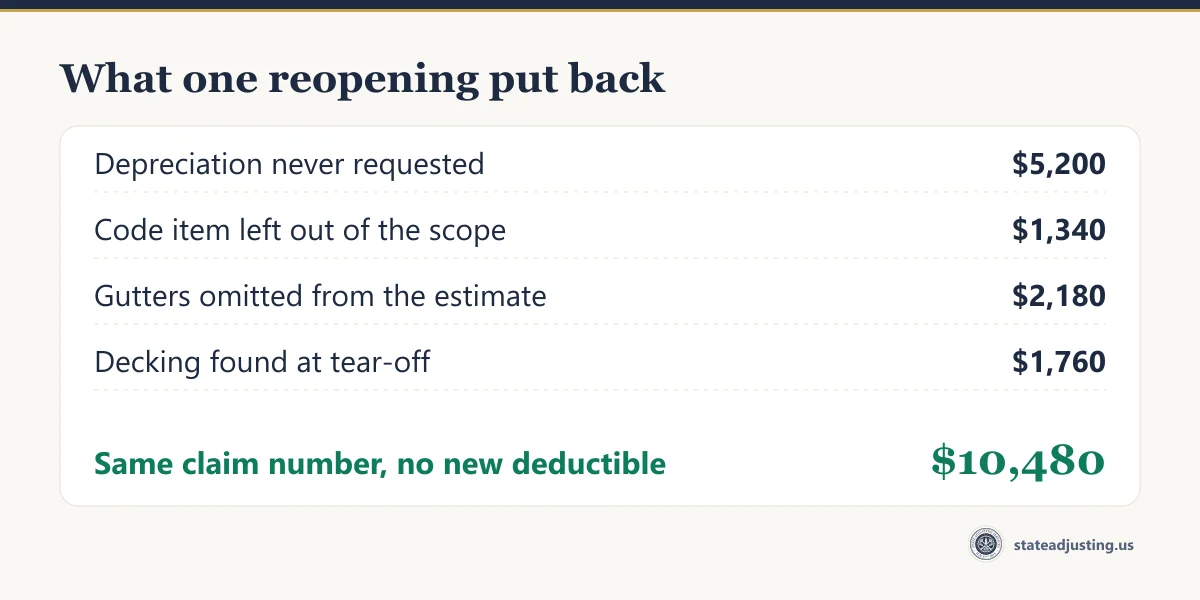
Take an Illinois hail file settled the ordinary way. Agreed replacement cost $26,400, depreciation withheld $5,200, deductible $2,500, first cheque $18,700. The homeowner collected bids, life intervened, and the file closed on inactivity. Two years later the roof is finally replaced and the reopening request carries four items:
| Item | What proves it | Amount |
|---|---|---|
| Recoverable depreciation never requested | The completed-work invoice | $5,200 |
| Ice and water shield required at replacement | The permit and the code section cited | $1,340 |
| Gutters and downspouts left out of the scope | Dated photographs of hail dents in the metal | $2,180 |
| Decking replaced at tear-off | Tear-off photographs and the invoice line | $1,760 |
| Requested on the same claim number | $10,480 |
Half of that — the $5,200 — was never in dispute. It sat in the carrier's own estimate as withheld depreciation and went unclaimed because nobody told the homeowner a second cheque existed. The other $5,280 is a scope argument that stands or falls entirely on the documents attached to each line. The deductible does not come off again; it was taken on the first payment. This is an illustrative worked example, not a result we are promising — every file turns on its own policy wording and its own evidence.
One caution on the easy half. The widely used homeowners form asks you to notify the carrier within 180 days of the date of loss that you intend to claim on a replacement cost basis, with separate wording setting how long you then have to complete the work. Carriers commonly extend the completion period on a written request, but the extension has to be asked for, and two years on it is that notice question — not the invoice — that decides whether the second cheque is still available. Read the loss settlement condition in your own policy before you assume either way.
Which clocks are still running?
Three. The suit limitation period written into your policy, the replacement cost notice and completion periods described above, and the practical clock — how long the evidence survives. Illinois law changes how the first one is counted, in a way most homeowners are never told.
Under 215 ILCS 5/143.1, the running of a policy's suit limitation period is tolled from the date proof of loss is filed, in whatever form the policy requires, until the date the claim is denied in whole or in part. The practical consequence is that the calendar on a file the carrier never formally denied does not necessarily read the way a homeowner counting from the storm date assumes. We set out the full set of Illinois claim clocks in deadlines that end claims in Illinois. How that statute applies to your particular file is a question for an attorney, not for us.
The evidence clock is the one that quietly decides most old files. Contractors change estimating software and lose archives, phones get replaced, the damaged roof is long gone. Two things push back against that. Carriers retain claim records for years under Illinois' claims-handling rules, so on a file closed a couple of years ago the estimate revisions, the field photographs and the adjuster's notes usually still exist — you have to ask for them in writing. And your own set is worth rebuilding before you write anything: see what to photograph before you touch anything, which applies just as much to a repair already finished as to a fresh loss.
How do you reopen a claim, step by step?
Reopening is a written process, not a phone call. The request that gets paid looks like an estimate with proof attached to each line; the request that gets refused looks like a complaint. Six steps, in this order:
- Put it in writing to the claims department. Quote the claim number and the date of loss, state plainly that you are requesting the claim be reopened for additional scope, and list what the additional scope is. Keep the app and the phone line for follow-up only — you want a dated record.
- Ask for the complete claim file first. Every estimate revision, the field photographs, the price list version in the header, and the payment log. You cannot argue with figures you have not read; reading the carrier's estimate shows where each of them sits.
- Separate the two piles. Money already agreed but unpaid is a payment request and should be worded as one. Money never agreed is a scope dispute. Mixing them lets a single "we have reviewed and are maintaining our position" answer bury both.
- Attach proof to each line, not to the request as a whole. A line item with a dated photograph, a code citation or an invoice line gets considered on its own merits. Three paragraphs of frustration with one photo at the bottom does not.
- Ask for a written decision with its reasons. If the carrier declines to reopen, request the specific reason and the policy provision relied on, in writing. A refusal that names a provision can be answered. A refusal that names nothing usually means nobody has looked yet.
- Check the clocks before you spend months on it. The suit limitation period and the replacement cost conditions decide whether patience is a strategy or a slow way of losing.
If the file is still open and you are supplementing rather than reopening, the process differs in the paperwork more than the principle — how a claim gets reopened when hidden damage appears covers that side of it.
What to do next
If you settled a claim in the last few years and have ever wondered whether the number was complete, the cheapest thing you can do is read the file. Pull the carrier's final estimate and look at the summary page for a withheld depreciation line, then walk the property against the scope and note anything on it that was never replaced. Most of the reopenings we take on start with one of those two checks, not with a new discovery.
We review settled and closed claims at no cost and tell you plainly whether there is anything left in the file — including when there is not. If there is, our fee is a percentage of what is recovered, set by written contract and capped by Illinois law: nothing upfront, and no fee if there is no recovery. You can see how we work a file, read what past claims have involved, or start with the claim type — hail, storm, water and the rest each have a page.
Call (630) 297-8136 Monday to Friday, 8:00 AM to 5:00 PM, or send us the claim number and the carrier's estimate and we will tell you what we see. If the repair itself still needs doing, our construction partner is one option among many and never a condition of us working your claim.
Questions we get about this
Can a closed insurance claim be reopened?
Usually, yes. Closed is an administrative status in the carrier’s system meaning nobody is actively working the file, not a decision about your policy rights. A written request quoting the claim number and date of loss, with documentation of the additional scope attached, reopens most files. What genuinely ends a claim is different: a signed release, the expiry of the policy’s suit limitation period, or a missed replacement cost deadline. Your own policy wording governs.
Do I pay the deductible again if my claim is reopened?
No. A reopening runs on the original claim number and the original date of loss, and the deductible was already taken out of the first payment. Additional money agreed on that file is paid without a second deductible. That only changes if the damage belongs to a later event, because a new date of loss means a new claim and its own deductible — which is why the date has to be reported accurately rather than conveniently.
How long do I have to reopen a property insurance claim in Illinois?
There is no single answer, because several clocks run at once: the suit limitation period written into your policy, and the replacement cost notice and completion periods in the loss settlement condition. Under 215 ILCS 5/143.1 a policy’s suit limitation period is tolled from the date proof of loss is filed until the claim is denied in whole or in part. How that applies to your file is a question for an attorney. Practically, evidence and records are the tighter limit.
Does cashing the insurance check mean I accepted the settlement?
Not by itself in an ordinary claim payment, but wording printed on or near the endorsement line — anything describing the payment as full and final settlement — raises an accord and satisfaction question, and that is a legal question rather than an adjusting one. A separate signed release is the clearer barrier. If either appears, read it before depositing and speak to an attorney about what it covers.