Storm tore the electric mast off your house: what insurance pays
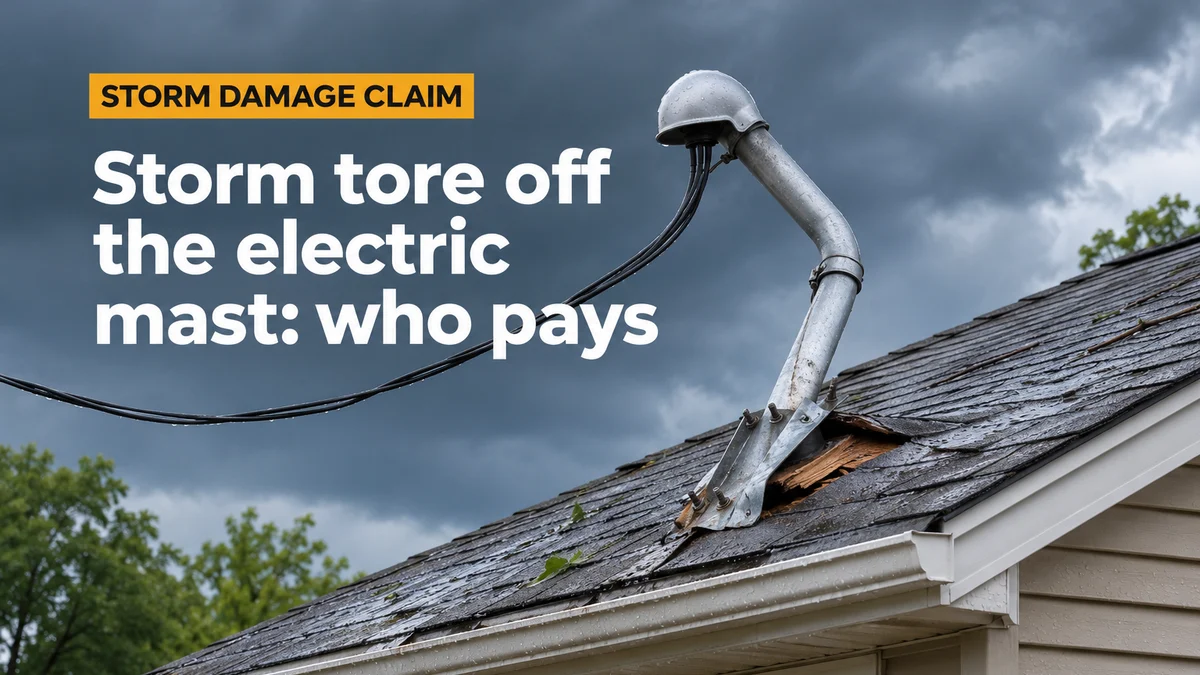
When a storm tears the electrical mast off a house in Illinois, the bill splits three ways. The utility repairs its own service wire and the meter. Your electrician repairs the mast, the weatherhead and the meter box, because those parts belong to you. And your homeowners policy usually treats those parts as part of the dwelling, so storm damage to them is a property claim like a damaged roof, subject to your deductible and to the wording of your own policy.
The electrician's invoice is rarely the whole claim. A mast that is pulled over can open the roof where it passes through, tear the siding behind the meter box and leave the house dark for days in cold weather. Below we follow the claim from the pole to the panel: who owns each part, the order the repair has to happen in, the one policy sentence that decides what a power loss at your own house leads to, and how the deductible changes the result.
Who owns each part, from the pole to your panel
ComEd publishes the split for its customers. On its equipment responsibility page, the service wire coming from its system and the meter are ComEd's; the attachment point, the weather head with its drip loop, the riser and the meter enclosure are the customer's. ComEd also asks customers to talk to a ComEd representative before any work starts. Ameren Illinois and the municipal utilities draw their own lines, so ask yours. The last column shows how a standard homeowners policy usually reads; your own policy form is what counts.
- PartOwnerWho repairs itWhich coverage
- Service dropThe wire from the pole to the houseOwner:ComEdRepair:Utility crewCoverage:Not part of your claim
- Attachment pointThe bracket or insulator that holds the wireOwner:YouRepair:Your electricianCoverage:Dwelling, Coverage A
- Weatherhead and drip loopThe hooded cap where the wires enter the pipeOwner:YouRepair:Your electricianCoverage:Dwelling, Coverage A
- Mast or riserThe pipe down the wall or through the roofOwner:YouRepair:Electrician, plus a roofer for the roof bootCoverage:Dwelling, Coverage A
- Meter boxThe enclosure that holds the meterOwner:YouRepair:Your electricianCoverage:Dwelling, Coverage A
- MeterThe device that measures your useOwner:ComEdRepair:UtilityCoverage:Not part of your claim
- Main panel and inside wiringOnly if the pull damaged itOwner:YouRepair:Your electricianCoverage:Dwelling, Coverage A
A detached garage with its own service sits under Coverage B, other structures, with its own limit. Rust, a mast that leaned for years or a weatherhead that cracked with age is wear, and the policy does not pay for wear. The claim is about what the storm did on a given date.
The repair runs in a fixed order, and the evidence leaves at step two
The utility will not reconnect a house while the parts you own are damaged, and most Illinois towns require a permit and an inspection for work on the electric service. That order matters for the claim, because the bent mast and the torn meter box usually leave in the electrician's truck.
The utility makes the line safe
Report the wire as down and keep everyone away from it. Treat every hanging wire as live.
For the claim: photograph from a safe distance the limb, the wire, the mast and the meter box before anything is moved, and write down when the power went out.
Your electrician repairs your parts
The utility usually has to disconnect the service first, and the electrician arranges that with them.
For the claim: ask the electrician to photograph the damage before taking it off, keep the old mast and meter box until the adjuster has seen them or said they can go, and ask for an invoice that lists the mast, weatherhead, meter box, wire, permit and labor on separate lines.
The town inspects
The inspector checks the new work against the code your town uses.
For the claim: keep the permit number and the inspection result. If the inspector requires something the old setup did not have, ask for it in writing.
The utility reconnects
Power comes back once the utility has the inspection or the permit details it asks for.
For the claim: write down the date and time. The days between the outage and this moment are the length of any extra living cost you claim.
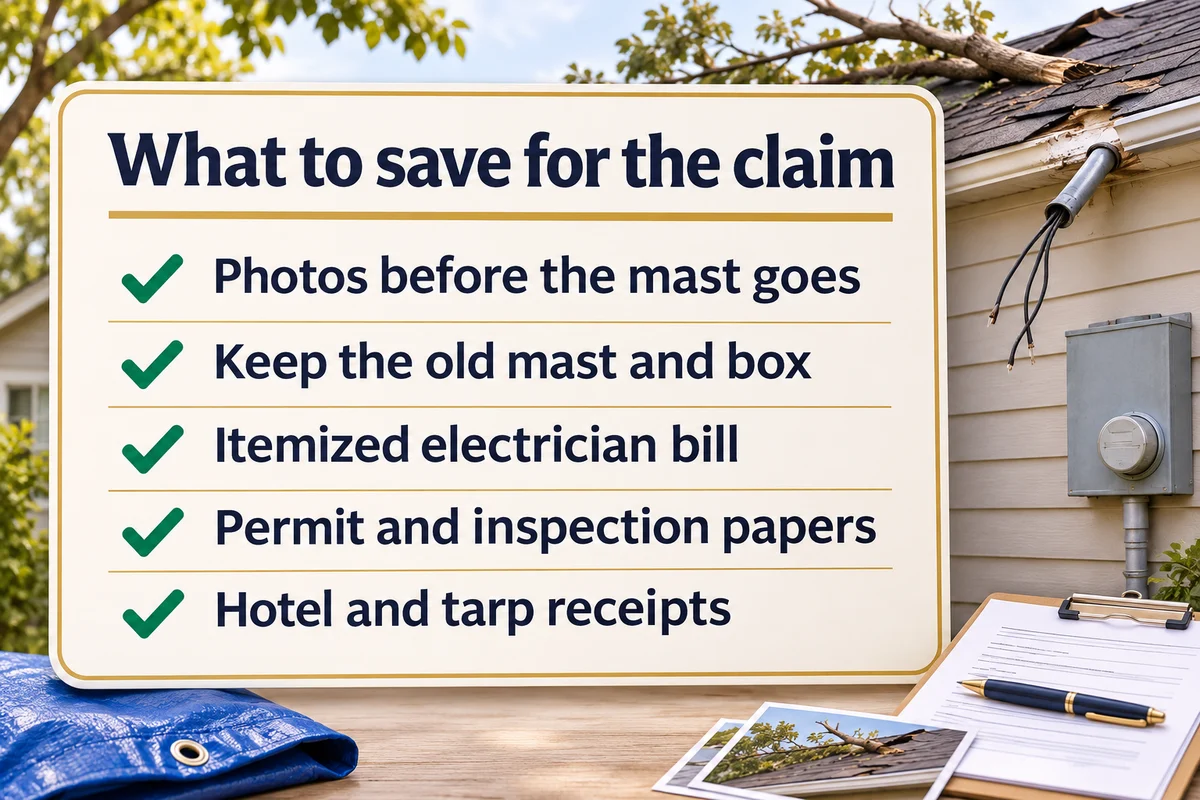
Tell your insurer as soon as you can, but do not wait for its inspection before stopping further damage. The standard form pays the reasonable cost of measures taken to protect damaged property from more damage, such as a tarp over the hole a pulled-through mast leaves in the roof. Photos first, then the tarp, and keep the receipt.
The power failure sentence: why an outage that starts at your house is different
Most homeowners policies exclude power failure, which is why food that spoils during a neighbourhood blackout so often goes unpaid. The standard wording draws its line at your property boundary:
Power Failure means the failure of power or other utility service if the failure takes place off the "residence premises". But if the failure results in a loss, from a Peril Insured Against on the "residence premises", we will pay for the loss caused by that peril.
Homeowners 3 special form HO 00 03 05 11, Section I exclusions, as filed with the Maine Bureau of Insurance
When a limb or an ice load tears the service off your own house, the failure took place on the residence premises, so that exclusion, as written in this form, does not reach it. What follows from the outage is then judged by the ordinary rules for each kind of damage. A typical chain looks like this:
- A limb comes down on the service drop at your house. The storm has damaged the dwelling.
- The mast and the meter box are torn loose. The house has no power, and the cause sits on your side of the line.
- The furnace stops. Inside temperatures fall through a cold night.
- A pipe in an outside wall freezes and splits. Now there is water damage inside as well.
The freezing rule still applies to that last link. The standard form pays for freezing of a plumbing system only if you used reasonable care to maintain heat in the building, or to shut off the water supply and drain the system. A house left dark for three days with the water on and nobody checking gives the carrier an argument. A house where you shut the main and opened the taps on the first night does not. Our article on frozen and burst pipe claims explains how that condition is read. A sump pump is a separate matter: the same form says a sump is not part of the plumbing system, and basement water from a pump that stopped usually needs a water backup endorsement. Spoiled food is personal property, read under its own perils and any food spoilage endorsement, so ask the carrier rather than assume either way.
A worked example: one torn service, two deductibles
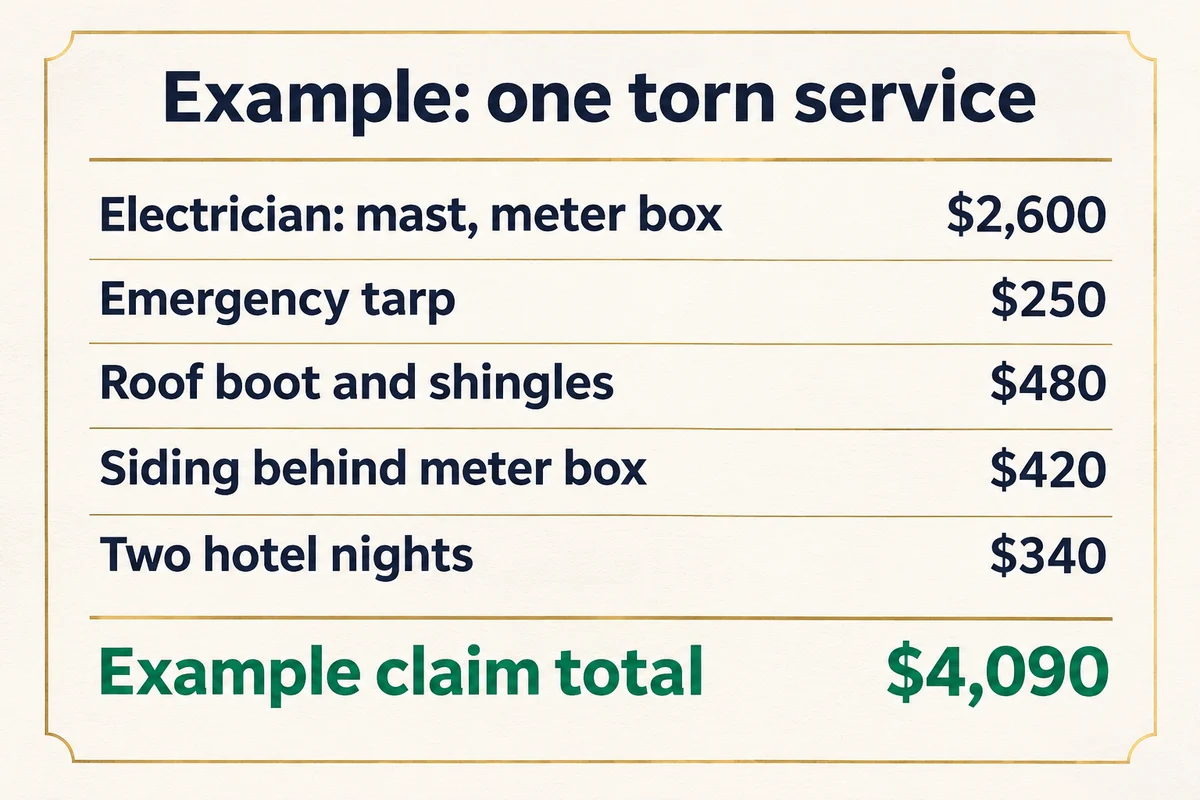
The numbers below are an illustration for one house. They are not a price list and not a result of ours. A wind gust drops a maple limb across the service drop of a house with a dwelling limit of $300,000. The mast pulls through the roof overhang, the meter box tears off the siding, and the family spends two nights in a hotel while the electrician, the inspector and the utility take their turns.
| Line on the claim | Which coverage | Amount |
|---|---|---|
| Electrician: new mast, weatherhead, meter box, permit | Dwelling | $2,600 |
| Emergency tarp over the mast hole | Reasonable repairs | $250 |
| Roofer: new mast boot and the shingles around it | Dwelling | $480 |
| Siding panels behind the meter box | Dwelling | $420 |
| Two hotel nights while the house had no power | Additional living expense | $340 |
| Example claim total | $4,090 |
Flat $1,000 deductible
$4,090 less $1,000
$3,090 paid
1% wind and hail deductible
1% of $300,000 is $3,000. $4,090 less $3,000
$1,090 paid
The cause decides which deductible applies. A percentage wind and hail deductible applies to loss caused by windstorm or hail. If the limb came down on a still night under the weight of ice, many policies use the all-other-perils deductible instead, and on this example that is a $2,000 difference. Read the wording of your deductible endorsement and keep a record of the weather that night. Our guide to percentage wind and hail deductibles shows how to find which one you have.
The hotel line depends on one phrase: the standard form pays additional living expense when a covered loss makes the home not fit to live in. A house with no heat and no power in an Illinois winter makes a strong case. A mild September night with a working gas stove makes a weaker one. Keep the receipts either way, and ask the adjuster before the second night if you can.
When the inspector asks for more than you had
Older Illinois houses often have a 60 or 100 amp service, a mast shorter than current rules want, or grounding that would not pass today. When the town will only sign off a repair that meets the current code, the extra cost is not ordinary repair cost. The standard form handles it under ordinance or law, an additional coverage of up to 10% of the dwelling limit for the increased cost of meeting a code on the damaged part of the building. Some policies change that percentage, so check yours. Our article on ordinance or law coverage walks through how it is claimed.
Keep two things apart on the invoice. What the inspector requires belongs in the claim. An upgrade you choose, such as a 200 amp service for a future car charger, is yours to pay. Ask the electrician to price the required work and the optional work on separate lines, so the adjuster does not have to guess where one ends.
Damage that turns up after the lights come back
- The roof around a through-roof mast can leak at the next rain, weeks later, if the boot was pulled or the shingles lifted. Look at the soffit and the ceiling below it.
- A hard pull on the service wires can loosen or break connections at the meter box or in the main panel. Ask the electrician to write down what they checked.
- A damaged neutral wire can send uneven voltage through the house before the power drops, and a dead furnace board or television can follow. Our article on who pays for power surge damage covers that part of the claim.
- The fasteners of a torn meter box can split the sheathing behind the siding and let water into the wall.
Each of these belongs to the same loss. Report it to the carrier when you find it and send photos. A supplement after the first payment is a normal step when damage shows up later.
When to bring us in
A torn service on its own is usually a modest claim. It grows when the roof, the pipes, a hotel stay or a code upgrade join it, or when the carrier pays the electrician and stops there. We handle fallen tree damage claims and ice and snow damage claims across Illinois, and we can read your policy and the estimate with you. There is nothing to pay upfront: our fee is a percentage of the recovery, regulated by Illinois law, and with no recovery there is no fee. Reach us through the contact page; we are open seven days a week.
Questions we get about this
Does homeowners insurance cover a damaged electrical mast?
Usually, yes, when a covered peril such as wind, a falling limb or the weight of ice damages it. The mast, weatherhead and meter box are normally treated as part of the dwelling, and the claim is paid less your deductible. Rust, wear and old age are not storm damage. The wording of your own policy governs.
Who pays to fix the meter box after a storm in Illinois?
Under ComEd's published equipment chart, the meter enclosure belongs to the customer and the meter belongs to ComEd. Your electrician repairs the box, the utility handles the meter, and the box can be part of your property claim. Other Illinois utilities set their own lines, so ask yours before work starts.
Will insurance pay for a hotel while the power is off?
Additional living expense is paid when a covered loss makes the home not fit to live in. An outage caused by storm damage at your own house can qualify, especially in winter, while a neighbourhood blackout usually does not. Keep every receipt and ask the adjuster early.
Does the claim pay for upgrading to a 200 amp service?
It pays to repair what the storm damaged and, under ordinance or law coverage, the extra cost of meeting a code the inspector requires. An upgrade you choose for your own reasons is not part of the claim. Ask the electrician to put required and optional work on separate invoice lines.