Insurance adjuster not responding: how to count the days and what to send
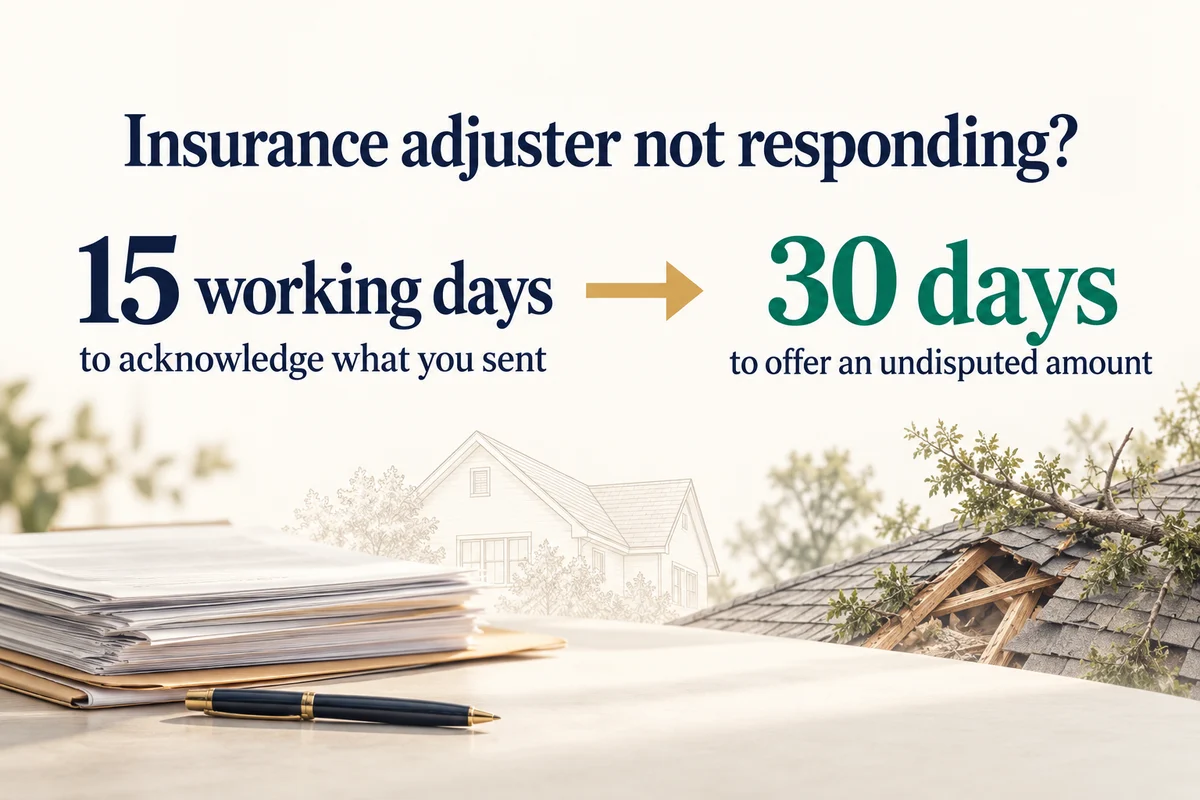
When an insurance adjuster is not responding on an Illinois property claim, the number to know is 15 working days. That is the longest Illinois rules give an insurer to acknowledge a communication about a claim, counted from the day it receives it. Send one dated written request with specific questions, count the days on a calendar, and go up the company's chain when the count runs out. If that gets nowhere, the Illinois Department of Insurance takes complaints about unanswered letters.
We are licensed Illinois public adjusters, not attorneys. The rules below come from the Illinois Insurance Code and Part 919 of the state's administrative rules. Whether a particular silence breaks them is for the Department or an attorney to say, and your own policy governs your claim.
Which rule covers what you are waiting for?
Illinois has several separate clocks, and a one-line answer such as 15 days to respond blurs them. Find the row for the thing you are actually missing. The right column matters as much as the middle one, since it shows what the rule does not hand you.
| You are waiting for | What the Illinois rule says | What it leaves open |
|---|---|---|
| A reply to your email, letter or supplement | Acknowledged with reasonable promptness, defined as a maximum of 15 working days from receipt. It covers all correspondence materially related to handling the claim (919.40). | An answer. A note saying your email arrived meets this count, so ask for the next step in the same message. |
| First contact after you reported the loss | A bona fide effort to communicate within 21 working days after notification of loss, when liability is reasonably clear (919.40). | Files where the company says liability is not yet clear. |
| The company's claim forms | Provided within 15 working days of your request, with the explanations needed to use them (215 ILCS 5/154.6(o)). | Forms you have not asked for. Put the request in writing. |
| A yes or no on the claim | Liability affirmed or denied within a reasonable time (919.50(a)). | Any fixed number of days on a property claim. Your dated record is what shows how long it has been. |
| Money for the part nobody disputes | Tendered within 30 days after liability is affirmed, where the payee is known (919.50(a)). | The part still in dispute. |
| A written reason for a denial or lower offer | Within 30 days after the investigation and determination of liability are complete, naming the policy provision relied on (919.50(a)(1)). | Time before the company treats its investigation as complete. |
The person who came to your house may work for an independent adjusting firm. Part 919 treats independent contractors doing claim work at the company's direction as its representatives, so a quiet field adjuster does not take the company off the hook. Copy the company's claim department on everything you send, and not only the individual.
Counting 15 working days on a real calendar
The count runs from receipt, so a date you can prove is worth more than a phone call you remember. An email keeps its own date stamp, and certified mail gives you a delivery date. Part 919 says that plain days means calendar days, and its definitions section does not spell out a working day. We count the cautious way, leaving out weekends and federal holidays, so nobody can say you complained a day early.
Say your email reached the company on Monday, November 2, 2026. Tuesday is day 1. Veterans Day on November 11 is left out, and day 15 lands on Tuesday, November 24.
| Sun | Mon | Tue | Wed | Thu | Fri | Sat |
|---|---|---|---|---|---|---|
| 1 | 2sent | 3day 1 | 4day 2 | 5day 3 | 6day 4 | 7 |
| 8 | 9day 5 | 10day 6 | 11out | 12day 7 | 13day 8 | 14 |
| 15 | 16day 9 | 17day 10 | 18day 11 | 19day 12 | 20day 13 | 21 |
| 22 | 23day 14 | 24day 15 | 25write | 26 | 27 | 28 |
| 29 | 30 |
Weekends are not counted, and neither is Veterans Day on the 11th. With no acknowledgement by the end of the 24th, the second letter goes out on Wednesday the 25th, ahead of Thanksgiving.
Your own dates will differ, so count them out on paper and keep the page with your claim papers. A holiday falling inside the count moves the end date, and the Thanksgiving and year-end weeks do that more than any other time of year.
Questions for the claims line before you escalate
A quiet file can have a plain explanation. Handlers change, and a request for a document may have gone to an old address. One call to the company's main claims line, using the number on your policy papers, can settle that. Don't hang up with "it's under review". Ask:
- Who is assigned to my claim today, and what are that person's direct email and the supervisor's name?
- Is the file waiting on anything from me? When did you ask for it, and at what address?
- Has the field adjuster's report or estimate come in, and on what date?
- Is the file waiting on someone else, such as an engineer's report?
- What is the next action on this claim, and by what date?
Write down the name, the time and each answer, then email yourself and the handler a short summary the same day. Part 919 requires the company's claim documentation to be dated and detailed enough to reconstruct what happened on the file. Your summary goes into that record, and if you later want to see the rest of it, our guide covers how to request your claim file.
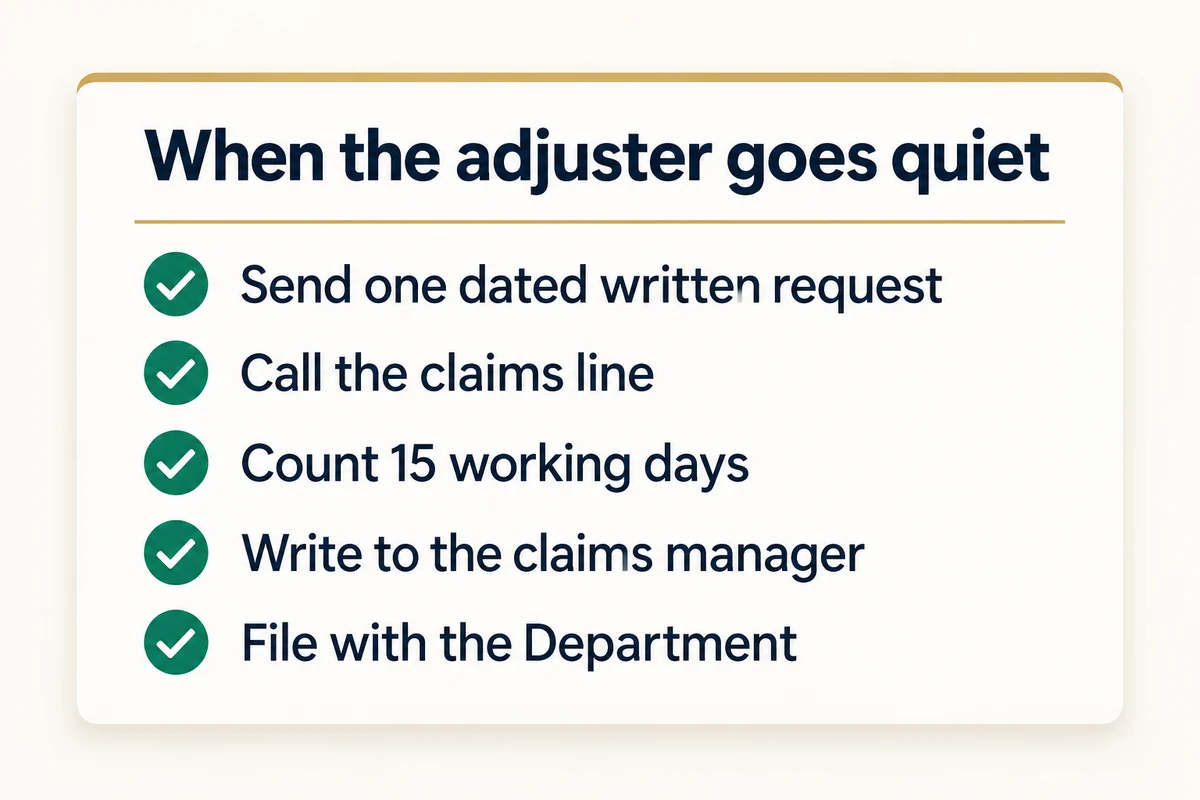
The order we would go in, and how far apart
Only the 15 working days comes from the rule. The spacing below is our suggestion, and a claim with an urgent problem, such as a house that can't be lived in, can move through it faster.
Today: one written request
Send it to the adjuster and copy the claim department. Give the claim number, what you sent and when, and what you need. This date starts your count.
Within three working days: the call
Use the questions above, then confirm the answers in writing.
Working day 15: check your count
Look for any acknowledgement, including one from a new handler you have not heard of.
The next working day: the claims manager
Send the letter below to the supervisor or claims manager you were given, with the adjuster copied.
About two weeks later: the Department
File a written complaint with the Illinois Department of Insurance. It's free, the insurer has 21 days to respond to the Department, and our guide to filing a Department of Insurance complaint goes through the form line by line.
A letter to copy when the count runs out
Keep it this short. It contains dates and requests, and nothing about how the claim has made you feel or what the roof is worth. It also leaves out the phrase bad faith, a legal term that belongs in a conversation with an attorney.
Re: Claim number [number], date of loss [date]
On [date] I sent [what you sent] to [name] at [address]. A copy is attached. I have received no acknowledgement. By my count, 15 working days from receipt ended on [date], which is the maximum in Section 919.40 of Part 919 for acknowledging a communication on a claim.
Please reply in writing with the following:
- The name and direct contact details of the person handling this claim.
- A list of anything you still need from me.
- Whether the company has affirmed or denied liability and, if it has not, what remains to be done and when you expect to decide.
- Any amount that is not in dispute, and the date it will be paid.
I ask for your reply by [date, about ten days out]. If I have no reply by then, my next step is a complaint to the Illinois Department of Insurance.
[Your name, property address, phone]
Attach the original request and your call summary. If what has gone unanswered is a supplement for damage found later, attach that too, with its photographs, so nobody has to go looking for it.
What keeps running on your side while nobody answers
Waiting for a reply does not put your own obligations on hold, and it would be easy to lose track of them during a long silence. Check these while you wait:
- The time limit for a lawsuit in your policy. Illinois pauses it from the day proof of loss is filed until a denial, so a claim with no proof of loss on file gets no pause. Our post on deadlines that end claims in Illinois shows how the count works.
- Your duty to protect the property from further damage. Tarps, water shutoffs and keeping a house heated in an Illinois winter can't wait for a callback. Keep the receipts, and see our notes on emergency work before the adjuster comes.
- The period your policy allows for claiming recoverable depreciation after repairs. Look it up on your replacement cost clause and put the date on your calendar.
- Evidence. If permanent repairs can't wait any longer, tell the company in writing what date they start, and photograph the damage first.
When to hand the file to someone else
Sending letters is a reasonable job for a homeowner when the only problem is silence. It gets harder when the claim is large, the house is out of use, or the reply finally arrives and the number is wrong. A public adjuster works for you under a written contract, prepares the claim and handles the correspondence with the insurer, on a water damage claim, a storm claim or any other property loss. An attorney is the right call when the question is coverage, a suit deadline or whether the delay gives you a legal claim, and our post on who handles which part sorts those out.
If your file has gone quiet, send us your letters and call notes through the contact page or call (630) 297-8136. We are open Monday through Friday, 7:00 AM to 7:00 PM, and Saturday and Sunday, 9:00 AM to 5:00 PM. We review the file at no charge and tell you where it stands. If we take it on, our process page shows what happens next. There is nothing to pay upfront: the fee is a percentage of the recovery, agreed in writing, and with no recovery there is no fee.
Questions we get about this
How long does an insurance adjuster have to respond in Illinois?
Illinois sets a maximum of 15 working days from receipt for an insurer to acknowledge a communication about a claim. That covers an acknowledgement, not a decision. The decision itself has to come within a reasonable time, and Part 919 gives no fixed number of days for it on a property claim.
Who do I contact if my insurance adjuster won't call me back?
Call the company's main claims line and ask who is assigned to the claim today and who the supervisor is. Confirm the answers by email. If the 15 working days pass with no acknowledgement, write to the supervisor or claims manager, and after that to the Illinois Department of Insurance.
Is an adjuster not responding bad faith?
Not automatically. Illinois lists failing to acknowledge communications with reasonable promptness as an improper claims practice when it is done without just cause, but whether a specific delay qualifies is for the Department of Insurance or an attorney to judge. A dated record of what you sent and when is what either of them will ask for.
Does my claim deadline stop while I wait for the adjuster?
Not all of them. The suit limitation in the policy is paused in Illinois from the day proof of loss is filed until a denial, but other time limits, such as the period for claiming recoverable depreciation, are set by your policy. Check each date in your policy rather than assuming silence holds them.